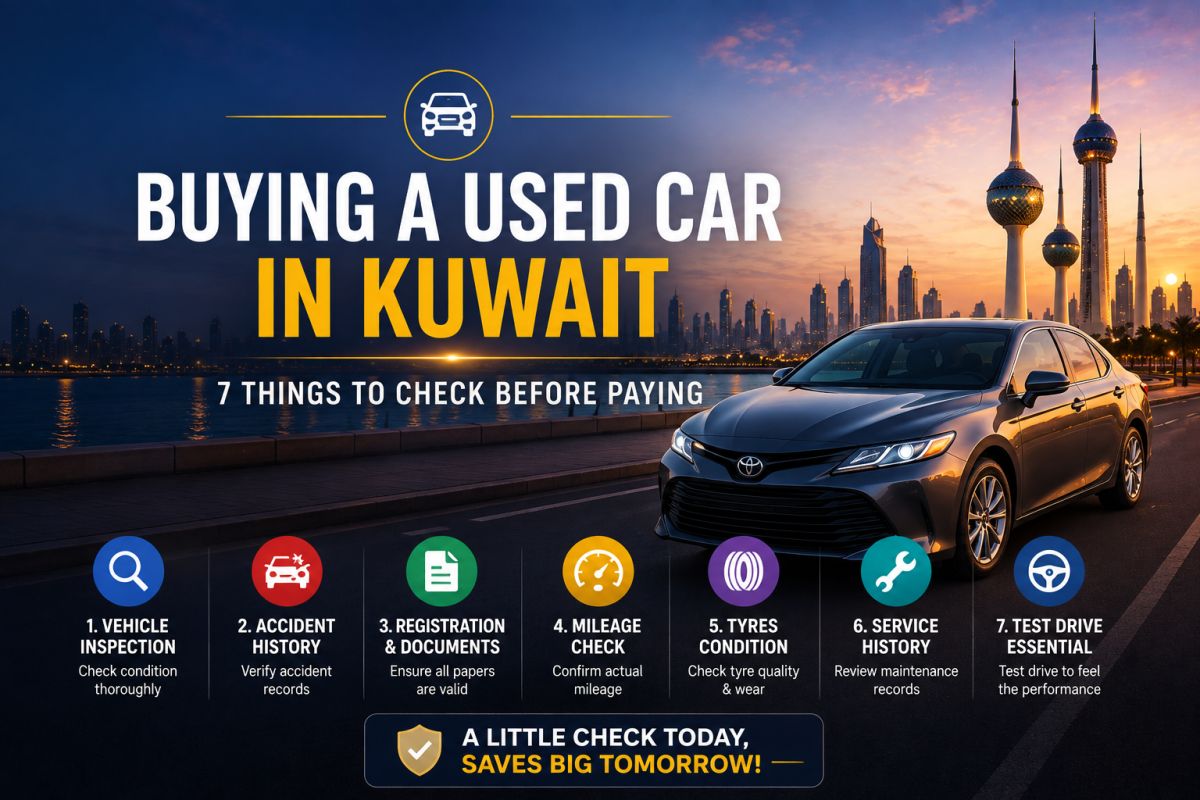
🚗 Buying a Used Car in Kuwait: 7 Things to Check Before Paying
Buying a used car in Kuwait can save a considerable amount of money compared with buying new, but the cheapest-looking deal is not always the cheapest car to own. A few careful checks before payment can protect you from expensive repairs, paperwork problems and a vehicle that becomes difficult to resell later.
Here are seven things worth checking before you hand over your money.
Check the car's overall condition before discussing the final price
Start with the basics. Walk around the vehicle in daylight and look at the body panels from different angles. Uneven paint shades, unusually wide panel gaps, fresh paint on only one part of the vehicle or overspray around rubber seals can indicate previous body repairs.
Small cosmetic repairs are not automatically a reason to reject a car. What matters is understanding what happened and whether the repair affected the chassis, airbags, suspension or structural areas.
Inside the car, compare the condition of the steering wheel, pedals, seats and switches with the claimed mileage. Heavy wear on a supposedly low-mileage vehicle deserves additional investigation.
Do not skip a proper mechanical inspection
A short look under the bonnet is not enough. If you are seriously considering the vehicle, have it checked by a workshop or technician you trust.
Ask them to examine the engine, transmission, cooling system, suspension, steering, brakes, battery and any visible fluid leaks. Diagnostic scanning can also reveal stored fault codes that may not currently trigger a warning light.
A relatively inexpensive pre-purchase inspection can prevent a much larger repair bill after purchase.
Check for signs of serious accident or chassis repair
Accident history matters because a vehicle can look excellent after bodywork while still having structural issues underneath.
Look for welding marks, repaired chassis rails, unusual sealant, misaligned doors, uneven tyre wear and differences between factory welds on the left and right sides. If anything looks suspicious, ask a professional body or chassis specialist to inspect the vehicle.
Do not rely only on a seller saying that the car has never had an accident.
Test the AC properly — especially in Kuwait
Air conditioning is not a minor convenience in Kuwait. Run the AC long enough to confirm that it cools properly, maintains cooling at idle and does not make unusual compressor noises.
Test every fan speed and, where applicable, rear AC vents and separate climate zones. An AC system that only feels acceptable during a quick evening test may struggle during peak summer temperatures.
Inspect the tyres, brakes and suspension
Tyres can immediately add to the cost of a used-car purchase. Check all four tyres for tread depth, cracking, uneven wear and production age. Uneven tyre wear may also point to alignment or suspension problems.
During the test drive, listen for suspension knocks and check whether the vehicle pulls to one side. Brake vibration through the steering wheel or pedal can indicate worn or distorted components.
Use these upcoming expenses when negotiating the final price.
Verify the vehicle documents and seller before paying
Make sure the person selling the vehicle has the authority to transfer it. Check the vehicle registration information carefully and make sure the vehicle details correspond with the car you are inspecting.
Do not treat ownership transfer as something to sort out days after paying. Payment and transfer should form part of one controlled transaction.
Complete payment and ownership transfer safely
Kuwait's Ministry of Interior provides vehicle ownership-transfer procedures through the General Department of Traffic, and vehicle ownership transfer is also available digitally through the Sahel government application.
In the Sahel process, the seller initiates the transfer, the buyer accepts the request and completes the required insurance step, and the transaction continues through the application until the new electronic vehicle licence becomes available to the buyer.
If your transaction requires an in-person procedure or has unusual circumstances, verify the current requirements directly with the Ministry of Interior before paying.
A simple rule before buying
Try not to become emotionally committed to one particular used car. Kuwait has a large used-car market, and walking away from a questionable vehicle is usually cheaper than repairing a bad purchase later.
The best deal is not necessarily the car with the lowest asking price. It is the car whose condition, documentation and total expected ownership cost make sense.
Quick used-car checklist
Inspect the body and chassis.
Get a mechanical inspection.
Check for accident repairs.
Test the AC thoroughly.
Inspect tyres, brakes and suspension.
Verify registration and seller details.
Complete payment and ownership transfer safely.
Government procedures can change. Always verify the latest vehicle-transfer requirements through Kuwait's Ministry of Interior or the Sahel government application before completing a transaction.
💬 Comments (0)
💬
No comments yet. Be the first to comment!
