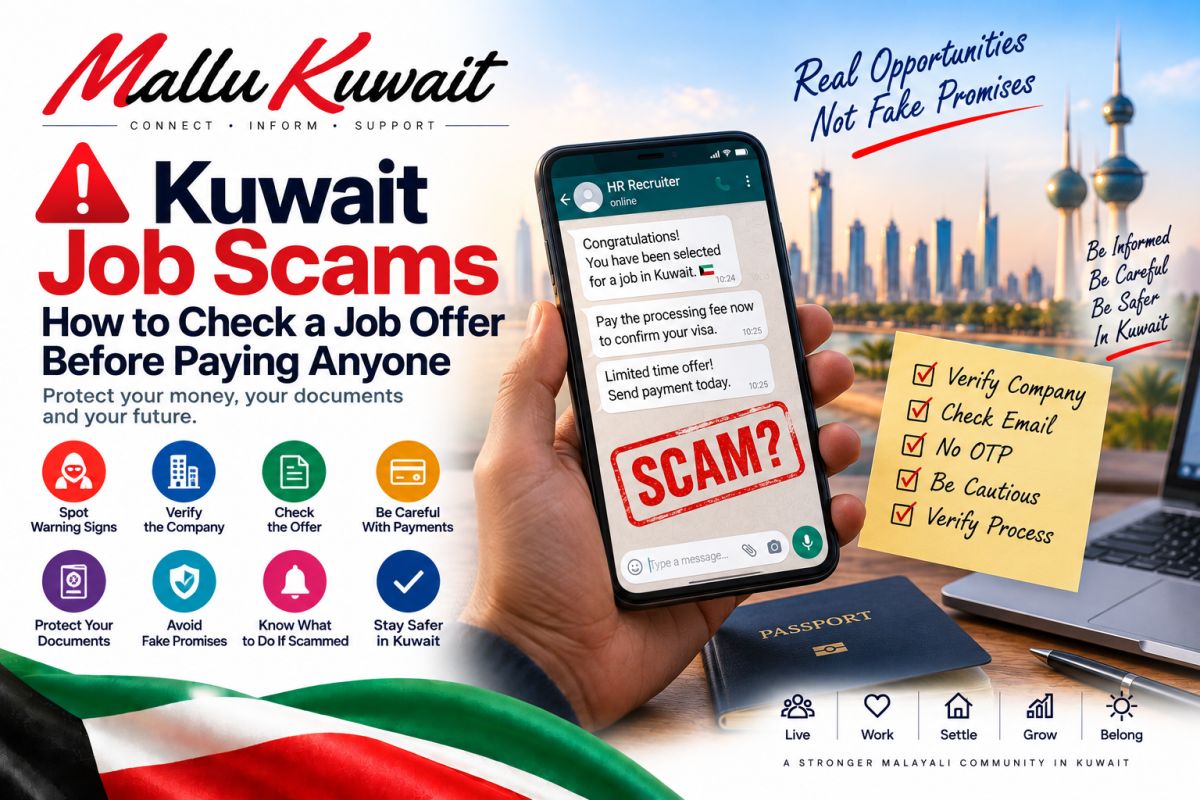
⚠️ Kuwait Job Scams: How to Check a Job Offer Before Paying Anyone
A Kuwait job offer can change someone's life.
Unfortunately, that also makes jobseekers attractive targets for scammers.
A professional-looking offer letter, Kuwait company logo, recruiter profile picture or WhatsApp message does not prove that a job is genuine.
Before sending money, your passport or sensitive personal information, stop and verify what you have actually received.
This MalluKuwait guide shows you how.
The 60-second check before you do anything
Before paying or sending sensitive documents, ask yourself:
Did I actually apply for this job? • Did I have a genuine interview? • Can I independently verify the employer? • Does the recruiter genuinely appear connected to that employer? • Does the email address make sense? • Is the salary believable for the position? • Can the claimed employment process be verified? • Why am I being rushed? • Why am I being asked to pay? • Who exactly will receive the money? • Are they asking for banking credentials or an OTP?
If several answers make you uncomfortable, stop.
Do not allow urgency to make the decision for you.
A warning sign does not automatically prove that a company or recruiter is fraudulent.
It means you should verify the situation before proceeding.
A job offer is not the same as a work permit
This distinction is extremely important.
A company can send an offer letter.
But an offer letter by itself does not prove that Kuwait's official employment process has been completed.
For private-sector recruitment, Kuwait Government Online currently lists a work permit issued by the Public Authority for Manpower and verified through the computerized system as part of the required work-entry documentation.
So if somebody sends you a PDF saying:
“KUWAIT JOB APPROVED”
do not automatically assume that means an official work permit exists.
Verify the company independently
Do not verify a company using only information supplied by the recruiter.
That defeats the purpose of verification.
Search independently for the employer.
Check things such as:
Official website • Official contact details • Business activity • Office information • Established online presence • Career/recruitment information
If somebody claims to represent a major company, find that company's contact details yourself.
Do not simply call the phone number printed on the suspicious offer letter.
Check the recruiter's email address
Look carefully at the sender's email.
A company using its own domain does not automatically prove legitimacy, but an unrelated address deserves additional checking.
For example, if somebody claims to represent a major employer but communicates only from an unrelated free email account, independently confirm that the person actually works for the company.
Also watch for lookalike domains.
Scammers can create addresses that look similar to a genuine company name.
Read the complete domain carefully.
WhatsApp is not proof of employment
Real recruiters may use WhatsApp.
That does not mean every WhatsApp recruiter is fake.
But WhatsApp itself proves nothing.
A profile can contain:
A copied company logo • A fake employee name • A stolen photograph • A Kuwait telephone number • Professional-looking documents
None of these alone proves that the person is authorized to recruit for the company.
Verify outside WhatsApp.
Did you actually have an interview?
Be particularly cautious when somebody suddenly offers you a high-paying professional position without meaningfully assessing your experience.
Recruitment processes vary.
But ask whether the process makes sense for the role.
A company hiring an engineer, nurse, accountant, manager or specialist normally has a reason to understand the candidate's qualifications and experience.
An instant offer followed immediately by a demand for money deserves careful verification.
Check whether the salary makes sense
Scammers often sell dreams rather than jobs.
A vacancy may advertise:
Very high salary • Free accommodation • Free food • Free transport • Free tickets • Immediate visa • No experience required
Any one of those things can exist in a genuine employment package.
The problem is when the entire offer appears designed to overwhelm your judgment.
Compare the role with realistic market conditions and your level of experience.
If an offer appears extraordinary, verify it more carefully — not less carefully.
Look carefully at the offer letter
A polished PDF can be created in minutes.
Do not judge legitimacy by design quality.
Check:
Employer name • Job title • Salary • Benefits • Work location • Contact details • Email/domain • Signatory • Dates • Spelling inconsistencies • Conflicting company information • Whether the company independently confirms the offer
A logo is not evidence.
Be cautious when money becomes the focus
Not every legitimate government or administrative process is free.
So MalluKuwait does not use the simplistic rule:
“If somebody asks for money, it is automatically a scam.”
Instead ask:
What exactly is this payment for?
Who legally/officially receives it?
Why am I paying this person?
Is the amount shown through an official process?
Can I obtain a proper receipt?
Can the requirement be independently verified?
Be particularly cautious when money must be transferred quickly to a personal bank account or unrelated recipient.
Never send an OTP
An OTP is not something a recruiter needs to “verify your job.”
Do not share:
Banking OTP • Card PIN • Online banking password • Mobile banking authentication • Card security code • Digital identity authentication intended only for you
If somebody asks you to read an OTP aloud, stop.
Be careful with payment links
A message may look like it comes from a company, government service, courier, bank or recruiter.
Do not trust a payment page merely because it contains familiar branding.
Kuwait's Ministry of Interior has repeatedly warned about fraudulent messages and links designed to obtain banking or personal information.
Open official services independently rather than relying on an unexpected link.
Protect your passport copy
A legitimate recruitment process can require passport information.
But do not send passport copies indiscriminately to unknown people.
Before sending sensitive identity documents:
Verify who is requesting them • Verify the employer • Understand why the document is required • Keep a record of where you sent it
The same caution applies to Civil ID copies, certificates and other personal documents.
Watch for fake “visa agents”
Be cautious when somebody claims they can guarantee:
A Kuwait job • A Kuwait work visa • Immediate approval • A specific employer • A work permit without a genuine employment process
A genuine private-sector work-entry process involves official Kuwait procedures.
Do not trust screenshots as verification
Screenshots can be edited.
This includes screenshots supposedly showing:
Government approvals • Visa systems • Work permits • Bank transfers • Employer portals • Email conversations
Where verification matters, use the actual official process or independently contact the responsible organization.
Be cautious about fake interviews
A video call does not automatically make a recruitment process genuine.
Someone can impersonate a recruiter or company employee.
After an interview, independently verify:
Who interviewed you • Their connection to the employer • The company's official contact information • Whether the vacancy actually exists
If necessary, contact the company through independently sourced contact information.
Never let urgency replace verification
Common pressure tactics can sound like:
“Only one vacancy left.”
“Pay today.”
“Visa closes tonight.”
“Your approval will expire.”
“Another candidate is waiting.”
“Transfer now and we will refund later.”
Urgency is exactly when you should slow down and verify.
A genuine opportunity should survive reasonable due diligence.
Check the employment process itself
If you are being recruited from outside Kuwait for private-sector employment, understand the broad official process.
A genuine process normally involves an actual employer and the relevant official employment/work-entry procedures.
Do not assume a recruiter can bypass government requirements simply because they claim to have “connections.”
Use Kuwait Government Online and PAM when checking current official requirements.
Search the company name — but don't stop there
Searching the company name together with words such as “scam” or “fraud” can sometimes reveal warnings.
But internet comments are not proof either.
Competitors, unhappy customers or unrelated people can post accusations online.
Use online reports as one input.
Then independently verify the employer and recruitment process.
Someone copied a real company's identity
This is particularly dangerous.
The company itself may be completely genuine while the recruiter is fake.
A scammer can copy:
Real company name • Real logo • Real address • Real employee names • Real website • Real vacancy information
Then substitute their own phone number, email or payment instructions.
That is why simply confirming that “the company exists” is not enough.
You must confirm that the person contacting you is genuinely connected to it.
Applying through social media
Facebook, WhatsApp, Telegram and other community channels can help people discover vacancies.
But treat them as discovery channels — not verification systems.
Once you find a vacancy:
Identify the actual employer • Check the employer independently • Verify the recruiter • Understand the position • Confirm the application route
Do not send money simply because hundreds of people are members of the group.
What if the recruiter says the payment is refundable?
“Refundable” does not make a payment safe.
Before paying, verify:
Why the payment exists • Who receives it • The written refund conditions • Whether the recipient is legitimate • Whether the underlying job is genuine
Do not let the word “refundable” remove your normal safety checks.
What if your friend got a job through the same person?
That is useful information, but it is still not complete verification.
Circumstances can change.
And scammers can use testimonials or compromised accounts to create trust.
Verify your own transaction.
You already sent money — what now?
Do not send more money in an attempt to recover the first payment.
Save the evidence.
Keep:
Messages • Phone numbers • Email addresses • Payment receipts • Bank details • Offer letters • Screenshots • URLs • Voice messages • Any identification provided by the person
Contact your bank/payment provider promptly if a financial transaction may be fraudulent.
If the matter involves electronic fraud in Kuwait, the Ministry of Interior's Electronic and Cyber Crime Combating Department is an official reporting route.
You sent your passport or Civil ID but no money
Do not assume there is no risk.
Keep records of exactly what information was sent and to whom.
If you believe your identity information may be misused, seek guidance through the appropriate official channel.
Also become especially cautious about subsequent calls or messages.
Someone who already knows your personal information can make a later scam sound much more convincing.
You shared banking information or an OTP
Act quickly.
Contact your bank through its official number or application.
Explain what information was exposed.
Follow the bank's security instructions.
If money has been taken or an electronic fraud occurred, preserve the evidence and report the matter through the appropriate official channels.
Do not continue negotiating with the scammer while ignoring your bank account.
Reporting electronic fraud in Kuwait
Kuwait's Ministry of Interior has an Electronic and Cyber Crime Combating Department.
The department states that it receives reports concerning electronic and cyber violations and investigates them.
Use the official MOI information for current reporting/contact details rather than relying on an old number copied from a social-media post.
Do not publicly accuse a company without evidence
Sometimes a scammer impersonates an innocent company.
So if something looks suspicious, distinguish between:
“This recruitment message may be fraudulent”
and:
“This company is committing fraud.”
Those are not the same claim.
Collect evidence and report suspected fraud through the proper channels.
Before travelling to Kuwait for a job
Do not make a major travel decision based solely on:
WhatsApp messages • A PDF offer • A recruiter promise • A screenshot of a visa • A social-media advertisement
Understand what immigration/employment status you are actually travelling under and what official process applies to you.
Verify important documents and instructions before leaving your current job, spending significant money or travelling.
The MalluKuwait 60-second job-offer test
Before proceeding, check:
I know the real employer • I independently verified the company • I know who the recruiter is • The interview/process makes sense • The salary is believable • The offer details are consistent • I understand why any payment is required • I know exactly who receives the payment • I have not shared an OTP • I understand the official work process • I am not being forced into an immediate decision
If you cannot comfortably answer these questions, verify first.
The safest mindset
Do not approach every recruiter as a scammer.
And do not approach every recruiter as trustworthy.
Approach the process professionally.
Verify.
Keep records.
Understand what you sign.
Protect your identity.
Protect your money.
And use official government information when the question involves work permits, immigration or legal employment status.
Final advice
A convincing job scam succeeds by making you stop checking.
Sometimes it uses excitement.
Sometimes desperation.
Sometimes fear of losing the opportunity.
Your strongest protection is simple:
Do not let the person offering the opportunity also become your only source of verification.
Check the employer independently.
Check the employment process independently.
And if money, identity documents or banking information are involved, verify before acting.
Government procedures and reporting channels can change. Always check current official Kuwait sources before making an important employment, immigration or financial decision.
Kuwait Government Online, Public Authority for Manpower and Kuwait Ministry of Interior.
Last verified: September 2026.
Related Guides
Looking for a Job in Kuwait? Complete Guide for Expats
New to Kuwait? What to Do After You Arrive — A First-Time Expat Guide
💬 Comments (0)
💬
No comments yet. Be the first to comment!
