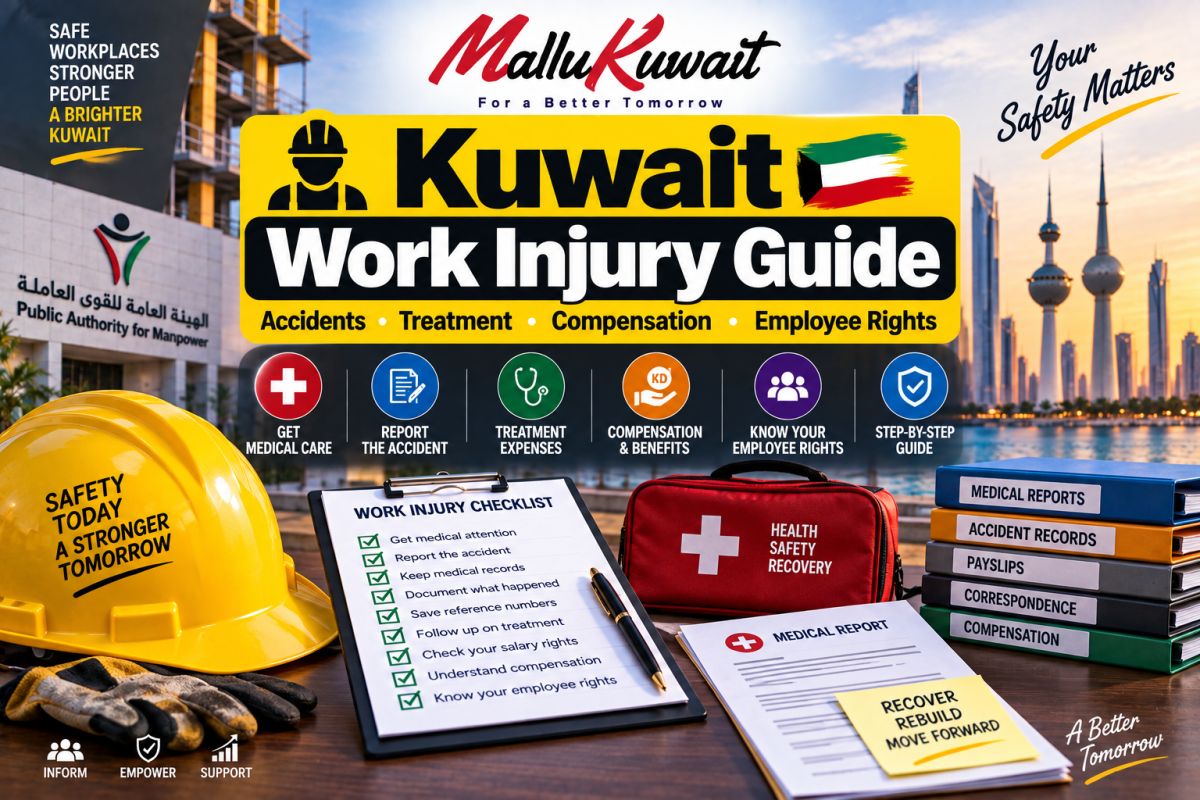
🦺 Kuwait Work Injury Guide: Workplace Accidents, Treatment, Compensation & Employee Rights
A workplace accident can become confusing very quickly.
The worker may be dealing with an injury while also wondering:
Who should report the accident?
Who pays for treatment?
Will salary continue during treatment?
What records should I keep?
Can compensation apply?
What happens if there is a permanent disability?
Kuwait's private-sector Labour Law contains specific provisions dealing with work injuries and occupational diseases.
This guide explains the major rules and the practical records workers should preserve.
Who is this guide for?
This guide is primarily for workers covered by Kuwait Labour Law No. 6 of 2010 concerning labour in the private sector and its amendments.
Different legal or insurance systems may apply to other categories of workers.
A work-injury case can involve labour law, medical findings, insurance/social-security provisions and the particular facts of the accident. Individual cases should be verified through the competent authorities.
What is a work injury?
Article 90 addresses a worker injured due to a reason connected with and during work, as well as an injury occurring on the worker's way to or from work.
Whether a particular incident legally qualifies as a work injury depends on the circumstances and applicable law.
Do not assume that every injury occurring somewhere near work automatically qualifies.
What should you do immediately after an accident?
Your health comes first.
Obtain appropriate medical attention.
As soon as reasonably possible, also make sure the accident is properly documented.
Record:
date
time
location
what happened
work being performed
persons who witnessed the incident
injury sustained
where treatment was received
when the employer was informed
If your health prevents you from handling these steps personally, the law recognizes reporting through representatives in relevant circumstances.
Report the accident promptly
Do not wait unnecessarily to tell the employer about a workplace accident.
Create a reliable record showing that the accident was reported.
Depending on the situation, this may include:
official accident report
employer incident report
written communication
medical documentation
other lawful evidence
Avoid relying only on a verbal conversation if a serious injury has occurred.
Article 90: employer reporting duties
Article 90 provides reporting requirements where a worker suffers a covered work injury.
The statutory text identifies notification to:
the police station for the area where the workplace is located
the competent Labour Department
the Public Institution for Social Security or the insurance company with which workers are insured against work injuries
The Article also provides that notification may be made by the worker if the worker's health permits, or by someone representing the worker.
Actual government reporting channels, electronic systems, departmental routing and insurance arrangements can change. Follow the current instructions of the competent authorities rather than relying only on an old online procedure.
Keep proof that the accident was reported
Where available, preserve:
accident-report reference
police reference
employer incident report
insurance reference
labour complaint/reference information
emails or messages confirming reporting
medical records showing the accident history
This can become important if the circumstances are later disputed.
Article 91: who bears treatment expenses?
Article 91 addresses treatment expenses for covered work injuries and occupational diseases.
Subject to the statutory framework, the employer bears the injured worker's treatment expenses at the governmental hospital or private clinic determined under the Article.
The provision includes:
treatment expenses
medicine
transportation expenses
The interaction with applicable health-insurance provisions should also be considered.
Keep every medical record
Preserve:
emergency report
medical report
diagnosis
imaging reports
prescriptions
treatment records
hospital/clinic documents
medical leave
follow-up appointments
rehabilitation records where relevant
receipts where relevant
Medical evidence can become central to a work-injury case.
What does the treating doctor determine?
Article 91 provides for the treating doctor's report to address matters including:
treatment period
percentage of disability resulting from the injury
extent to which the worker can continue performing work
These findings can have important consequences.
What if the worker or employer disagrees with the medical report?
Article 91 provides a mechanism for either the worker or employer to object to the medical report.
The statutory text provides for an application to the competent department within one month from notification of the report for consideration by the Medical Arbitration Committee at the Ministry of Health.
Medical-review procedures, forms and routing should always be confirmed through the current competent authority. Do not rely on an old form or office location.
Article 92: employer injury statistics
Article 92 requires employers to provide the Ministry of Health with periodic statistical statements concerning work-injury accidents and occupational diseases occurring at the establishment.
This is an employer reporting responsibility.
Article 93: salary during treatment
Article 93 provides an important wage protection.
A worker suffering a covered work injury or occupational disease is entitled to wage for the treatment period fixed by the medical doctor.
If the treatment period exceeds six months, Article 93 provides for half wage after that point until:
recovery
proven disability
or
death
as applicable under the Article.
Do not automatically treat work-injury treatment absence as ordinary sick leave. Work-injury provisions have their own statutory framework.
Keep salary records during treatment
Preserve:
payslips
bank statements
wage-transfer records
medical treatment dates
medical leave records
employer correspondence
If salary changes during the treatment period, document when and why.
Work injury is not necessarily ordinary sick leave
Kuwait Labour Law contains separate provisions for ordinary sick leave and for work injuries/occupational diseases.
If the absence results from a covered workplace injury, identify the correct legal basis rather than automatically calculating it using ordinary sick-leave percentages.
Article 94: work-injury compensation
Article 94 provides for compensation to an injured worker or the worker's beneficiaries for work injuries or occupational diseases according to the applicable statutory schedule issued by ministerial resolution.
The amount cannot be determined simply from the fact that an accident happened.
Relevant medical findings and the applicable compensation framework matter.
Do not guess a disability percentage
Do not estimate your own permanent disability percentage from symptoms.
Medical assessment is critical.
The statutory framework uses medical findings in determining disability arising from the injury.
If disability is disputed, use the applicable official medical-review process.
Article 95: circumstances affecting compensation
Article 95 contains important exceptions concerning compensation.
The statutory provision addresses situations where investigation proves that:
the worker intentionally injured himself
or
the injury resulted from gross misconduct and an intentional act by the worker
The Article contains further provisions concerning conduct involving alcohol/drugs and violations of posted work-hazard and occupational-safety instructions.
Article 95 also contains an important qualification
Do not summarize Article 95 simply as:
"Any safety-rule violation means no compensation."
The statutory text contains qualifications, including circumstances involving death or permanent disability exceeding the threshold stated in the Article.
Work-injury compensation disputes can therefore require careful examination of both the facts and the precise statutory language.
MalluKuwait cannot determine whether Article 95 applies to an individual accident.
Occupational diseases are also covered
Work injuries are not limited to sudden accidents.
The law separately recognizes occupational diseases.
These can involve illnesses associated with occupational exposure or working conditions as defined under the applicable legal framework.
Kuwait Government Online currently lists ministerial decisions concerning occupational diseases and work-injury procedures among the decisions implementing the Labour Law.
Article 96: occupational disease after leaving employment
Article 96 contains an especially important provision.
Where a worker suffers an occupational disease, or relevant symptoms develop during service or within one year after leaving service, the Article provides for application of Articles 93, 94 and 95.
This means that a potentially occupational condition should not automatically be ignored merely because symptoms became apparent after employment ended.
Medical and occupational evidence remains crucial.
Preserve occupational-exposure history
Where an occupational disease is suspected, keep lawful records relating to:
job title
nature of work
period of exposure
workplace conditions
chemicals/materials involved where legitimately known
protective equipment provided
medical examinations
symptoms
diagnosis
employment dates
Do not take confidential employer documents you are not entitled to retain.
Article 97: medical determination matters
Article 97 continues the statutory framework concerning medical reports and the condition of an injured worker.
Medical findings are therefore not merely administrative paperwork.
They can materially affect how the injury, disability and employment consequences are assessed.
What if you cannot return to the same work?
If an injury affects your ability to perform your previous duties, obtain clear medical documentation.
Do not rely on informal assumptions about:
permanent disability
fitness for work
ability to perform the previous job
need for restrictions
long-term prognosis
Use the competent medical assessment process.
What evidence should a worker preserve?
Depending on the case:
Civil ID/identification information
employment contract
work permit/employment information
accident report
police reference where applicable
employer incident report
witness information
photographs lawfully obtained
medical reports
prescriptions
imaging/test results
treatment dates
medical leave
salary records
bank statements
insurance correspondence
communications with employer
official reference numbers
This is an evidence-preparation checklist, not a statement that every authority requires every listed document in every case.
Witness information can matter
If colleagues or other people witnessed the accident, record their names and available contact details where lawful and appropriate.
Do not pressure witnesses to provide a particular version of events.
Record facts accurately.
Photographs and video
If safe and lawful, photographs of the accident location or relevant conditions can sometimes help document what occurred.
But never:
interfere with emergency treatment
enter a dangerous area merely to take photographs
alter the scene improperly
take confidential material you have no right to retain
fabricate or edit evidence deceptively
Safety comes first.
Write down the accident while details are fresh
When medically able, prepare a factual timeline.
For example:
Date: Time: Location: Task being performed: What happened: Injury: Witnesses: Employer notified: Medical facility: Report/reference number:
Avoid exaggeration.
A clear factual record is more useful than an emotional reconstruction made months later.
What if the employer disputes that the accident happened at work?
Preserve independent evidence where available.
Examples may include:
contemporaneous medical history
accident report
police record
witnesses
attendance
work schedule
employer messages
location/time evidence lawfully available to you
A disputed work-injury case may require official or legal determination.
What about an accident travelling to or from work?
Article 90 expressly includes relevant injuries occurring on the worker's way to and from work within its wording.
However, whether a particular journey or accident falls within the statutory protection depends on the facts and legal interpretation.
Do not assume every road accident occurring before or after work automatically qualifies.
Preserve:
accident record
time
location
work schedule
journey information
police documentation
medical records
and seek official guidance where coverage is disputed.
What if the employer does not report the injury?
Do not simply abandon the matter.
Article 90 expressly allows notification by the worker where the worker's health permits and also contemplates notification by a representative.
If reporting is disputed or has not occurred, contact the competent authority promptly for the current procedure.
Can a labour complaint also be necessary?
A work-injury case may create an employment dispute if, for example:
the employer disputes the accident
salary during treatment is disputed
treatment expenses are disputed
compensation is disputed
employment consequences are disputed
Where a labour complaint is appropriate, preserve the injury records together with the employment records.
What if employment is terminated after an injury?
Do not assume the injury itself answers every termination question.
Preserve:
medical records
termination letter
stated reason
dates
notice information
salary records
final settlement
Then examine the termination separately under the applicable employment rules.
Check the final settlement separately
A work-injury or occupational-disease claim and an employment final settlement can involve different components.
When employment ends, separately review:
final salary
notice amount where applicable
overtime
unused annual leave
end-of-service indemnity
deductions
employment documents
any distinct work-injury rights or compensation
Do not sign documents you do not understand
Be careful with documents stating that:
the accident did not happen at work
you accept responsibility for the accident
all treatment expenses were received
all compensation was received
all employment rights were settled
you waive future claims
Read the document carefully.
For a serious injury or substantial dispute, qualified legal advice may be appropriate before signing.
When should you seek official or professional help?
Consider prompt official or qualified professional guidance where:
the injury is serious
permanent disability is possible
the employer disputes the accident
reporting has not occurred
treatment is disputed
wages during treatment are disputed
compensation is disputed
the medical assessment is disputed
an occupational disease is suspected
employment is terminated after the injury
you are being asked to sign a waiver
the case may involve procedural deadlines
Do not intentionally delay a serious work-injury claim.
Work injury checklist
After a workplace accident, where medically possible:
□ Obtain medical attention
□ Inform the employer promptly
□ Record date, time and location
□ Record what happened
□ Identify witnesses
□ Ensure official reporting is addressed
□ Keep accident/reference numbers
□ Preserve medical reports
□ Preserve treatment records
□ Preserve prescriptions and relevant receipts
□ Keep salary records
□ Track the treatment period
□ Keep medical assessment/disability records
□ Preserve employer correspondence
□ Check compensation issues where applicable
□ Keep employment documents
□ Seek official help if reporting, treatment, wages or compensation are disputed
Official references
The principal private-sector Labour Law provisions discussed in this guide are Articles 90–97 concerning work injuries and occupational diseases.
Kuwait Government Online also currently lists implementing decisions relating to occupational diseases, medical arbitration, disability percentages and workplace protection requirements.
Important Legal & Medical Disclaimer
This guide is provided for general informational and educational purposes only.
It is not:
medical advice
legal advice
an official work-injury report
a medical disability assessment
an official compensation calculation
a determination that an accident legally qualifies as a work injury
a determination of fault
a substitute for emergency medical care
a substitute for the competent Kuwait authorities or qualified professionals
Work-injury cases can depend on medical findings, accident circumstances, employment status, insurance/social-security provisions, reporting, evidence, statutory provisions and official decisions.
Government procedures, forms, departments and electronic systems can also change.
For an emergency or serious injury, obtain appropriate medical assistance immediately.
For an actual work-injury claim, verify the current reporting and procedural requirements through the competent Kuwait authorities.
MalluKuwait does not represent the Public Authority for Manpower, Ministry of Health, Public Institution for Social Security, police, courts or any other Kuwait government authority. Always rely on current official instructions for an individual work-injury case.
Kuwait Labour Complaint Guide
Kuwait Termination Guide
Kuwait Final Settlement Guide
💬 Comments (0)
💬
No comments yet. Be the first to comment!
