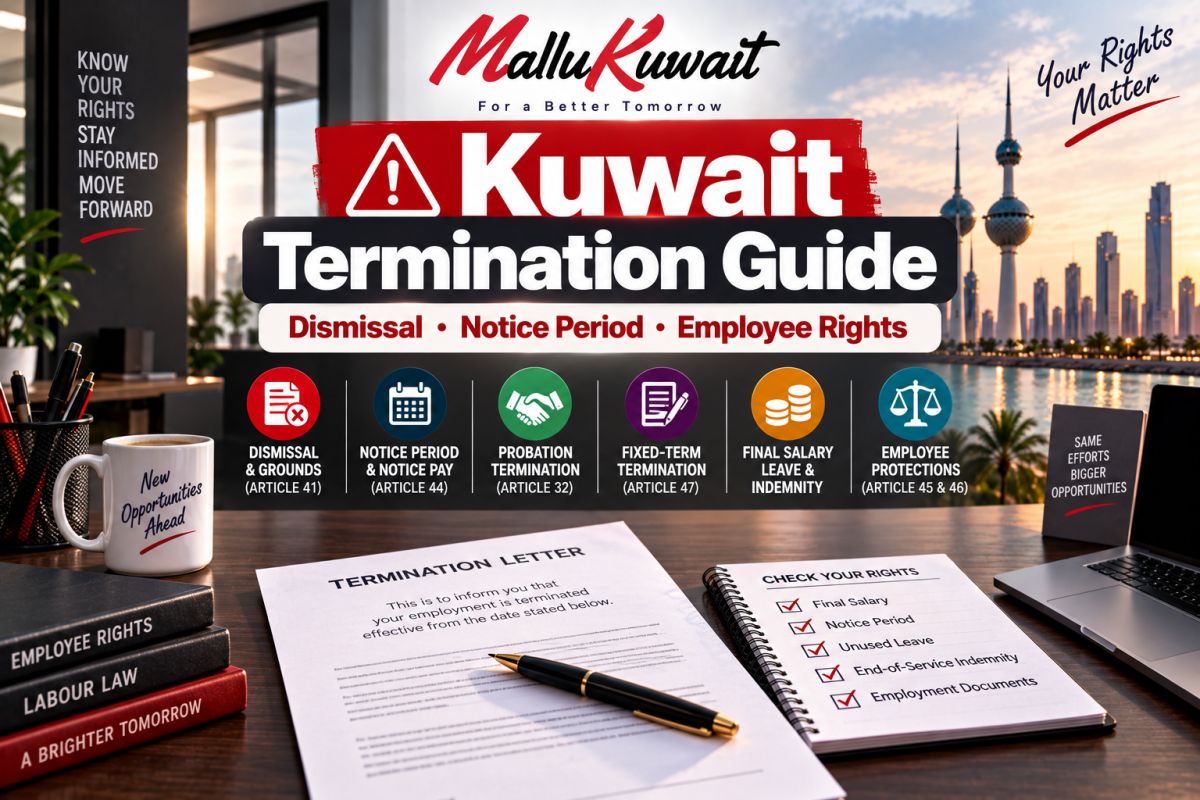
⚠️ Kuwait Termination Guide: Dismissal, Notice Period, Final Settlement & Employee Rights
Losing a job can be stressful, especially when an employee is unsure whether the employer followed Kuwait labour law or whether salary, leave and end-of-service amounts are still due.
But not every termination is legally the same.
Kuwait private-sector law distinguishes between ordinary termination, termination during probation, termination of a fixed-term contract, serious dismissal cases and situations where the worker may challenge the employer's decision.
This guide explains the major termination rules employees should understand and the records they should keep.
Who is this termination guide for?
This guide is primarily for workers covered by Kuwait Labour Law No. 6 of 2010 concerning labour in the private sector and its amendments.
Government employees, domestic workers and employees governed by special employment regimes may be subject to different rules.
First identify which employment regime and contract type apply to you before relying on the rules below.
First identify how your employment ended
Do not treat every job ending as simply "termination."
Ask which situation applies:
ordinary employer termination
termination during probation
dismissal under Article 41
fixed-term contract ended early
fixed-term contract expired
establishment closure or another statutory event
employee resignation
another legally relevant circumstance
The legal consequences can differ substantially.
Check your employment contract
Before assessing termination, obtain your employment contract and identify:
employer
contract type
start date
effective date
fixed-term expiry date if applicable
salary
job or nature of work
probation provision
termination provisions
Keep all amendments as well.
Ordinary termination of an unlimited contract
Article 44 addresses termination of an unlimited-period employment contract.
Either party may terminate such a contract after giving written notice to the other party.
For workers appointed on a monthly salary, Article 44 generally provides for:
at least 3 months' notice
For other workers covered by Article 44:
at least 1 month's notice
The three-month rule should not be applied automatically to every worker or every type of employment contract.
What if the employer does not provide the required notice?
Article 44 addresses failure to observe the applicable notice period.
The party terminating the contract without observing the required notice may be required to pay the other party an amount corresponding to the worker's wage for the notice period.
Therefore, check both:
the termination date
and
how the notice period or notice compensation was handled.
Can an employer release the worker from work during employer notice?
Article 44 also provides that the employer may exempt the worker from working during the notice period.
In that situation, the Article provides for the worker's service to continue to be calculated until expiry of the notice period, together with the resulting effects, particularly entitlement to wage for that notice period.
Keep written evidence if the employer tells you not to attend work during notice.
Job-search time during employer notice
Article 44 contains another useful protection where termination notice comes from the employer.
The worker is entitled to be absent:
one full day per week
or
eight hours during the week
to search for another job, while retaining wage entitlement for that absence.
The worker determines the day or hours, subject to notifying the employer at least on the preceding day.
Can the employer terminate an employee while on statutory leave?
Article 45 provides that the employer may not exercise the Article 44 termination right while the worker is enjoying one of the leaves provided for in the law.
This is an important distinction when ordinary termination coincides with statutory leave.
If this issue affects you, preserve the leave approval and termination records.
Can an employee be terminated without a reason?
Article 46 provides important protection.
It states that a worker's service shall not be terminated without reason.
It also protects against termination because of:
trade-union activity
claiming legitimate rights under the law
enjoying legitimate rights under the law
Article 46 additionally states that service shall not be terminated because of:
sex
origin
religion
A worker who believes a termination falls into a prohibited category should preserve evidence and seek appropriate official or legal guidance.
What is Article 41 dismissal?
Article 41 deals with specified dismissal situations.
It is important not to summarize the whole Article as:
"Employer can fire you immediately and you lose everything."
Article 41 contains different categories with different consequences.
Article 41 serious cases: dismissal without notice, compensation or indemnity
Subject to the relevant provisions of the law, Article 41(a) allows the employer to dismiss the worker without notice, compensation or end-of-service indemnity in specified serious circumstances.
The official law includes cases where:
the worker commits a fault resulting in serious loss to the employer
it is established that the worker obtained employment through cheating or fraud
the worker discloses establishment secrets causing or capable of causing real loss to the establishment
These are serious statutory grounds.
Whether the facts of a particular case actually satisfy one of these grounds can be disputed.
Not every Article 41 dismissal means loss of indemnity
Article 41(b) contains another group of dismissal grounds.
These include specified situations concerning:
a final conviction involving honour, trust or morals
an act violating public morals at the workplace
assault on a colleague, employer or employer's representative during or because of work
breach or failure concerning obligations imposed by the contract or law
repeated violation of the employer's instructions
Crucially, the Article provides that dismissal in these cases does not result in depriving the worker of end-of-service indemnity.
Do not assume that every Article 41 dismissal automatically means the employee loses end-of-service benefits.
Can a worker challenge an Article 41 dismissal?
Yes.
Article 41 provides a worker dismissed under the cases mentioned in that Article with the right to challenge the dismissal before the competent labour circuit according to the procedures provided by law.
The Article further addresses the situation where a final judgment establishes that the employer acted arbitrarily in dismissing the worker.
This makes evidence extremely important.
What can happen if dismissal is finally found arbitrary?
Article 41 addresses the consequences where a final judgment establishes arbitrary dismissal.
The statutory text provides for entitlement to end-of-service indemnity and compensation for material and moral damage in that situation.
The actual outcome and amount are matters for the competent process and facts of the case.
MalluKuwait cannot determine whether a particular dismissal is legally arbitrary.
Employer notification concerning Article 41 dismissal
Article 41 also contains an employer notification requirement concerning the dismissal decision and its reasons.
Employees should therefore keep any written dismissal decision or reason provided by the employer.
If no clear documentation is available, preserve other reliable evidence concerning what occurred.
Termination during probation
Probation has a separate statutory rule.
Article 32 provides that during a valid probation period either party may terminate the employment contract without notice.
Probation must be specified in the contract and cannot exceed 100 working days.
Where the employer terminates during probation, Article 32 addresses terminal service indemnity for the employment period according to the law.
Fixed-term contracts need separate treatment
Article 44 is an unlimited-contract provision.
Do not automatically apply its ordinary three-month or one-month notice rules to every fixed-term contract.
Article 47 separately addresses early termination of a limited-period contract where a party terminates without having a legal right to do so.
What does Article 47 say about wrongful early fixed-term termination?
Article 47 provides for compensation for damage where either party terminates a fixed-term contract without having a right to do so.
The compensation is subject to a ceiling:
it shall not exceed an amount equal to the worker's wage for the remaining period of the contract
The Article also directs consideration of factors affecting whether damage exists and its extent.
Therefore, do not treat the remaining contract salary automatically as a guaranteed compensation amount in every case.
Fixed-term expiry is different from early dismissal
If a fixed-term contract simply reaches its agreed expiry, that is not necessarily the same legal event as terminating it early.
Check:
contract expiry date
whether employment continued after expiry
whether the contract was renewed
whether either party ended it before expiry
what final amounts remain due
These distinctions matter.
What happens to salary when employment ends?
Termination does not erase salary already earned.
Check:
salary through the applicable employment date
salary during applicable notice
outstanding wages
overtime where applicable
lawful deductions
other documented wage components
Keep bank statements and payslips.
What happens to unpaid overtime?
If overtime was properly worked and established before termination, ending employment does not make the underlying record irrelevant.
Preserve:
attendance
schedules
written instructions
payroll records
other evidence available to you
What happens to unused annual leave?
Unused annual-leave rights can form part of the amounts that need to be considered when employment ends.
Preserve your leave records before losing access to employer systems.
Compare:
entitlement
leave taken
remaining balance
employer calculation
What about end-of-service indemnity?
End-of-service indemnity should be calculated according to the applicable statutory provisions and the circumstances in which employment ended.
Do not assume:
every termination means loss of indemnity
or
every termination automatically produces exactly the same entitlement.
Article 41 itself demonstrates why the reason and legal basis for dismissal can matter.
Check your final settlement carefully
A final settlement may involve several separate components.
Check:
outstanding salary
notice wage or compensation where applicable
overtime where applicable
unused annual leave
end-of-service indemnity
documented deductions
any other established amounts
Ask for a written breakdown where possible.
Do not sign a settlement you do not understand
Read any final-settlement, receipt or waiver document carefully.
Pay particular attention if the document says:
all amounts were received
no further money is due
claims are waived
you agree with the employer's stated reason for termination
If the amount or wording is disputed, understand the document before signing it.
For a significant dispute, qualified advice may be appropriate.
Keep the termination letter
If the employer provides a termination or dismissal letter, keep it.
The document may help establish:
date of termination
stated reason
notice treatment
final working date
employer position
Do not depend on continued access to company email after employment ends.
Preserve your own employment records
Before leaving, lawfully preserve your own records such as:
employment contract
amendments
salary records
payslips
bank statements
attendance records available to you
overtime records
leave records
warnings or disciplinary documents issued to you
termination letter
final settlement
relevant correspondence
Do not take confidential company material that you are not entitled to retain.
What if you disagree with the reason for dismissal?
Do not destroy documents or react only verbally.
Write down the timeline and preserve evidence.
Identify:
what the employer says happened
when the alleged incident occurred
what documents were issued
who was involved
whether warnings or investigations occurred
what the contract says
what salary and settlement were paid
Then obtain appropriate official or qualified legal guidance.
Termination and work permit are separate issues
Ending the employment relationship does not by itself explain every work-permit, residency or transfer consequence.
Do not assume that a termination letter automatically:
transfers your work permit
approves a new employer
completes residency procedures
determines every transfer right
Check current administrative requirements separately.
Termination is not the same as resignation
Do not allow documents to describe the end of employment inaccurately without understanding the consequences.
Resignation means the worker initiated the termination.
Employer termination means the employer initiated it.
Other legal circumstances may also exist.
The distinction can affect notice, indemnity, evidence and other issues.
What if the employer asks you to resign instead?
An employer may sometimes ask a worker to submit a resignation rather than issuing an employer termination.
Do not treat the two documents as automatically equivalent.
Before signing or submitting something that changes how the employment ended, understand:
what the document says
who is legally initiating termination
notice consequences
end-of-service consequences
final settlement
work-permit implications
If the situation is disputed or financially significant, obtain appropriate advice before signing.
Common termination mistakes
Avoid assumptions such as:
"An employer can terminate anyone for any reason."
"Every dismissal means no indemnity."
"Article 41 has only one type of dismissal."
"Every employee gets three months' notice."
"Fixed-term contracts follow exactly the same rule as unlimited contracts."
"Probation termination requires normal Article 44 notice."
"Termination automatically cancels or transfers my work permit."
"Once I am terminated, unpaid salary and leave disappear."
"I should sign the final settlement immediately."
These assumptions can materially affect an employee's decisions.
Termination checklist
If your employer terminates your employment:
obtain the termination decision where available
note the stated reason
identify your contract type
check whether probation applies
check applicable notice
record your final working date
preserve salary records
preserve attendance and overtime evidence
obtain your leave balance
review indemnity
review the final settlement
return company property appropriately
keep proof of return where useful
check work-permit and transfer procedures separately
seek official help if the dismissal or settlement is disputed
When should you seek official help?
Consider obtaining current official guidance or qualified legal advice where:
the employer alleges serious misconduct
Article 41 is being relied upon
you believe the dismissal reason is prohibited or unjustified
you were terminated while on statutory leave
your fixed-term contract was ended early
salary remains unpaid
notice compensation is disputed
indemnity is denied
the final settlement appears incorrect
the employer asks you to sign a resignation you do not agree with
work-permit or transfer consequences are unclear
Official references
The principal provisions discussed in this guide include Articles 32, 41, 44, 45, 46, 47 and the relevant end-of-service provisions of Kuwait Labour Law No. 6 of 2010 concerning labour in the private sector and its amendments.
Important Legal Disclaimer
This guide is provided for general informational and educational purposes only.
It is not:
legal advice
employment advice
a determination that a dismissal is lawful or unlawful
an official calculation of compensation or indemnity
an official work-permit or residency decision
a substitute for a court, government authority or qualified legal professional
Termination cases can be highly fact-specific.
The contract, reason for dismissal, evidence, service history, wage, applicable statutory provision and current administrative rules can materially change the outcome.
Kuwait laws, amendments, regulations, ministerial decisions, procedures and official interpretations may also change.
If your employment has been terminated and the dismissal, compensation, indemnity or work-permit consequences are disputed, verify the current position through official Kuwait sources and obtain appropriate professional guidance where necessary.
MalluKuwait does not represent the Public Authority for Manpower, the Ministry of Interior, Kuwait Government Online, the courts or any other Kuwait government authority. This information is provided for general guidance only. Always verify your individual situation using current official Kuwait government sources.
Kuwait Resignation Guide
Kuwait Employment Contract Guide
Kuwait Indemnity Guide
💬 Comments (0)
💬
No comments yet. Be the first to comment!
