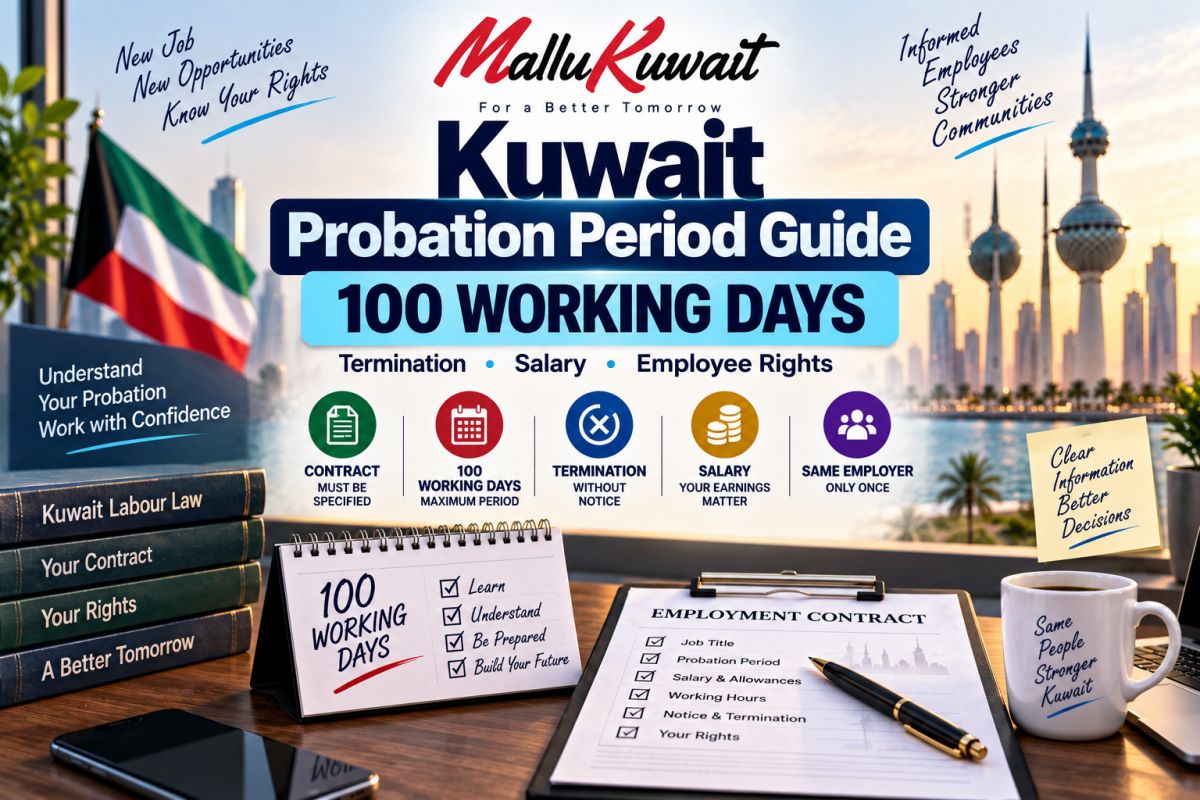
🧪 Kuwait Probation Period Guide: 100 Working Days, Termination, Salary & Employee Rights
Starting a new job in Kuwait often means going through a probation period.
But probation does not mean that an employer can simply ignore the employment contract or Kuwait labour law.
For private-sector workers covered by Kuwait Labour Law No. 6 of 2010, Article 32 contains specific rules governing probation.
This guide explains the 100-working-day limit, termination during probation, notice, repeat probation and the practical records employees should keep.
Who is this probation guide for?
This guide is primarily for workers covered by Kuwait Labour Law No. 6 of 2010 concerning labour in the private sector and its amendments.
Government employees, domestic workers and workers covered by other special employment regimes may be subject to different rules.
First confirm which employment regime applies to you before relying on the private-sector probation rules explained here.
Where is the Kuwait probation rule found?
The principal private-sector probation provision is Article 32 of Kuwait Labour Law No. 6 of 2010.
Article 32 deals specifically with:
specifying probation in the employment contract
maximum probation duration
termination during probation
notice during probation
employer-initiated termination
repeated probation with the same employer
These points are important for both employees and employers.
Must probation be mentioned in the employment contract?
Yes.
Article 32 states that the labourer's probation period shall be specified in the work contract.
That makes the employment contract an important document when determining whether probation applies and what was agreed.
Do not rely only on a verbal statement that you are "on probation."
Check the written employment contract.
What is the maximum probation period?
Article 32 provides that probation shall not exceed:
100 working days
This wording matters.
The statutory maximum is expressed as working days.
It is not simply described in Article 32 as:
100 calendar days
exactly 3 months
exactly 90 days
When checking whether probation has ended, do not automatically treat 100 working days as 100 calendar days.
Why are working days different from calendar days?
A calendar includes days whether you work on them or not.
A working-day calculation can depend on the worker's actual work schedule and the circumstances of employment.
For example, weekly rest days may mean that 100 working days extend across more than 100 calendar days.
Because individual schedules can differ, do not use a generic calendar estimate as a definitive legal calculation where the exact probation-end date matters.
Should I calculate my probation from the contract date or joining date?
First check the employment contract carefully.
Article 32 requires the probation period to be specified in the contract.
The contract should also be read together with the actual employment facts and relevant dates.
Keep evidence of:
contract signing date
contract effective date
actual joining date
attendance
work schedule
weekly rest days
If the exact probation-end date becomes disputed, these records may matter.
Can probation exceed 100 working days if the contract says so?
Article 32 sets the maximum probation period at 100 working days.
A contract should therefore not be treated as overriding the statutory maximum merely because it contains a longer probation clause.
If your contract appears to impose a probation period beyond the statutory limit, verify your individual position with the Public Authority for Manpower or qualified legal advice.
Can an employer terminate an employee during probation?
Article 32 provides that either party may terminate the contract during the probation period.
The Article specifically states that termination during probation may occur:
without notice
This is one of the major differences between probation termination and ordinary termination rules that may apply outside probation.
Can the employee leave during probation?
Article 32 says either party may terminate the contract during probation without notice.
That wording includes the worker as well as the employer.
However, employment termination can interact with other practical matters such as:
work permit status
residency procedures
transfer requirements
final salary
company property
employment documents
Do not assume that "without notice" means every administrative consequence disappears.
Is the normal three-month notice period required during probation?
Article 32 expressly provides for termination during probation without notice.
This is different from the ordinary notice provisions applicable in relevant circumstances outside probation.
Do not mix the probation rule with the general notice rules for an unlimited employment contract.
We will cover ordinary resignation and notice periods separately in the MalluKuwait resignation guide.
What happens if the employer terminates during probation?
Article 32 specifically addresses employer-initiated termination.
The official English text provides that if termination is made by the employer, the employer shall pay the worker terminal service indemnity for the employment period according to the provisions of the law.
The actual amount in an individual case depends on the applicable statutory calculation and employment facts.
Does probation mean the employer does not have to pay salary?
No.
Probation is part of the employment relationship.
Article 32 gives specific rules concerning probation and termination, but it does not turn paid employment into unpaid work.
Keep records of:
salary agreed
days worked
bank salary deposits
payslips
attendance
overtime where applicable
If earned salary is missing, the salary issue should be considered separately from the fact that you were on probation.
What about overtime during probation?
Being on probation does not itself mean that working-hours and overtime provisions disappear.
If you perform overtime, keep evidence such as:
attendance records
shift schedules
written overtime instructions
payroll records
relevant messages or correspondence
Do normal working-hours rules still matter?
Yes.
Probation should not be confused with a separate category of employment where ordinary labour protections automatically disappear.
Private-sector working-hour rules remain relevant where applicable.
Can the same employer put me on probation twice?
Article 32 directly addresses this.
It states that a labourer may not be employed under probation with the same employer more than once.
This is an important protection.
If you have already completed probation with the same employer and are later told that you must begin another probation period, do not assume that the new probation is automatically valid.
Article 32 specifically uses the concept of the same employer. If the legal employer has changed, the situation may require individual assessment rather than assuming it is legally the same case.
What if I change job title with the same employer?
A change of:
department
role
title
work location
does not automatically answer whether a new probation period is lawful.
Article 32's key wording is that a worker may not be employed under probation with the same employer more than once.
If there is disagreement about the legal employer or employment relationship, obtain current official guidance for the specific situation.
What happens after probation ends?
If employment continues after the valid probation period, the special Article 32 probation-termination provision should not simply be assumed to continue indefinitely.
The employment relationship continues subject to the applicable contract and labour-law provisions.
This is why it is useful to know the exact probation period rather than allowing "probation" to remain an undefined status.
What if the employer says probation was extended?
Check:
what the original contract says
how many working days have actually elapsed
whether you were already placed under probation with that employer
whether the claimed extension would exceed the statutory maximum
Article 32 says probation shall not exceed 100 working days.
Do not rely only on an informal statement that probation has been extended.
Can an employer reduce salary because I am on probation?
Do not assume that probation gives an employer a general right to ignore the agreed wage.
Your contract and the statutory wage protections remain important.
Compare:
agreed basic salary
allowances
amount actually deposited
payslip
deductions
days actually worked
Keep evidence from your first working day
Do not wait until a dispute occurs.
Keep copies of:
employment contract
job offer
joining communication
work permit documents available to you
attendance records
duty schedules
salary records
bank statements
payslips
leave records
important emails or messages
probation review documents
warning letters if any
termination communication
These records can help establish what actually happened and when.
If the employer terminates you during probation
Before leaving, try to obtain and keep appropriate records showing:
last working date
termination communication
salary paid or outstanding
overtime outstanding if applicable
leave or other employment records where relevant
final settlement information
employment/work-permit documentation available to you
Return company property appropriately and keep evidence where useful.
If you decide to leave during probation
Do not simply disappear from work because you believe Article 32 allows termination without notice.
Communicate the decision clearly and preserve evidence of that communication.
Also check any necessary employment, work-permit and residency procedures applicable to your situation.
This helps separate the labour-law notice issue from other administrative requirements.
Probation and changing employers
Ending employment during probation and transferring to another employer are not necessarily the same legal or administrative question.
A worker may need to consider current work-permit and transfer rules separately.
Common probation mistakes
Avoid these common assumptions:
"Probation is always exactly three months."
"100 working days means 100 calendar days."
"Probation does not need to appear in my contract."
"My employer can put me on probation repeatedly."
"I need the normal notice period even though Article 32 applies."
"Because I am on probation, salary rules do not matter."
"No notice means I can ignore work-permit or residency procedures."
Each of these can create unnecessary confusion.
Simple probation checklist
When starting a new job, confirm:
Is probation written in my contract?
What is the stated probation period?
When did employment actually begin?
What is my work schedule?
How will working days be recorded?
Have I previously completed probation with this same employer?
What salary is written in the contract?
Are salary payments reaching my bank account?
Am I keeping attendance and payroll records?
Do I understand what happens if either side ends employment during probation?
Keeping these answers clear from the beginning can prevent problems later.
When should you seek official help?
Consider checking with the relevant authority or qualified legal professional when:
the employer claims probation exceeds 100 working days
you are placed on probation again with the same employer
there is disagreement about when probation ended
salary remains unpaid
termination creates a final-settlement dispute
your employment or work-permit status is unclear
contract documents conflict
Official references
The principal statutory provision discussed in this guide is Article 32 of Kuwait Labour Law No. 6 of 2010 concerning labour in the private sector and its amendments.
Important Legal Disclaimer
This guide is provided for general informational and educational purposes only.
It is not:
legal advice
employment advice
an official government interpretation
a decision on whether a particular termination is lawful
a guarantee of work-permit or residency consequences
Individual circumstances, contract terms, employment history and current administrative rules can materially affect a worker's position.
Kuwait laws, amendments, regulations, ministerial decisions, procedures and official interpretations may change.
For an important employment decision or dispute, verify the current position using official Kuwait sources and, where appropriate, obtain guidance from the relevant authority or a qualified legal professional.
MalluKuwait does not represent the Public Authority for Manpower, the Ministry of Interior, Kuwait Government Online or any other Kuwait government authority. This information is provided for general guidance only. Always verify your individual situation using current official Kuwait government sources.
Kuwait Employment Contract Guide
Kuwait Salary & Wage Rights Guide
Kuwait Work Permit & Article 18 Guide
💬 Comments (0)
💬
No comments yet. Be the first to comment!
