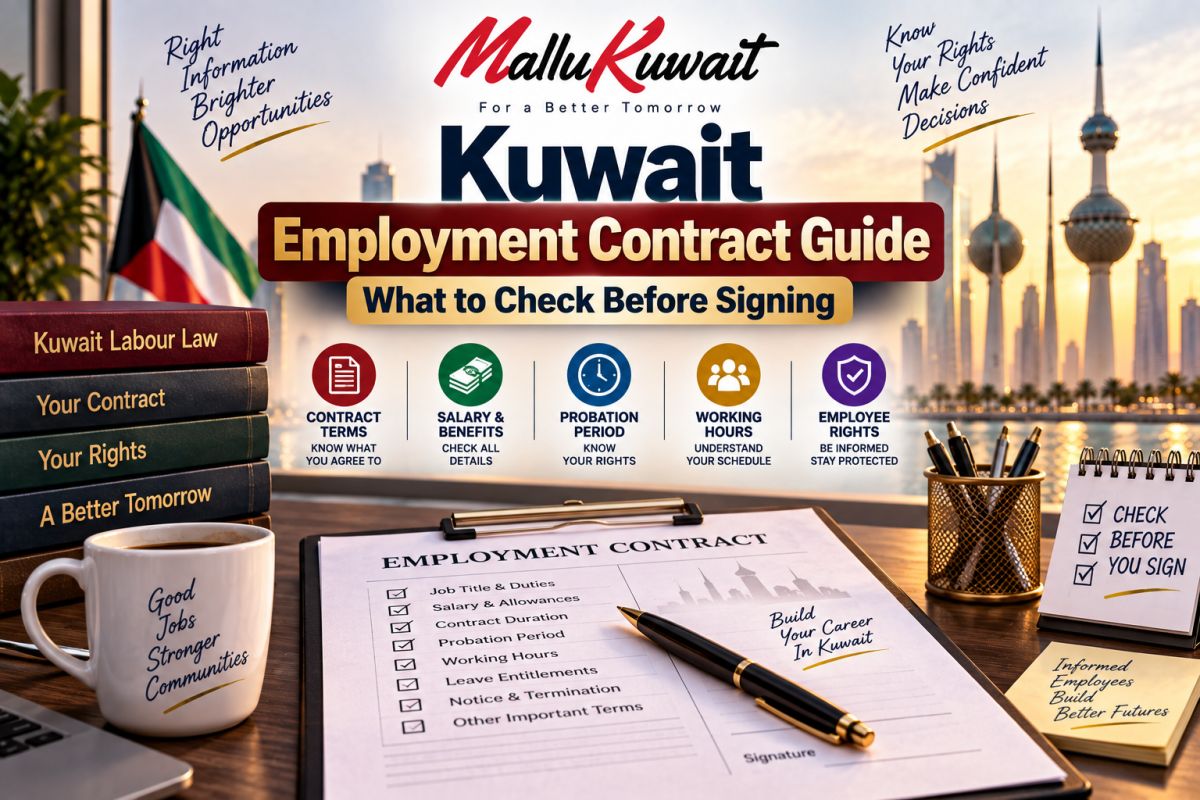
📄 Kuwait Employment Contract Guide: What to Check Before Signing, Salary, Probation & Your Rights
A job offer can look attractive because of the salary, job title or company name.
But before signing an employment contract in Kuwait, it is important to check what the contract actually says.
Your salary, job, contract duration, probation period and many other employment rights can later depend on the documents you agreed to.
This guide explains important points private-sector employees should understand before signing a Kuwait employment contract.
Who is this employment-contract guide for?
This guide is primarily for workers covered by Kuwait Labour Law No. 6 of 2010 concerning labour in the private sector and its amendments.
Government employees, domestic workers and workers governed by special employment regimes may have different contract rules.
First confirm which employment regime applies to the job you are accepting.
Should your employment contract be in writing?
Article 28 provides that a work contract shall be prepared in writing.
The Article identifies important information that the written contract should contain, including:
date the contract is signed
effective date
amount of wage
contract period if it is for a limited period
nature of the work
These are fundamental terms that deserve careful attention before signing.
How many copies of the contract are prepared?
Article 28 provides for three copies of the work contract.
The official English text describes:
one copy for the worker
one copy for the employer
a third copy for the competent authority
Do not leave employment without keeping your own contract records.
A clear copy of the signed contract can become extremely important if a disagreement occurs later.
What if there is no written contract?
Article 28 also addresses this situation.
The absence of a written document does not automatically mean that the employment relationship never existed.
The Article provides that, where the work contract is not established in writing, it is still deemed to exist and the worker may establish rights through methods of evidence.
Even so, relying on a clear written contract is far safer than trying to reconstruct employment terms after a dispute.
Which language controls the employment contract?
Article 29 states that contracts shall be made in Arabic.
A translation into another language may be added.
However, if there is a discrepancy, the Arabic-language version has preference under Article 29.
If you do not read Arabic, do not assume that an English or other-language translation necessarily says exactly the same thing as the Arabic contract. Obtain help understanding the Arabic terms before signing if anything important is unclear.
Compare every language version before signing
Check important terms in both versions, particularly:
employer name
employee name
job title or nature of work
basic salary
allowances
contract duration
effective date
probation
work location
any other important conditions
If the versions appear inconsistent, ask for clarification before signing rather than waiting until a dispute develops.
Check the employer identity
Make sure you know which legal employer is actually named in the employment documents.
The company or brand where you physically work may not always be the name you expected to see on every document.
Compare the employer information across the documents available to you.
If something does not match, ask why before signing.
Check the nature of work carefully
Article 28 specifically identifies the nature of work as an important contract term.
The same Article also provides protection concerning assignment of work inconsistent with the nature of work stated in the contract or unsuitable for the qualifications and experience on which the contract was signed.
Your job description therefore matters.
Do not focus only on the job title.
Understand what work you are actually agreeing to perform.
Check the salary before signing
Compare the salary in the final contract with the salary you were promised during recruitment.
Look carefully at:
basic salary
fixed allowances
other wage components
any written benefits
payment frequency
any conditions attached to particular payments
Do not rely only on a verbal salary promise.
Can salary simply be reduced during the contract?
Article 28 contains an important wage protection.
The official English text provides that the worker's wage shall not be reduced during the validity of a limited or unlimited contract, and addresses agreements contrary to this protection.
An individual salary dispute can depend on its facts, so obtain proper advice where necessary.
But this provision is another reason to make sure the agreed wage is correctly documented from the beginning.
Limited-term or unlimited-term contract?
Check whether the contract is:
for a specified/limited period
or
for an unlimited period
The distinction can become important when considering renewal, resignation, termination and other employment consequences.
Never assume the contract type from the job advertisement alone.
Read the final contract.
How long can a limited-period contract be?
Article 30 provides that a limited-period employment contract shall generally be:
not more than 5 years
and
not less than 1 year
The contract may be extended after expiry by agreement of both parties.
What happens when a limited contract expires but work continues?
Article 31 addresses continuation after expiry.
If both parties continue implementing a limited-period contract after its expiry without formally extending it, the law provides for renewal for similar periods under the same conditions unless the parties agree to renew under other conditions.
Article 31 also protects accrued dues arising from the previous contract.
This is why employees should keep both old and renewed contracts.
Check the effective date
The date you sign a contract and the date the employment takes effect are not necessarily the same thing.
Article 28 specifically identifies both the signing date and effective date.
Check them carefully.
Dates can later matter when considering:
service duration
probation
annual leave
notice
indemnity
contract expiry
Keep evidence of your actual employment history as well.
What is the probation-period rule?
Article 32 provides that probation must be specified in the work contract.
The probation period may not exceed:
100 working days
The law also provides that a worker may not be employed under probation with the same employer more than once.
The statutory wording refers to 100 working days, not simply 100 calendar days.
Can the contract be ended during probation?
Article 32 provides that either party may terminate the contract during the probation period without notice.
Where termination during probation is made by the employer, Article 32 addresses the worker's terminal service indemnity for the employment period in accordance with the law.
Probation therefore does not mean that employment has no legal consequences at all.
Check working hours and weekly schedule
Before signing, ask what the actual working arrangement will be.
Check:
normal daily hours
weekly hours
break arrangement
number of working days
weekly rest
shift pattern
overtime expectations
Ramadan schedule where applicable
Check overtime arrangements
If the job regularly involves work beyond normal hours, understand how overtime is recorded and paid.
Ask:
who authorizes overtime?
how are hours recorded?
how does overtime appear on payroll?
are rest-day or holiday hours treated separately?
Do not rely only on a verbal statement that overtime will be "taken care of later."
Check annual-leave arrangements
Understand the statutory annual-leave rules as well as the employer's administrative process.
Ask how:
leave is requested
leave is approved
leave balances are recorded
leave salary is processed
unused leave is recorded
The employment contract or company policy should not be read in isolation from applicable statutory rights.
Check sick-leave procedures
Know the employer's procedure for reporting sickness and submitting medical documentation.
This is particularly important because qualifying private-sector sick leave has statutory stages and medical-certification requirements.
Check notice and termination clauses
Read every clause dealing with:
resignation
termination
notice
contract expiry
disciplinary termination
final settlement
Do not assume that limited and unlimited contracts always have identical consequences.
We will cover resignation and termination separately in dedicated MalluKuwait guides.
Check end-of-service implications
End-of-service benefits can become financially important after years of employment.
Keep your contracts and salary records from the beginning rather than trying to reconstruct them when employment ends.
Offer letter vs final employment contract
An offer letter can be useful evidence of what was discussed during recruitment.
But do not assume that an earlier offer letter and the final employment contract are identical.
Before signing the final documents, compare:
salary
allowances
job title
nature of work
contract duration
work location
benefits
probation
joining date
other important promises
If something important disappeared or changed, ask for an explanation before signing.
Never sign documents you do not understand
Do not sign a contract simply because someone says:
"Everyone signs this."
Take enough time to understand the important terms.
Pay particular attention to Arabic-language provisions because Article 29 gives the Arabic text preference where versions differ.
For an important or unusual contract, consider obtaining qualified professional advice.
Do not rely on blank spaces or future promises
Be cautious if important terms are:
left blank
promised verbally
said to be added later
inconsistent between documents
materially different from recruitment discussions
Get important agreed terms documented properly before signing whenever possible.
Keep the complete employment-document trail
Employees should keep copies of:
job advertisement where relevant
job offer
employment contract
Arabic contract
translated contract
contract amendments
work-permit-related records available to them
salary records
payslips
bank statements
attendance records
leave records
important employer correspondence
resignation or termination documents
Do not wait until employment ends to start collecting records.
Contract and work permit are related but not identical
An employment contract sets out important employment terms.
Work-permit and immigration processes involve additional official requirements.
Do not assume that possessing one document automatically answers every question about another.
Check before paying anyone for a job
A legitimate-looking contract does not automatically prove that every recruitment request is genuine.
Be cautious if someone asks for money, particularly where the request conflicts with official procedures or comes through an unverified person.
Before-signing checklist
Before signing your Kuwait employment contract, check:
correct employer identity
your correct personal details
signing date
effective date
nature of work
job title
salary
allowances
contract type
limited-contract duration if applicable
probation period
working hours
weekly schedule
work location
overtime arrangements
leave procedures
termination and notice clauses
Arabic and translated versions
any promised benefits
whether you received your own complete copy
If anything important is unclear, resolve it before signing where possible.
Official references
The principal provisions discussed in this guide include Articles 28 to 32 of Kuwait Labour Law No. 6 of 2010 concerning labour in the private sector and its amendments.
Important Legal Disclaimer
This guide is provided for general informational and educational purposes only.
It is not:
legal advice
employment advice
an official interpretation of your contract
an official government decision
a guarantee of any employment right or outcome
Contract wording and individual circumstances can materially affect a worker's legal position.
Kuwait laws, amendments, regulations, ministerial decisions, procedures and official interpretations may also change.
For an important employment decision or contract dispute, verify the current position using official Kuwait sources and, where appropriate, obtain advice from the relevant authority or a qualified legal professional.
MalluKuwait does not represent the Public Authority for Manpower, the Ministry of Interior, Kuwait Government Online or any other Kuwait government authority. This information is provided for general guidance only. Always verify your individual situation using current official Kuwait government sources.
Kuwait Salary & Wage Rights Guide
Kuwait Working Hours Guide
Kuwait Work Permit & Article 18 Guide
💬 Comments (0)
💬
No comments yet. Be the first to comment!
