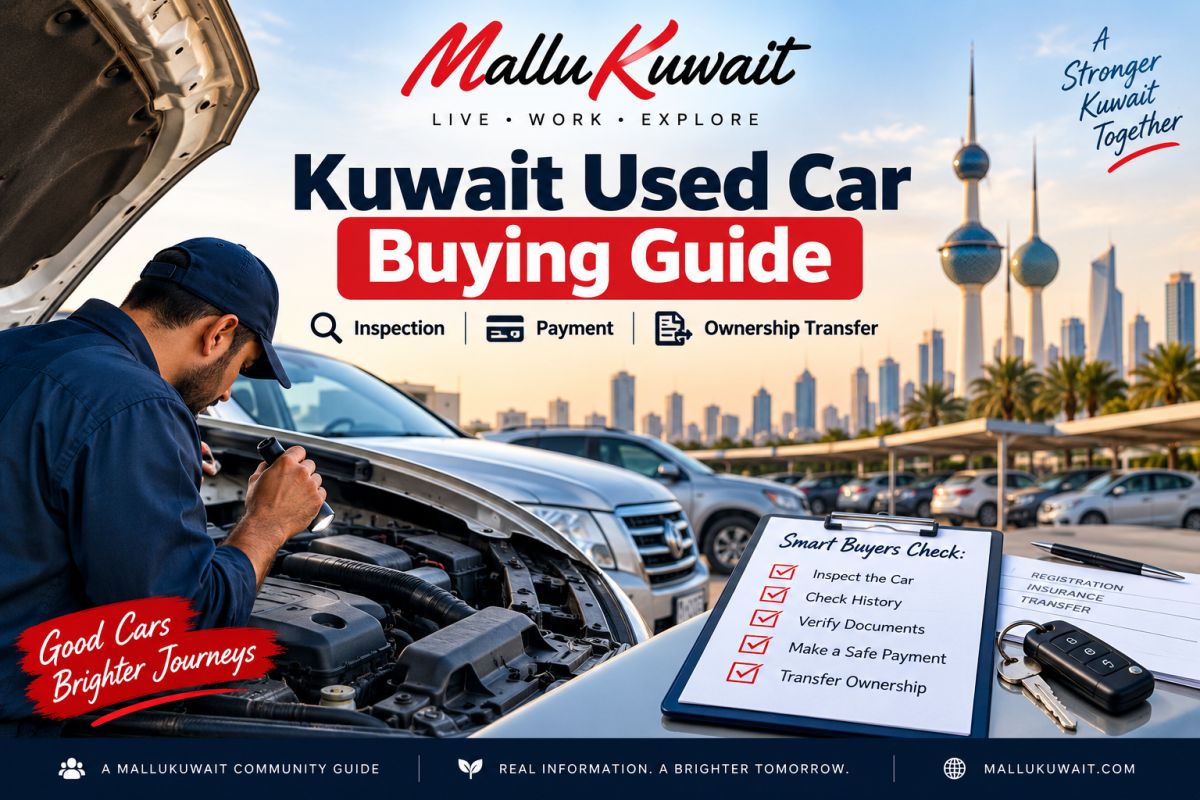
🚘 Kuwait Used Car Buying Guide: Inspection, Payment & Ownership Transfer
Buying a used car in Kuwait can save a substantial amount of money, but a low advertised price does not automatically mean a good deal.
A safe purchase has three separate parts: checking the car itself, protecting your payment and completing the official ownership transfer.
This guide takes you through that journey from the first advertisement to the moment the vehicle is officially registered in your name.
Do not judge the car from the advertisement
Photos can make almost any car look clean.
Treat the advertisement as an invitation to inspect the vehicle, not as proof of its condition.
Before travelling to see it, ask for:
exact model year
mileage
engine size and specification
registration status
accident or repair history
service history
number of owners if known
reason for selling
whether the seller is the registered owner
asking price
Keep a copy or screenshot of the original advertisement and important claims made by the seller.
Confirm who is actually selling the vehicle
Before paying anything significant, establish whether you are dealing with the registered owner or someone legitimately authorized to act for the owner.
Compare the seller's details with the vehicle's official documents during the transaction.
Be cautious if someone says:
the owner is unavailable
transfer can be done much later
you can simply keep driving under the old owner's registration
full payment must be made before you can verify the documents
official transfer is unnecessary
Possession of the keys is not the same as legal ownership.
Check the vehicle identification details
Verify the vehicle details against its documents.
Pay particular attention to:
chassis or VIN information
make
model
model year
registration details
plate information
Never buy a vehicle if identification markings appear altered, damaged or suspicious.
If something does not match, stop the transaction until it is properly explained and verified.
Inspect the car in daylight
Whenever possible, inspect a used vehicle during daylight.
Dark parking areas can hide:
paint differences
scratches
dents
panel gaps
glass damage
tyre condition
fluid leaks
Walk around the entire vehicle slowly before starting it.
A clean car can still have serious mechanical or accident-related problems.
Look for accident and body-repair signs
A repaired car is not automatically a bad car.
The important question is what was damaged and whether the repair was performed properly.
Look for:
inconsistent paint shades
overspray
unusual welding
uneven panel gaps
doors or bonnet that do not align properly
replaced lights with noticeably different ages
damaged mounting points
signs of chassis repair
Major structural damage deserves much more caution than a properly repaired cosmetic panel.
If you cannot evaluate structural repairs yourself, use an independent inspection.
Check the engine when it is cold
If practical, ask the seller not to warm the vehicle before you arrive.
A cold start can reveal problems that are less obvious once the engine is already warm.
Watch and listen for:
difficult starting
unusual knocking
excessive vibration
abnormal smoke
warning lights
fluid leaks
unstable idle
Do not diagnose an engine solely from one symptom.
If something concerns you, have a qualified workshop inspect it.
Check the gearbox carefully
Automatic transmission repairs can be expensive.
During the test drive, pay attention to:
delayed engagement
harsh shifting
slipping
unusual noises
vibration
warning messages
For a manual vehicle, check clutch operation and gear engagement.
A short drive around a parking area is not always enough to reveal drivetrain problems.
Kuwait makes the cooling system especially important
Kuwait's climate places heavy demand on a vehicle's cooling and air-conditioning systems.
Check:
engine temperature
radiator and coolant condition where safely accessible
cooling fans
visible coolant leaks
AC cooling
blower operation
unusual compressor noise
Test the AC properly rather than accepting that it "just needs gas."
Weak cooling can have several causes.
Inspect tyres, brakes and suspension
Check all tyres, not just the easiest one to see.
Look for:
uneven wear
cracks or damage
very old tyres
mismatched tyres
abnormal steering wear patterns
During a safe test drive, pay attention to braking, steering and suspension behaviour.
Listen for knocking or other unusual noises.
If the car pulls strongly to one side or the steering behaves abnormally, investigate before buying.
Test the electronics
Modern vehicles can contain expensive electronic systems.
Test as many functions as reasonably possible:
headlights
indicators
brake lights
power windows
central locking
mirrors
cameras
parking sensors
infotainment
dashboard display
seat controls
sunroof if fitted
AC controls
Do not assume a warning light is merely a cheap sensor.
Check dashboard warning lights properly
When the ignition is switched on, observe whether expected warning lamps illuminate and then behave normally after the engine starts.
Be suspicious if important warning indicators appear to have been deliberately hidden or disabled.
An electronic diagnostic scan can reveal useful information, but a scan alone is not a complete mechanical inspection.
Check mileage against the overall condition
The odometer number should make sense when compared with the rest of the vehicle.
Consider:
steering-wheel wear
pedal wear
seat wear
service records
previous inspection/service mileage
overall mechanical condition
Low displayed mileage is useful only when it is credible.
Do not accuse a seller of odometer manipulation without evidence, but investigate inconsistencies.
Ask for service and maintenance history
A well-maintained higher-mileage car can sometimes be a better purchase than a neglected lower-mileage one.
Ask for:
service invoices
dealer records if available
major repair invoices
tyre replacement history
battery history
transmission service
cooling-system work
accident-repair records
A missing service history does not prove a vehicle is bad, but it increases uncertainty.
Price that uncertainty into your decision.
Get an independent pre-purchase inspection
For a meaningful purchase, an independent inspection is one of the strongest protections available.
Ideally, use a workshop or inspection provider that is not financially dependent on the seller.
Ask them to check:
engine
transmission
chassis/body
suspension
brakes
cooling system
AC
electronics
diagnostic faults
leaks
tyres
road-test behaviour
The inspection cost can be tiny compared with discovering a major problem after purchase.
Do not let the seller choose your decision for you
A seller may recommend a workshop they regularly use.
That does not automatically mean the workshop is dishonest, but you should be comfortable with the independence of the inspection.
If the seller refuses any reasonable independent inspection, consider why.
You are allowed to walk away from a deal.
Estimate the real purchase cost
The purchase price is only part of the cost.
Before deciding, consider likely near-term expenses such as:
tyres
battery
brakes
scheduled servicing
insurance
registration-related costs
immediate repairs
major maintenance due soon
A KD 2,000 car requiring KD 500 of immediate work is not really a KD 2,000 purchase.
Check fines and transfer readiness
Before completing the ownership transfer, make sure the vehicle and parties are ready for the official process.
The General Traffic Department's published transfer procedure includes checking that there are no outstanding financial fines on the parties during the transfer process.
Do not leave unresolved transfer problems until after handing over the full purchase amount.
Insurance must be handled as part of the transfer
The official transfer procedure requires the vehicle's insurance document to be transferred from the old owner to the new owner.
In the Sahel electronic workflow, the buyer receives the request and pays the insurance-document transfer fee before the process returns to the seller.
Follow the current official instructions shown for your transaction.
Do not assume the seller's existing insurance automatically becomes yours without the required procedure.
Keep proof that you paid for the vehicle
The General Traffic Department has stated that proof of payment of the vehicle price is a basic requirement for ownership transfer.
Its published notice gives examples including:
copy of a cheque
receipt for a cash payment
bank certificate showing the transferred amount
This is also valuable protection for both buyer and seller.
Keep clear evidence showing what was paid and why.
Understand the Sahel ownership-transfer process
MOI has introduced electronic vehicle ownership transfer through the Sahel application.
According to the General Traffic Department's published workflow:
the seller starts a new vehicle-transfer request
the seller selects the vehicle
the seller enters the new owner's Civil ID number
the buyer receives a notification
the buyer approves the transfer procedure
the buyer pays the insurance-document transfer fee
the seller receives the next notification
the seller confirms receiving the vehicle price
the seller pays the ownership-transfer fee
the buyer receives the completed request
the buyer downloads the new electronic vehicle licence
The buyer can then add the new vehicle licence to the digital wallet in Kuwait Mobile ID.
Do not confuse handing over the car with transferring ownership
Keys, cash and a signed private note do not by themselves replace the official ownership-transfer process.
Complete the applicable official transfer procedure.
From the buyer's perspective, the goal is not merely to drive away with the car.
The goal is to have the vehicle officially transferred into the buyer's name.
Be careful with deposits
Sometimes a seller may request a deposit to hold a vehicle.
Before paying one, establish in writing:
vehicle details
deposit amount
agreed purchase price
whether the deposit is refundable
circumstances for refund
expected transfer date
seller identity
Avoid large informal deposits to strangers when the vehicle or documents have not been properly verified.
Avoid pressure-payment tactics
Be cautious if you hear:
"Many buyers are coming right now."
"Transfer later, pay today."
"No need for inspection."
"Give cash and take the car."
"The ownership document will be fixed later."
"Do not worry about the warning light."
A genuinely good vehicle can still be sold quickly, but urgency should not remove basic verification.
Keep a simple record of the transaction
Keep copies or records of relevant transaction information.
Depending on the transaction, this can include:
advertisement
seller communication
inspection report
agreed price
payment evidence
transfer confirmations
insurance documents
new vehicle registration
important repair/service records received from seller
Store these safely after the purchase.
Verify the new electronic vehicle licence
After completing the Sahel ownership-transfer process, MOI's published instructions say the buyer can download the new electronic vehicle licence and then add it to Kuwait Mobile ID's digital wallet.
Check that the vehicle information is correct.
Do not simply assume the transfer completed because money changed hands.
Before you drive away
Complete a final check:
□ vehicle inspected
□ VIN/chassis details checked
□ seller/ownership details checked
□ agreed price confirmed
□ payment evidence retained
□ insurance transfer completed as required
□ official ownership transfer completed
□ new registration verified
□ keys received
□ spare key received if included
□ service records received if included
□ personal belongings from previous owner removed
□ immediate mechanical issues understood
Do not let excitement make you skip the final paperwork.
After buying the car
During the first days of ownership, consider establishing your own maintenance baseline.
Depending on the vehicle and available service history, this may include checking:
engine oil
filters
fluids
tyres
brakes
battery
coolant
AC performance
upcoming scheduled maintenance
Keep your own records from this point forward.
Official references
Kuwait Ministry of Interior — General Traffic Department:
https://www.moi.gov.kw/main/eservices/gdt
GDT Vehicle Ownership Transfer Procedure:
https://www.moi.gov.kw/main/eservices/gdt/procedures/105
MOI — Sahel Vehicle Ownership Transfer:
https://www.moi.gov.kw/gdt/traffic-news/details/53214
MOI — Proof of Vehicle Payment Requirement:
https://moi.gov.kw/gdt/traffic-news/details/42422
🚗 Buying a Used Car in Kuwait: 7 Things to Check Before Paying
🚗 Kuwait Driving Licence Guide: Eligibility, Application, Tests & Renewal
MalluKuwait is an independent community platform and does not represent the Kuwait Ministry of Interior, General Traffic Department or any Kuwait government authority. Vehicle-transfer procedures, fees, insurance requirements and electronic services can change. Mechanical inspection guidance in this article is general buyer-safety information, not a government inspection or guarantee of a vehicle's condition. Confirm current official requirements before paying for or transferring a vehicle.
💬 Comments (0)
💬
No comments yet. Be the first to comment!
