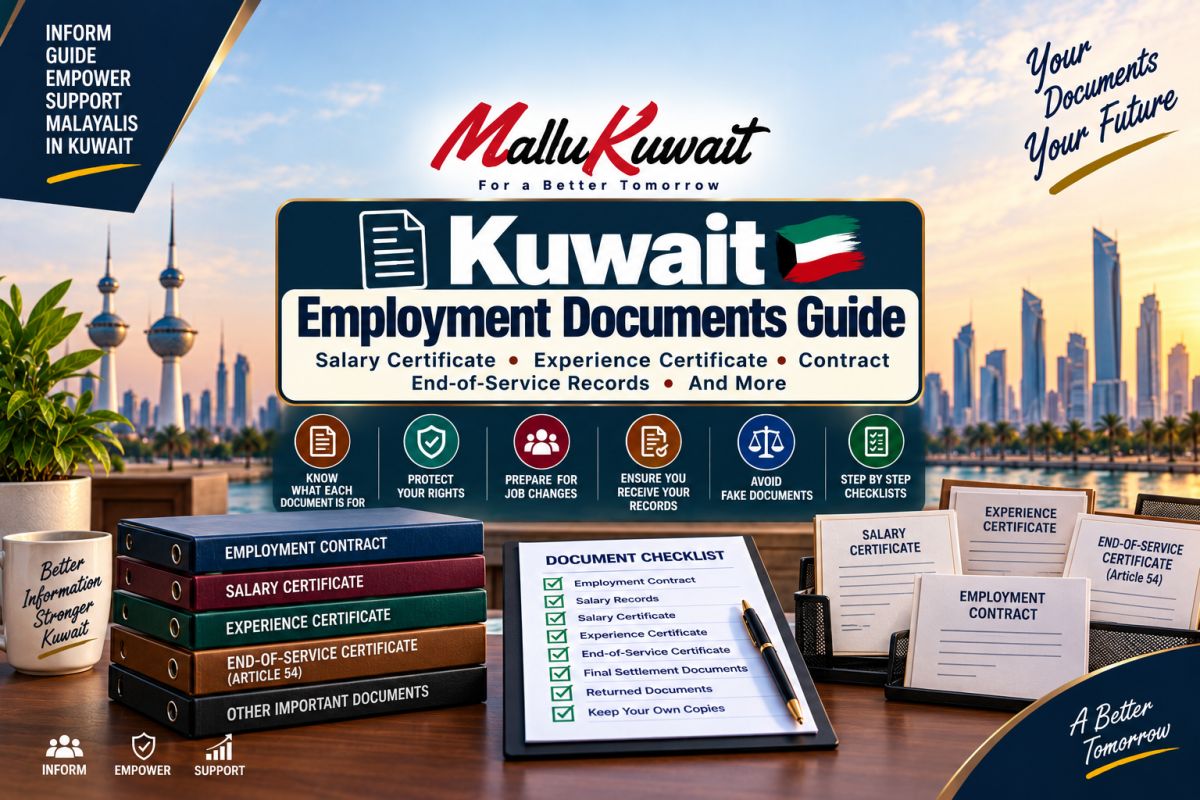
📄 Kuwait Employment Documents Guide: Salary Certificate, Experience Certificate, Contract & End-of-Service Records
Employment documents can become extremely important when you change jobs, apply for a bank service, rent a property, deal with an official procedure, calculate your final settlement or leave Kuwait.
Many workers only start looking for these documents after they urgently need them.
A better approach is to understand what each document proves and maintain your own employment record throughout your time in Kuwait.
This guide explains salary certificates, employment certificates, contracts, salary records, experience records and the end-of-service certificate provided for under Article 54 of Kuwait's Private Sector Labour Law.
Why employment documents matter
Different documents prove different things.
Depending on the document and the receiving organization, employment records may help establish:
who employs you
your job title
your salary
when employment started
how long you worked
the nature of your work
your last wage
whether employment has ended
amounts paid to you
Do not assume one certificate can replace every other document.
What is a salary certificate?
A salary certificate is generally an employer-issued document confirming employment and salary information for a particular purpose.
Organizations may request one for matters such as:
banking
financing
housing or rental requirements
administrative procedures
other employment verification
The exact information and format required can depend on the organization requesting it.
Do not confuse an employer's salary certificate with the statutory end-of-service certificate addressed by Article 54 of Kuwait's Private Sector Labour Law. They can serve different purposes.
What may appear on a salary certificate?
Depending on the employer and purpose, a salary certificate may contain information such as:
employee name
employee number
job title
department
employment start date
basic salary
allowances
total salary
employer information
certificate date
authorized signature or verification
The receiving organization may require particular wording or information.
Ask the receiving organization what it needs
Before requesting a certificate from HR, find out what the organization receiving it actually requires.
Ask whether it needs:
salary certificate
employment certificate
salary transfer certificate
recent payslips
bank statements
employment contract
another specific document
This can prevent repeated HR requests.
Do not assume every salary certificate has the same format
A certificate requested by a bank may not necessarily be identical to one requested for another purpose.
Check:
required language
required salary breakdown
addressee
issue-date requirements
validity period imposed by the receiving organization
signature or verification requirements
These are often procedural requirements of the organization requesting the certificate rather than universal Labour Law rules.
Check the certificate before using it
Before submitting an employment document, verify:
□ Your name is correct
□ Job title is correct
□ Employer name is correct
□ Salary information is correct
□ Employment date is correct where shown
□ Certificate date is correct
□ Any required addressee is correct
□ No important information is missing
Ask for correction if there is a genuine error.
Keep your employment contract
Your employment contract is one of your core employment records.
Article 28 of Kuwait's Private Sector Labour Law addresses employment contracts and specifies information including:
date of signing
effective date
wage
duration where the contract is for a limited period
nature of work
The law also addresses written contract copies.
Check your contract information
When you receive your contract, review important details including:
□ Employer
□ Job
□ Wage
□ Contract duration where applicable
□ Effective date
□ Relevant employment terms
Keep your own copy securely.
Contract salary and actual payments
Your contract is important, but it is also wise to maintain records of salary actually received.
Depending on your circumstances, useful records can include:
bank statements
salary-transfer records
payslips
employer payroll statements
legitimate written correspondence concerning salary
These can help establish a payment history if a disagreement later arises.
Keep salary records regularly
Do not wait until a dispute begins.
Maintain an organized monthly record where practical.
For example:
2026-01 — salary record
2026-02 — salary record
2026-03 — salary record
This makes it much easier to review missing or unusual payments later.
Salary certificate and payslip are not the same thing
A salary certificate generally confirms employment/salary information.
A payslip generally records the salary calculation for a particular pay period.
A bank statement records transactions through the bank.
These documents can support different questions and should not automatically be treated as interchangeable.
What if your salary record appears wrong?
Compare:
employment contract
payslip/payroll statement
bank payment
approved allowances where applicable
relevant HR correspondence
If there is a discrepancy, ask payroll or HR for clarification in writing.
Keep records of approved changes
Employment terms can change during a person's service.
Where applicable, preserve legitimate records concerning:
promotion
salary revision
job-title change
department transfer
approved allowance changes
contract renewal
employer transfer
Do not rely entirely on memory.
What is an experience certificate?
The phrase "experience certificate" is commonly used for a document describing a person's employment history or work experience.
The exact format can vary between employers.
It should not automatically be treated as legally identical to every other employment certificate.
Article 54 provides an important statutory certificate right
When a worker's employment contract ends, Article 54 of Kuwait's Private Sector Labour Law provides that the worker may obtain an end-of-service certificate from the employer.
The certificate states:
period of service
profession/work performed
last wage received
This is a particularly important document when employment ends.
Article 54 protects the worker from harmful wording
Article 54 also provides protection concerning the contents of the certificate.
The employer must not include statements that may harm the worker or reduce the worker's opportunities for future employment.
This makes the Article 54 certificate more than a casual reference letter.
Request the Article 54 certificate when employment ends
If you are leaving an employer, include this in your exit checklist.
Ask for your end-of-service certificate and verify:
□ Service period
□ Work/profession
□ Last wage
Keep the original securely.
Article 54 also covers return of deposited documents
Article 54 further requires the employer to return documents, certificates and tools deposited by the worker.
This may be important for originals that were given to the employer during employment.
Make a document-return checklist
Before leaving employment, identify originals that may be held by the employer.
Depending on your situation:
□ Educational certificates
□ Professional certificates
□ Training certificates
□ Other deposited originals
□ Personal documents held for processing
□ Other property/documents you are entitled to receive back
Keep a record of your request.
Final settlement documents
When employment ends, keep records connected with the final settlement.
Depending on your circumstances, these may include:
final salary calculation
unused leave calculation
indemnity calculation
notice-related calculation
approved deductions
payment confirmation
settlement correspondence
end-of-service certificate
Do not rely only on a verbal explanation of the final amount.
Keep your resignation documents
If you resign, preserve:
resignation letter
date submitted
acknowledgment
notice-period correspondence
final working date
settlement records
document-return correspondence
These records can help establish the timeline later.
Keep your termination documents
If the employer terminates the employment relationship, preserve:
termination notice
stated reason where provided
notice information
final working date
final settlement
document-return correspondence
Article 54 certificate
Keep leave records
Leave can affect questions involving:
remaining annual leave
leave salary
final settlement
absence records
Maintain relevant approved leave records rather than relying solely on recollection.
Keep overtime records where relevant
Where overtime is relevant to your work, preserve legitimate records that may help establish:
dates
hours
approvals/orders
payroll treatment
payments received
Do not create or alter evidence after a dispute begins.
Keep work-permit and residence-related records
Expatriate employment in Kuwait can also involve documents administered through government systems.
Where appropriate, keep your own lawful copies or records of relevant:
work-permit information
residence information
Civil ID information
passport information
official transaction references
Do not publicly share these documents.
Use Kuwait Mobile ID and Sahel carefully
Official digital services can make government information easier to access.
Keep your account and authentication information private.
Never give another person:
OTP codes
passwords
authentication approvals you do not understand
banking credentials
Protect sensitive employment records
Employment files can contain significant personal information.
Avoid publicly posting unredacted copies of:
Civil ID
passport
salary certificate
bank statement
employment contract
signatures
phone numbers
addresses
government reference numbers
Share sensitive information only when genuinely necessary and through an appropriate channel.
Keep personal records separate from confidential company information
Keeping documents about your own employment does not mean taking confidential material belonging to the employer.
Do not improperly copy:
customer data
patient information
company trade secrets
internal credentials
confidential files unrelated to your employment record
Keep only records you are lawfully entitled to possess.
What if HR refuses to correct an obvious error?
First identify the error clearly.
For example:
"The salary shown on this certificate does not match the current salary information. Please review and correct it."
Preserve the request and response.
Do not alter the certificate yourself.
Never edit an employer-issued certificate
Do not change:
salary
job title
employment dates
signature
company stamp
certificate number
wording
If information is incorrect, request a corrected document from the issuer.
An altered employment certificate can create serious problems.
Verify documents before submitting them
If a bank, government authority or another organization requests an employment document, confirm its current requirements directly with that organization.
Requirements may change.
Do not rely solely on an old social-media post showing what another person submitted previously.
Do not pay strangers for fake employment documents
Avoid anyone offering:
fake salary certificates
fake experience certificates
altered contracts
fake company stamps
false salary records
fabricated employment history
False documents can create employment, financial and legal consequences.
Create your personal employment archive
A simple folder structure can help.
Employment Contract
Salary Records
Salary Certificates
Leave
Overtime
HR Letters
Work Permit & Residence
Resignation or Termination
Final Settlement
Article 54 Certificate
Returned Documents
Keep digital copies securely and protect sensitive information.
Before changing employers
Before changing jobs, consider checking that you have the records you may reasonably need from the current employment relationship.
This may include:
□ Contract
□ Salary records
□ Relevant HR letters
□ Approved leave records
□ Employment-change documents
□ Copies of important personal employment records
Do not wait until access to an old HR portal or company email has ended.
Before leaving Kuwait or finishing employment
Consider this final document check:
□ Passport/personal originals returned where applicable
□ Employment contract copy retained
□ Salary records retained
□ Final settlement checked
□ End-of-service certificate requested
□ Deposited documents returned
□ Resignation/termination records retained
□ Relevant official employment/residence records checked
This can save considerable difficulty later.
What if important employment documents are not returned?
Make a clear written request.
Identify exactly what you are requesting.
Keep:
request date
document name
person/department contacted
employer response
proof the original was deposited where available
If an employment dispute remains unresolved, check the current Public Authority for Manpower complaint procedure.
Employment document master checklist
During employment:
□ Employment contract
□ Salary/payment records
□ Salary certificates when issued
□ Approved salary revisions
□ Relevant HR letters
□ Leave records
□ Overtime records where applicable
□ Work-permit/residence records where appropriate
When employment ends:
□ Resignation or termination record
□ Final salary record
□ Leave settlement
□ Indemnity calculation
□ Final settlement record
□ Article 54 end-of-service certificate
□ Deposited documents returned
□ Important personal originals returned
Official references
Use official Kuwait sources when checking current labour rules and procedures.
Important Legal Disclaimer
This guide provides general informational and educational material.
It is not:
legal advice
financial advice
immigration advice
a guarantee that an employer must issue every type of salary or experience certificate on demand
a statement that every organization accepts the same certificate format
an official interpretation of an individual employment dispute
The Article 54 end-of-service certificate described in this guide is a statutory employment-ending certificate and should not automatically be treated as identical to every salary certificate, bank letter, experience letter or HR document used in practice.
Document requirements imposed by banks, employers, government authorities and other organizations can change.
Always verify the current requirements with the organization requesting the document and use current official Kuwait sources for labour procedures.
MalluKuwait does not represent the Public Authority for Manpower, Ministry of Interior, Kuwait Government Online, any bank, employer, court or other government/private organization. Individual rights and procedures depend on the applicable law and facts.
Kuwait Final Settlement Guide
Kuwait Passport & Personal Documents Guide
Kuwait Employment Contract Guide
💬 Comments (0)
💬
No comments yet. Be the first to comment!
