📰 MalluPost
Community stories, news & updates

📄 Kuwait Employment Documents Guide: Salary Certificate, Experience Certificate, Contract & End-of-Service Records
Employment documents can become extremely important when you change jobs, apply for a bank service, rent a property, deal with an official procedure, calculate your final settlement or leave Kuwait. Many workers only start looking for these documents after they urgently need them. A better approach is to understand what each document proves and maintain your own employment record throughout your time in Kuwait. This guide explains salary certificates, employment certificates, contracts, salary records, experience records and the end-of-service certificate provided for under Article 54 of Kuwait's Private Sector Labour Law. 1. Why employment documents matter Different documents prove different things. Depending on the document and the receiving organization, employment records may help establish: • who employs you • your job title • your salary • when employment started • how long you worked • the nature of your work • your last wage • whether employment has ended • amounts paid to you Do not assume one certificate can replace every other document. 2. What is a salary certificate? A salary certificate is generally an employer-issued document confirming employment and salary information for a particular purpose. Organizations may request one for matters such as: • banking • financing • housing or rental requirements • administrative procedures • other employment verification The exact information and format required can depend on the organization requesting it. Important: Do not confuse an employer's salary certificate with the statutory end-of-service certificate addressed by Article 54 of Kuwait's Private Sector Labour Law. They can serve different purposes. 3. What may appear on a salary certificate? Depending on the employer and purpose, a salary certificate may contain information such as: • employee name • employee number • job title • department • employment start date • basic salary • allowances • total salary • employer information • certificate date • authorized signature or verification The receiving organization may require particular wording or information. 4. Ask the receiving organization what it needs Before requesting a certificate from HR, find out what the organization receiving it actually requires. Ask whether it needs: • salary certificate • employment certificate • salary transfer certificate • recent payslips • bank statements • employment contract • another specific document This can prevent repeated HR requests. 5. Do not assume every salary certificate has the same format A certificate requested by a bank may not necessarily be identical to one requested for another purpose. Check: • required language • required salary breakdown • addressee • issue-date requirements • validity period imposed by the receiving organization • signature or verification requirements These are often procedural requirements of the organization requesting the certificate rather than universal Labour Law rules. 6. Check the certificate before using it Before submitting an employment document, verify: □ Your name is correct □ Job title is correct □ Employer name is correct □ Salary information is correct □ Employment date is correct where shown □ Certificate date is correct □ Any required addressee is correct □ No important information is missing Ask for correction if there is a genuine error. 7. Keep your employment contract Your employment contract is one of your core employment records. Article 28 of Kuwait's Private Sector Labour Law addresses employment contracts and specifies information including: • date of signing • effective date • wage • duration where the contract is for a limited period • nature of work The law also addresses written contract copies. [ACTION] type=official label=Kuwait Government Online — Labour Law url=https://www.e.gov.kw/sites/kgoarabic/Pages/ApplicationPages/LaborLaw.aspx [/ACTION] 8. Check your contract information When you receive your contract, review important details including: □ Employer □ Job □ Wage □ Contract duration where applicable □ Effective date □ Relevant employment terms Keep your own copy securely. [ACTION] type=service label=📄 Read Kuwait Employment Contract Guide url=https://mallukuwait.com/mallupost/kuwait-employment-contract-guide-before-signing-salary-probation-rights [/ACTION] 9. Contract salary and actual payments Your contract is important, but it is also wise to maintain records of salary actually received. Depending on your circumstances, useful records can include: • bank statements • salary-transfer records • payslips • employer payroll statements • legitimate written correspondence concerning salary These can help establish a payment history if a disagreement later arises. 10. Keep salary records regularly Do not wait until a dispute begins. Maintain an organized monthly record where practical. For example: 2026-01 — salary record 2026-02 — salary record 2026-03 — salary record This makes it much easier to review missing or unusual payments later. 11. Salary certificate and payslip are not the same thing A salary certificate generally confirms employment/salary information. A payslip generally records the salary calculation for a particular pay period. A bank statement records transactions through the bank. These documents can support different questions and should not automatically be treated as interchangeable. 12. What if your salary record appears wrong? Compare: • employment contract • payslip/payroll statement • bank payment • approved allowances where applicable • relevant HR correspondence If there is a discrepancy, ask payroll or HR for clarification in writing. [ACTION] type=service label=💰 Read Kuwait Salary & Wage Rights Guide url=https://mallukuwait.com/mallupost/kuwait-salary-wage-rights-payment-delay-deductions-guide [/ACTION] 13. Keep records of approved changes Employment terms can change during a person's service. Where applicable, preserve legitimate records concerning: • promotion • salary revision • job-title change • department transfer • approved allowance changes • contract renewal • employer transfer Do not rely entirely on memory. 14. What is an experience certificate? The phrase "experience certificate" is commonly used for a document describing a person's employment history or work experience. The exact format can vary between employers. It should not automatically be treated as legally identical to every other employment certificate. 15. Article 54 provides an important statutory certificate right When a worker's employment contract ends, Article 54 of Kuwait's Private Sector Labour Law provides that the worker may obtain an end-of-service certificate from the employer. The certificate states: • period of service • profession/work performed • last wage received This is a particularly important document when employment ends. 16. Article 54 protects the worker from harmful wording Article 54 also provides protection concerning the contents of the certificate. The employer must not include statements that may harm the worker or reduce the worker's opportunities for future employment. This makes the Article 54 certificate more than a casual reference letter. 17. Request the Article 54 certificate when employment ends If you are leaving an employer, include this in your exit checklist. Ask for your end-of-service certificate and verify: □ Service period □ Work/profession □ Last wage Keep the original securely. 18. Article 54 also covers return of deposited documents Article 54 further requires the employer to return documents, certificates and tools deposited by the worker. This may be important for originals that were given to the employer during employment. [ACTION] type=service label=🛂 Read Passport & Personal Documents Guide url=https://mallukuwait.com/mallupost/kuwait-employer-keeping-passport-personal-documents-employee-rights [/ACTION] 19. Make a document-return checklist Before leaving employment, identify originals that may be held by the employer. Depending on your situation: □ Educational certificates □ Professional certificates □ Training certificates □ Other deposited originals □ Personal documents held for processing □ Other property/documents you are entitled to receive back Keep a record of your request. 20. Final settlement documents When employment ends, keep records connected with the final settlement. Depending on your circumstances, these may include: • final salary calculation • unused leave calculation • indemnity calculation • notice-related calculation • approved deductions • payment confirmation • settlement correspondence • end-of-service certificate Do not rely only on a verbal explanation of the final amount. [ACTION] type=service label=💼 Read Kuwait Final Settlement Guide url=https://mallukuwait.com/mallupost/kuwait-final-settlement-guide-salary-leave-indemnity-documents [/ACTION] 21. Keep your resignation documents If you resign, preserve: • resignation letter • date submitted • acknowledgment • notice-period correspondence • final working date • settlement records • document-return correspondence These records can help establish the timeline later. [ACTION] type=service label=🚪 Read Kuwait Resignation Guide url=https://mallukuwait.com/mallupost/kuwait-resignation-guide-notice-period-final-settlement-rights [/ACTION] 22. Keep your termination documents If the employer terminates the employment relationship, preserve: • termination notice • stated reason where provided • notice information • final working date • final settlement • document-return correspondence • Article 54 certificate [ACTION] type=service label=⚠️ Read Kuwait Termination Guide url=https://mallukuwait.com/mallupost/kuwait-termination-guide-dismissal-notice-employee-rights [/ACTION] 23. Keep leave records Leave can affect questions involving: • remaining annual leave • leave salary • final settlement • absence records Maintain relevant approved leave records rather than relying solely on recollection. [ACTION] type=service label=🏖️ Read Kuwait Annual Leave Guide url=https://mallukuwait.com/mallupost/kuwait-annual-leave-guide-30-days-six-month-rule-leave-salary [/ACTION] 24. Keep overtime records where relevant Where overtime is relevant to your work, preserve legitimate records that may help establish: • dates • hours • approvals/orders • payroll treatment • payments received Do not create or alter evidence after a dispute begins. [ACTION] type=service label=⏱️ Read Kuwait Overtime Guide url=https://mallukuwait.com/mallupost/kuwait-overtime-pay-calculation-rest-day-holiday-guide [/ACTION] 25. Keep work-permit and residence-related records Expatriate employment in Kuwait can also involve documents administered through government systems. Where appropriate, keep your own lawful copies or records of relevant: • work-permit information • residence information • Civil ID information • passport information • official transaction references Do not publicly share these documents. 26. Use Kuwait Mobile ID and Sahel carefully Official digital services can make government information easier to access. Keep your account and authentication information private. Never give another person: • OTP codes • passwords • authentication approvals you do not understand • banking credentials [ACTION] type=official label=Kuwait Government Online url=https://www.e.gov.kw/ [/ACTION] 27. Protect sensitive employment records Employment files can contain significant personal information. Avoid publicly posting unredacted copies of: • Civil ID • passport • salary certificate • bank statement • employment contract • signatures • phone numbers • addresses • government reference numbers Share sensitive information only when genuinely necessary and through an appropriate channel. 28. Keep personal records separate from confidential company information Keeping documents about your own employment does not mean taking confidential material belonging to the employer. Do not improperly copy: • customer data • patient information • company trade secrets • internal credentials • confidential files unrelated to your employment record Keep only records you are lawfully entitled to possess. 29. What if HR refuses to correct an obvious error? First identify the error clearly. For example: "The salary shown on this certificate does not match the current salary information. Please review and correct it." Preserve the request and response. Do not alter the certificate yourself. 30. Never edit an employer-issued certificate Do not change: • salary • job title • employment dates • signature • company stamp • certificate number • wording If information is incorrect, request a corrected document from the issuer. An altered employment certificate can create serious problems. 31. Verify documents before submitting them If a bank, government authority or another organization requests an employment document, confirm its current requirements directly with that organization. Requirements may change. Do not rely solely on an old social-media post showing what another person submitted previously. 32. Do not pay strangers for fake employment documents Avoid anyone offering: • fake salary certificates • fake experience certificates • altered contracts • fake company stamps • false salary records • fabricated employment history False documents can create employment, financial and legal consequences. 33. Create your personal employment archive A simple folder structure can help. Employment Contract Salary Records Salary Certificates Leave Overtime HR Letters Work Permit & Residence Resignation or Termination Final Settlement Article 54 Certificate Returned Documents Keep digital copies securely and protect sensitive information. 34. Before changing employers Before changing jobs, consider checking that you have the records you may reasonably need from the current employment relationship. This may include: □ Contract □ Salary records □ Relevant HR letters □ Approved leave records □ Employment-change documents □ Copies of important personal employment records Do not wait until access to an old HR portal or company email has ended. [ACTION] type=service label=🔄 Read Kuwait Changing Jobs Guide url=https://mallukuwait.com/mallupost/changing-jobs-kuwait-article-18-transfer-employer-guide [/ACTION] 35. Before leaving Kuwait or finishing employment Consider this final document check: □ Passport/personal originals returned where applicable □ Employment contract copy retained □ Salary records retained □ Final settlement checked □ End-of-service certificate requested □ Deposited documents returned □ Resignation/termination records retained □ Relevant official employment/residence records checked This can save considerable difficulty later. 36. What if important employment documents are not returned? Make a clear written request. Identify exactly what you are requesting. Keep: • request date • document name • person/department contacted • employer response • proof the original was deposited where available If an employment dispute remains unresolved, check the current Public Authority for Manpower complaint procedure. [ACTION] type=official label=Public Authority for Manpower url=https://www.manpower.gov.kw/ [/ACTION] [ACTION] type=service label=⚖️ Read Kuwait Labour Complaint Guide url=https://mallukuwait.com/mallupost/kuwait-labour-complaint-guide-file-complaint-employee-rights [/ACTION] 37. Employment document master checklist During employment: □ Employment contract □ Salary/payment records □ Salary certificates when issued □ Approved salary revisions □ Relevant HR letters □ Leave records □ Overtime records where applicable □ Work-permit/residence records where appropriate When employment ends: □ Resignation or termination record □ Final salary record □ Leave settlement □ Indemnity calculation □ Final settlement record □ Article 54 end-of-service certificate □ Deposited documents returned □ Important personal originals returned 38. Official references Use official Kuwait sources when checking current labour rules and procedures. [ACTION] type=official label=Public Authority for Manpower url=https://www.manpower.gov.kw/ [/ACTION] [ACTION] type=official label=Kuwait Government Online — Labour Law url=https://www.e.gov.kw/sites/kgoarabic/Pages/ApplicationPages/LaborLaw.aspx [/ACTION] 39. Important Legal Disclaimer This guide provides general informational and educational material. It is not: • legal advice • financial advice • immigration advice • a guarantee that an employer must issue every type of salary or experience certificate on demand • a statement that every organization accepts the same certificate format • an official interpretation of an individual employment dispute The Article 54 end-of-service certificate described in this guide is a statutory employment-ending certificate and should not automatically be treated as identical to every salary certificate, bank letter, experience letter or HR document used in practice. Document requirements imposed by banks, employers, government authorities and other organizations can change. Always verify the current requirements with the organization requesting the document and use current official Kuwait sources for labour procedures. Important: MalluKuwait does not represent the Public Authority for Manpower, Ministry of Interior, Kuwait Government Online, any bank, employer, court or other government/private organization. Individual rights and procedures depend on the applicable law and facts. [RELATED] title=Kuwait Final Settlement Guide slug=kuwait-final-settlement-guide-salary-leave-indemnity-documents [/RELATED] [RELATED] title=Kuwait Passport & Personal Documents Guide slug=kuwait-employer-keeping-passport-personal-documents-employee-rights [/RELATED] [RELATED] title=Kuwait Employment Contract Guide slug=kuwait-employment-contract-guide-before-signing-salary-probation-rights [/RELATED]

🛂 Kuwait Passport & Personal Documents Guide: Can Your Employer Keep Your Passport?
Your passport is one of your most important personal documents. For expatriate workers in Kuwait it may be needed for travel, identification and official residence procedures. A common question is: "Can my employer keep my passport?" For workers in Kuwait's private and oil sectors, the applicable manpower regulations contain a prohibition on employers retaining workers' travel documents. But there is an important distinction between an employer keeping a passport as a continuing practice and temporarily receiving the original document because it is genuinely required for a specific official government procedure. This guide explains that distinction, what workers should document, Article 54 rights when employment ends, and what to do if personal documents are not returned. 1. Who is this guide for? This guide primarily discusses workers covered by Kuwait's private-sector employment framework. Different rules can apply to: • domestic workers • government employees • diplomatic employment • other special employment categories Do not automatically apply one employment regime to another. Important: This article provides general information. The correct authority and procedure can depend on the worker's employment category, residence status, document involved and facts of the dispute. 2. Can a private-sector employer keep a worker's passport? Public Authority for Manpower regulations concerning private-sector and oil-sector employment prohibit employers from retaining workers' travel documents. A passport should therefore not simply be treated as ordinary company property that an employer may keep indefinitely because the person works for the company. 3. Your passport and your employment file are different things An employer may legitimately need passport information for employment and residence administration. That can involve: • passport number • expiry date • nationality information • passport copy • information required for work-permit or residence procedures Needing passport information does not automatically mean the employer has a general right to retain the worker's original passport continuously. 4. Some official procedures require an original passport This distinction is important. Kuwait Government Online currently lists the original passport among required documents for certain residence transactions, including Article 18 residence procedures. Therefore an employer or authorized representative may sometimes need the original passport for a genuine official transaction. That is different from keeping it indefinitely. 5. Ask why the original passport is required If HR or the company requests your original passport, it is reasonable to ask: • Which government procedure is this for? • Which authority requires it? • When will it be submitted? • When should it be returned? • Can I have acknowledgment that it was received? This keeps the process clear for both sides. 6. Keep a record when handing over an original If you give an original passport to the employer for an official process, keep a simple record where possible. Record: • date handed over • person or department receiving it • stated purpose • government procedure involved • expected return date • date actually returned A written acknowledgment, email or HR receipt can be useful. 7. Keep a passport copy yourself Maintain a secure copy of: • passport identification page • passport number • issue date • expiry date • relevant residence information where applicable Do not publish these details publicly or send them unnecessarily to strangers. 8. What if the employer says "company policy"? Internal company policy does not replace applicable Kuwait law or manpower regulations. If an employer retains a travel document and refuses to return it, the worker should not assume that the practice becomes lawful simply because it is described as company policy. 9. What if I previously handed it over voluntarily? A worker may have originally handed a passport to HR for administration or safekeeping. If the worker later requests its return and a dispute develops, the exact circumstances matter. Do not turn the issue into a physical confrontation. Make a clear written request for return and preserve the response. 10. Make the first request simple A useful first message can be factual: "Please return my original passport. If it is currently required for an official government transaction, please confirm the procedure and expected return date." This creates a clear record without unnecessary accusations. 11. If there is no response Follow up in writing. Record: • date of first request • follow-up date • person contacted • response received • reason given for continued retention • any promised return date Screenshots or emails should be preserved in their original form where possible. 12. Do not manufacture evidence Never alter: • messages • emails • receipts • passport copies • dates • HR correspondence • government documents Authentic records are far more valuable than edited evidence. 13. What about the Civil ID? Civil ID and passport are different documents governed by different administrative systems. Do not assume that every rule concerning a passport automatically applies identically to every other identity document. If an employer has your original Civil ID and refuses to return it, document the situation and obtain current guidance from the competent authority. 14. What about educational certificates? Workers sometimes provide original: • degree certificates • diplomas • professional certificates • training certificates • experience certificates for employment or official processing. Keep a record whenever an original is handed over. 15. Article 54 becomes especially important when employment ends Article 54 of Kuwait's private-sector Labour Law provides important document protections when the employment relationship ends. The worker is entitled to an end-of-service certificate containing information including: • period of service • profession/work performed • last wage received The certificate must not contain expressions that may harm the worker or reduce opportunities for future employment. 16. Article 54 also requires return of deposited documents Article 54 further requires the employer to return documents, certificates and tools deposited by the worker. This is important where the employer is holding originals connected with the employment relationship. 17. Ask for your documents before your final day Before leaving employment, prepare a document checklist. Depending on your situation: □ Passport □ Civil ID if held for processing □ Educational certificates □ Professional certificates □ Experience documents □ Other originals deposited with employer □ End-of-service certificate □ Final-settlement documents □ Copies of relevant employment records Do not wait several months after leaving if you already know important originals are held by the employer. 18. Ask for an end-of-service certificate Article 54 gives a worker whose employment contract ends the right to request an end-of-service certificate. This can be useful when applying for another job or documenting previous employment. [ACTION] type=service label=💼 Read Kuwait Final Settlement Guide url=https://mallukuwait.com/mallupost/kuwait-final-settlement-guide-salary-leave-indemnity-documents [/ACTION] 19. Passport return and final settlement are separate issues Do not assume your passport should remain held simply because: • final salary is being calculated • indemnity is being calculated • the company is preparing clearance • another financial dispute exists A financial/employment dispute and possession of a travel document should be considered according to their own applicable rules. 20. What if the employer says you owe money? Do not attempt to resolve a disputed debt by surrendering control of important personal documents indefinitely. Ask for: • written explanation of the claimed amount • calculation • supporting records Then deal with the financial dispute through the appropriate employment/legal process. [ACTION] type=service label=💰 Read Kuwait Salary & Wage Rights Guide url=https://mallukuwait.com/mallupost/kuwait-salary-wage-rights-payment-delay-deductions-guide [/ACTION] 21. What if you resigned? Keep: • resignation letter • proof of submission • notice-period correspondence • passport-return request • document-return request • final-settlement records The resignation process does not make your personal documents ordinary employer property. [ACTION] type=service label=🚪 Read Kuwait Resignation Guide url=https://mallukuwait.com/mallupost/kuwait-resignation-guide-notice-period-final-settlement-rights [/ACTION] 22. What if you were terminated? Preserve: • termination letter • stated reason • document-return request • passport-return request • settlement calculation • relevant HR correspondence Article 54 document-return rights are particularly relevant once the employment relationship has ended. [ACTION] type=service label=⚠️ Read Kuwait Termination Guide url=https://mallukuwait.com/mallupost/kuwait-termination-guide-dismissal-notice-employee-rights [/ACTION] 23. What if the employer refuses to return the passport? Create a clear record first. Document: • that the employer possesses the passport • when it was handed over • why it was handed over • when return was requested • responses received • whether an official transaction is genuinely pending If the matter remains unresolved, seek assistance through the competent Kuwait authority. 24. Labour complaint route For a private-sector employment dispute, the Public Authority for Manpower is a key authority. The appropriate complaint route and department can depend on the facts and current government procedures. Do not rely on an old office address or social-media screenshot. Check the current PAM services. [ACTION] type=official label=Public Authority for Manpower url=https://www.manpower.gov.kw/ [/ACTION] [ACTION] type=service label=⚖️ Read Kuwait Labour Complaint Guide url=https://mallukuwait.com/mallupost/kuwait-labour-complaint-guide-file-complaint-employee-rights [/ACTION] 25. Could another authority also be relevant? Possibly. A passport/document dispute can involve facts beyond an ordinary employment disagreement. For example, circumstances involving loss, theft, coercion, misuse, travel restrictions, immigration processing or another alleged offence may require guidance from another competent authority. Do not assume that every passport problem is resolved through exactly the same channel. For an actual case, explain the facts accurately to the competent authority and follow its current instructions. 26. Do not falsely report a passport as lost If you know the employer or another person possesses the passport, do not knowingly create a false story that it was simply lost. Explain the actual circumstances to the competent authority. False statements can create additional problems. 27. Do not physically seize documents Even if you believe a document is being wrongfully retained, avoid: • threats • violence • entering restricted company areas • taking unrelated company property • damaging property Use documented requests and official channels. 28. What if your passport is needed urgently for travel? Tell the employer clearly and in writing that you require the passport. If it is being used for a genuine official transaction, ask for: • current status • authority handling the transaction • expected return date If the employer refuses to return it or the explanation is unclear, seek current official guidance promptly. 29. What if the passport is close to expiry? Passport renewal is generally a matter involving the passport holder and the competent authority of the person's nationality. An employer may need updated passport information for Kuwait employment/residence administration. Keep copies of both the old and new passport details where appropriate. 30. Residence procedures are a separate administrative issue Kuwait residence procedures can require: • original passport • Civil ID • work permit information • sponsor/employer documentation depending on the transaction. Kuwait Government Online currently lists original passports for several Article 18 residence procedures. This legitimate administrative requirement should not be confused with indefinite employer retention. [ACTION] type=official label=Kuwait Government Online — Article 18 Residence url=https://e.gov.kw/sites/kgoenglish/Pages/Services/MOI/WorkResidenceArticle18.aspx [/ACTION] 31. Keep your own employment-document archive Workers should maintain a secure personal archive where lawful. Consider keeping copies of: • employment contract • work-permit information • passport • Civil ID • salary records • leave records • resignation/termination documents • final settlement • end-of-service certificate • important HR correspondence Do not keep confidential company information that you are not entitled to possess. 32. Do not post your passport online If asking for help online, never publicly upload an unredacted passport. A passport contains sensitive identity information. The same caution applies to: • Civil ID • bank account details • signatures • personal phone numbers • home address • government reference numbers Share sensitive documents only where genuinely necessary and through appropriate channels. 33. Domestic workers are a separate legal category Domestic workers have a separate statutory framework. PAM's current domestic-worker guidance specifically describes the passport as the domestic worker's personal document and addresses employer seizure/retention under the Domestic Labour Law. Do not use this private-sector guide as a substitute for the domestic-worker rules. [ACTION] type=official label=Public Authority for Manpower url=https://www.manpower.gov.kw/ [/ACTION] 34. Passport/document dispute checklist If an employer is holding an important original: □ Identify exactly which document is held □ Record when it was handed over □ Record why it was handed over □ Ask whether an official transaction is pending □ Ask for expected return date □ Request return in writing □ Preserve the employer's response □ Keep copies of the document □ Preserve HR correspondence □ Keep employment contract and work records □ Check Article 54 if employment has ended □ Check current PAM complaint services if unresolved □ Seek appropriate official help if circumstances are serious 35. When should you seek professional help quickly? Consider prompt official or qualified legal assistance where: • the employer refuses repeated passport-return requests • the document is urgently needed • threats or coercion are involved • employment has ended but originals remain withheld • the employer conditions passport return on signing disputed documents • a significant financial dispute is involved • immigration or residence status is affected • travel is affected • the passport appears lost or misused • court proceedings or procedural deadlines may be involved 36. Official references For current employment rules and complaint procedures, use official Kuwait sources. [ACTION] type=official label=Public Authority for Manpower url=https://www.manpower.gov.kw/ [/ACTION] [ACTION] type=official label=Kuwait Government Online — Labour Law url=https://www.e.gov.kw/sites/kgoarabic/Pages/ApplicationPages/LaborLaw.aspx [/ACTION] [ACTION] type=official label=Kuwait Government Online — Article 18 Residence url=https://e.gov.kw/sites/kgoenglish/Pages/Services/MOI/WorkResidenceArticle18.aspx [/ACTION] 37. Important Legal Disclaimer This guide is provided for general informational and educational purposes only. It is not: • legal advice • immigration advice • an official PAM complaint • a police report • a determination that a criminal offence occurred • a determination of ownership or legal possession in an individual dispute • representation before any Kuwait authority or court Employment category, residence status, consent, the purpose for which a document was handed over, current official processing and the facts of the dispute can affect the appropriate procedure. Government services and administrative procedures can also change. If an original passport or another important document is being withheld, preserve accurate evidence and verify the current procedure with the competent Kuwait authority. Important: MalluKuwait does not represent the Public Authority for Manpower, Ministry of Interior, police, courts, Kuwait Government Online or any other Kuwait government authority. Always rely on current official instructions for an individual document dispute. [RELATED] title=Kuwait Labour Complaint Guide slug=kuwait-labour-complaint-guide-file-complaint-employee-rights [/RELATED] [RELATED] title=Kuwait Final Settlement Guide slug=kuwait-final-settlement-guide-salary-leave-indemnity-documents [/RELATED] [RELATED] title=Kuwait Resignation Guide slug=kuwait-resignation-guide-notice-period-final-settlement-rights [/RELATED]

🦺 Kuwait Work Injury Guide: Workplace Accidents, Treatment, Compensation & Employee Rights
A workplace accident can become confusing very quickly. The worker may be dealing with an injury while also wondering: Who should report the accident? Who pays for treatment? Will salary continue during treatment? What records should I keep? Can compensation apply? What happens if there is a permanent disability? Kuwait's private-sector Labour Law contains specific provisions dealing with work injuries and occupational diseases. This guide explains the major rules and the practical records workers should preserve. 1. Who is this guide for? This guide is primarily for workers covered by Kuwait Labour Law No. 6 of 2010 concerning labour in the private sector and its amendments. Different legal or insurance systems may apply to other categories of workers. Important: A work-injury case can involve labour law, medical findings, insurance/social-security provisions and the particular facts of the accident. Individual cases should be verified through the competent authorities. 2. What is a work injury? Article 90 addresses a worker injured due to a reason connected with and during work, as well as an injury occurring on the worker's way to or from work. Whether a particular incident legally qualifies as a work injury depends on the circumstances and applicable law. Do not assume that every injury occurring somewhere near work automatically qualifies. 3. What should you do immediately after an accident? Your health comes first. Obtain appropriate medical attention. As soon as reasonably possible, also make sure the accident is properly documented. Record: • date • time • location • what happened • work being performed • persons who witnessed the incident • injury sustained • where treatment was received • when the employer was informed If your health prevents you from handling these steps personally, the law recognizes reporting through representatives in relevant circumstances. 4. Report the accident promptly Do not wait unnecessarily to tell the employer about a workplace accident. Create a reliable record showing that the accident was reported. Depending on the situation, this may include: • official accident report • employer incident report • written communication • medical documentation • other lawful evidence Avoid relying only on a verbal conversation if a serious injury has occurred. 5. Article 90: employer reporting duties Article 90 provides reporting requirements where a worker suffers a covered work injury. The statutory text identifies notification to: • the police station for the area where the workplace is located • the competent Labour Department • the Public Institution for Social Security or the insurance company with which workers are insured against work injuries The Article also provides that notification may be made by the worker if the worker's health permits, or by someone representing the worker. Important: Actual government reporting channels, electronic systems, departmental routing and insurance arrangements can change. Follow the current instructions of the competent authorities rather than relying only on an old online procedure. 6. Keep proof that the accident was reported Where available, preserve: • accident-report reference • police reference • employer incident report • insurance reference • labour complaint/reference information • emails or messages confirming reporting • medical records showing the accident history This can become important if the circumstances are later disputed. 7. Article 91: who bears treatment expenses? Article 91 addresses treatment expenses for covered work injuries and occupational diseases. Subject to the statutory framework, the employer bears the injured worker's treatment expenses at the governmental hospital or private clinic determined under the Article. The provision includes: • treatment expenses • medicine • transportation expenses The interaction with applicable health-insurance provisions should also be considered. 8. Keep every medical record Preserve: • emergency report • medical report • diagnosis • imaging reports • prescriptions • treatment records • hospital/clinic documents • medical leave • follow-up appointments • rehabilitation records where relevant • receipts where relevant Medical evidence can become central to a work-injury case. 9. What does the treating doctor determine? Article 91 provides for the treating doctor's report to address matters including: • treatment period • percentage of disability resulting from the injury • extent to which the worker can continue performing work These findings can have important consequences. 10. What if the worker or employer disagrees with the medical report? Article 91 provides a mechanism for either the worker or employer to object to the medical report. The statutory text provides for an application to the competent department within one month from notification of the report for consideration by the Medical Arbitration Committee at the Ministry of Health. Important: Medical-review procedures, forms and routing should always be confirmed through the current competent authority. Do not rely on an old form or office location. 11. Article 92: employer injury statistics Article 92 requires employers to provide the Ministry of Health with periodic statistical statements concerning work-injury accidents and occupational diseases occurring at the establishment. This is an employer reporting responsibility. 12. Article 93: salary during treatment Article 93 provides an important wage protection. A worker suffering a covered work injury or occupational disease is entitled to wage for the treatment period fixed by the medical doctor. If the treatment period exceeds six months, Article 93 provides for half wage after that point until: • recovery • proven disability or • death as applicable under the Article. Important: Do not automatically treat work-injury treatment absence as ordinary sick leave. Work-injury provisions have their own statutory framework. 13. Keep salary records during treatment Preserve: • payslips • bank statements • wage-transfer records • medical treatment dates • medical leave records • employer correspondence If salary changes during the treatment period, document when and why. [ACTION] type=service label=💰 Read Kuwait Salary & Wage Rights Guide url=https://mallukuwait.com/mallupost/kuwait-salary-wage-rights-payment-delay-deductions-guide [/ACTION] 14. Work injury is not necessarily ordinary sick leave Kuwait Labour Law contains separate provisions for ordinary sick leave and for work injuries/occupational diseases. If the absence results from a covered workplace injury, identify the correct legal basis rather than automatically calculating it using ordinary sick-leave percentages. [ACTION] type=service label=🏥 Read Kuwait Sick Leave Guide url=https://mallukuwait.com/mallupost/kuwait-sick-leave-guide-paid-sick-leave-salary-medical-certificate [/ACTION] 15. Article 94: work-injury compensation Article 94 provides for compensation to an injured worker or the worker's beneficiaries for work injuries or occupational diseases according to the applicable statutory schedule issued by ministerial resolution. The amount cannot be determined simply from the fact that an accident happened. Relevant medical findings and the applicable compensation framework matter. 16. Do not guess a disability percentage Do not estimate your own permanent disability percentage from symptoms. Medical assessment is critical. The statutory framework uses medical findings in determining disability arising from the injury. If disability is disputed, use the applicable official medical-review process. 17. Article 95: circumstances affecting compensation Article 95 contains important exceptions concerning compensation. The statutory provision addresses situations where investigation proves that: • the worker intentionally injured himself or • the injury resulted from gross misconduct and an intentional act by the worker The Article contains further provisions concerning conduct involving alcohol/drugs and violations of posted work-hazard and occupational-safety instructions. 18. Article 95 also contains an important qualification Do not summarize Article 95 simply as: "Any safety-rule violation means no compensation." The statutory text contains qualifications, including circumstances involving death or permanent disability exceeding the threshold stated in the Article. Work-injury compensation disputes can therefore require careful examination of both the facts and the precise statutory language. Important: MalluKuwait cannot determine whether Article 95 applies to an individual accident. 19. Occupational diseases are also covered Work injuries are not limited to sudden accidents. The law separately recognizes occupational diseases. These can involve illnesses associated with occupational exposure or working conditions as defined under the applicable legal framework. Kuwait Government Online currently lists ministerial decisions concerning occupational diseases and work-injury procedures among the decisions implementing the Labour Law. 20. Article 96: occupational disease after leaving employment Article 96 contains an especially important provision. Where a worker suffers an occupational disease, or relevant symptoms develop during service or within one year after leaving service, the Article provides for application of Articles 93, 94 and 95. This means that a potentially occupational condition should not automatically be ignored merely because symptoms became apparent after employment ended. Medical and occupational evidence remains crucial. 21. Preserve occupational-exposure history Where an occupational disease is suspected, keep lawful records relating to: • job title • nature of work • period of exposure • workplace conditions • chemicals/materials involved where legitimately known • protective equipment provided • medical examinations • symptoms • diagnosis • employment dates Do not take confidential employer documents you are not entitled to retain. 22. Article 97: medical determination matters Article 97 continues the statutory framework concerning medical reports and the condition of an injured worker. Medical findings are therefore not merely administrative paperwork. They can materially affect how the injury, disability and employment consequences are assessed. 23. What if you cannot return to the same work? If an injury affects your ability to perform your previous duties, obtain clear medical documentation. Do not rely on informal assumptions about: • permanent disability • fitness for work • ability to perform the previous job • need for restrictions • long-term prognosis Use the competent medical assessment process. 24. What evidence should a worker preserve? Depending on the case: • Civil ID/identification information • employment contract • work permit/employment information • accident report • police reference where applicable • employer incident report • witness information • photographs lawfully obtained • medical reports • prescriptions • imaging/test results • treatment dates • medical leave • salary records • bank statements • insurance correspondence • communications with employer • official reference numbers Important: This is an evidence-preparation checklist, not a statement that every authority requires every listed document in every case. 25. Witness information can matter If colleagues or other people witnessed the accident, record their names and available contact details where lawful and appropriate. Do not pressure witnesses to provide a particular version of events. Record facts accurately. 26. Photographs and video If safe and lawful, photographs of the accident location or relevant conditions can sometimes help document what occurred. But never: • interfere with emergency treatment • enter a dangerous area merely to take photographs • alter the scene improperly • take confidential material you have no right to retain • fabricate or edit evidence deceptively Safety comes first. 27. Write down the accident while details are fresh When medically able, prepare a factual timeline. For example: Date: Time: Location: Task being performed: What happened: Injury: Witnesses: Employer notified: Medical facility: Report/reference number: Avoid exaggeration. A clear factual record is more useful than an emotional reconstruction made months later. 28. What if the employer disputes that the accident happened at work? Preserve independent evidence where available. Examples may include: • contemporaneous medical history • accident report • police record • witnesses • attendance • work schedule • employer messages • location/time evidence lawfully available to you A disputed work-injury case may require official or legal determination. 29. What about an accident travelling to or from work? Article 90 expressly includes relevant injuries occurring on the worker's way to and from work within its wording. However, whether a particular journey or accident falls within the statutory protection depends on the facts and legal interpretation. Do not assume every road accident occurring before or after work automatically qualifies. Preserve: • accident record • time • location • work schedule • journey information • police documentation • medical records and seek official guidance where coverage is disputed. 30. What if the employer does not report the injury? Do not simply abandon the matter. Article 90 expressly allows notification by the worker where the worker's health permits and also contemplates notification by a representative. If reporting is disputed or has not occurred, contact the competent authority promptly for the current procedure. [ACTION] type=official label=Public Authority for Manpower url=https://www.manpower.gov.kw/ [/ACTION] 31. Can a labour complaint also be necessary? A work-injury case may create an employment dispute if, for example: • the employer disputes the accident • salary during treatment is disputed • treatment expenses are disputed • compensation is disputed • employment consequences are disputed Where a labour complaint is appropriate, preserve the injury records together with the employment records. [ACTION] type=service label=⚖️ Read Kuwait Labour Complaint Guide url=https://mallukuwait.com/mallupost/kuwait-labour-complaint-guide-file-complaint-employee-rights [/ACTION] 32. What if employment is terminated after an injury? Do not assume the injury itself answers every termination question. Preserve: • medical records • termination letter • stated reason • dates • notice information • salary records • final settlement Then examine the termination separately under the applicable employment rules. [ACTION] type=service label=⚠️ Read Kuwait Termination Guide url=https://mallukuwait.com/mallupost/kuwait-termination-guide-dismissal-notice-employee-rights [/ACTION] 33. Check the final settlement separately A work-injury or occupational-disease claim and an employment final settlement can involve different components. When employment ends, separately review: • final salary • notice amount where applicable • overtime • unused annual leave • end-of-service indemnity • deductions • employment documents • any distinct work-injury rights or compensation [ACTION] type=service label=💼 Read Kuwait Final Settlement Guide url=https://mallukuwait.com/mallupost/kuwait-final-settlement-guide-salary-leave-indemnity-documents [/ACTION] 34. Do not sign documents you do not understand Be careful with documents stating that: • the accident did not happen at work • you accept responsibility for the accident • all treatment expenses were received • all compensation was received • all employment rights were settled • you waive future claims Read the document carefully. For a serious injury or substantial dispute, qualified legal advice may be appropriate before signing. 35. When should you seek official or professional help? Consider prompt official or qualified professional guidance where: • the injury is serious • permanent disability is possible • the employer disputes the accident • reporting has not occurred • treatment is disputed • wages during treatment are disputed • compensation is disputed • the medical assessment is disputed • an occupational disease is suspected • employment is terminated after the injury • you are being asked to sign a waiver • the case may involve procedural deadlines Do not intentionally delay a serious work-injury claim. 36. Work injury checklist After a workplace accident, where medically possible: □ Obtain medical attention □ Inform the employer promptly □ Record date, time and location □ Record what happened □ Identify witnesses □ Ensure official reporting is addressed □ Keep accident/reference numbers □ Preserve medical reports □ Preserve treatment records □ Preserve prescriptions and relevant receipts □ Keep salary records □ Track the treatment period □ Keep medical assessment/disability records □ Preserve employer correspondence □ Check compensation issues where applicable □ Keep employment documents □ Seek official help if reporting, treatment, wages or compensation are disputed 37. Official references The principal private-sector Labour Law provisions discussed in this guide are Articles 90–97 concerning work injuries and occupational diseases. Kuwait Government Online also currently lists implementing decisions relating to occupational diseases, medical arbitration, disability percentages and workplace protection requirements. [ACTION] type=official label=Public Authority for Manpower — Kuwait Labour Law url=https://www.manpower.gov.kw/docs/LaborLaw/Labor_Law_Eng.pdf [/ACTION] [ACTION] type=official label=Kuwait Government Online — Labour Law & Related Decisions url=https://www.e.gov.kw/sites/kgoarabic/Pages/ApplicationPages/LaborLaw.aspx [/ACTION] 38. Important Legal & Medical Disclaimer This guide is provided for general informational and educational purposes only. It is not: • medical advice • legal advice • an official work-injury report • a medical disability assessment • an official compensation calculation • a determination that an accident legally qualifies as a work injury • a determination of fault • a substitute for emergency medical care • a substitute for the competent Kuwait authorities or qualified professionals Work-injury cases can depend on medical findings, accident circumstances, employment status, insurance/social-security provisions, reporting, evidence, statutory provisions and official decisions. Government procedures, forms, departments and electronic systems can also change. For an emergency or serious injury, obtain appropriate medical assistance immediately. For an actual work-injury claim, verify the current reporting and procedural requirements through the competent Kuwait authorities. Important: MalluKuwait does not represent the Public Authority for Manpower, Ministry of Health, Public Institution for Social Security, police, courts or any other Kuwait government authority. Always rely on current official instructions for an individual work-injury case. [RELATED] title=Kuwait Labour Complaint Guide slug=kuwait-labour-complaint-guide-file-complaint-employee-rights [/RELATED] [RELATED] title=Kuwait Termination Guide slug=kuwait-termination-guide-dismissal-notice-employee-rights [/RELATED] [RELATED] title=Kuwait Final Settlement Guide slug=kuwait-final-settlement-guide-salary-leave-indemnity-documents [/RELATED]
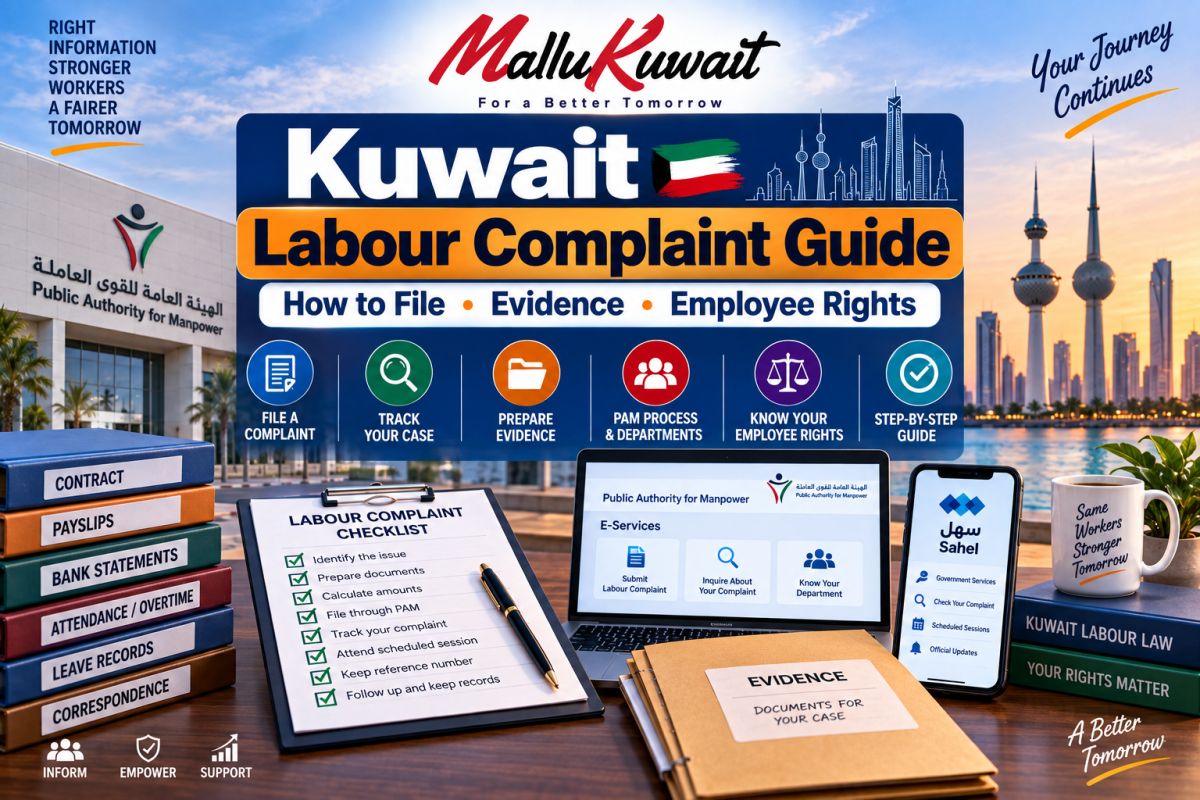
⚖️ Kuwait Labour Complaint Guide: How to File a Complaint, Evidence & Employee Rights
When a salary, termination, leave, indemnity or other employment dispute cannot be resolved directly with an employer, a worker may need to use Kuwait's official labour-dispute process. The most important first step is not arguing more. It is organizing the facts and evidence clearly. This guide explains how private-sector workers can prepare for a labour complaint, what records may be useful, how to follow the complaint and what to do when a dispute is serious. 1. Who is this guide for? This guide is primarily intended for employees covered by Kuwait Labour Law No. 6 of 2010 concerning labour in the private sector and its amendments. Different systems may apply to: • government employees • domestic workers • workers covered by special employment legislation • other employment categories Important: Confirm the employment regime that applies to you before relying on a private-sector labour complaint procedure. 2. What is a labour complaint? A labour complaint is a formal way of raising an employment dispute through the competent authority rather than relying only on conversations with the employer. A complaint may concern matters such as: • unpaid or delayed salary • disputed salary deductions • overtime • annual leave • end-of-service indemnity • final settlement • notice-period disputes • termination or dismissal • employment documents • other employment rights The correct legal treatment depends on the facts of each case. 3. Try to identify the exact problem first Before submitting a complaint, write the problem in one sentence. For example: "My employer has not paid my salary for two months." or: "My employer terminated my employment and my final settlement does not include the indemnity I believe is due." or: "My final settlement shows four unused leave days, but my records show eleven." This is much more useful than simply saying: "My company is unfair." 4. Separate multiple claims If several issues exist, list them separately. For example: Claim 1: Unpaid salary Claim 2: Unused annual leave Claim 3: End-of-service indemnity Claim 4: Notice-period amount Claim 5: Employment certificate or documents This makes the dispute easier to understand and document. 5. Build a simple timeline Write down important dates in order. Include where relevant: • employment start date • contract date • salary changes • date salary stopped or became delayed • leave dates • overtime dates • resignation date • termination date • notice start date • last working date • final-settlement date • dates you contacted the employer A clear timeline can be extremely useful when explaining the dispute. 6. Preserve your employment contract Keep a copy of: • original employment contract • amendments • salary amendments • renewal documents • other employment documents provided to you Your contract can help establish the agreed employment terms. [ACTION] type=service label=📄 Read Kuwait Employment Contract Guide url=https://mallukuwait.com/mallupost/kuwait-employment-contract-guide-before-signing-salary-probation-rights [/ACTION] 7. Preserve salary evidence For salary disputes, useful records may include: • payslips • bank statements • salary-transfer records • employment contract • salary certificate where available • employer correspondence • records of unpaid periods Do not depend entirely on employer systems that you may lose access to later. [ACTION] type=service label=💰 Read Kuwait Salary & Wage Rights Guide url=https://mallukuwait.com/mallupost/kuwait-salary-wage-rights-payment-delay-deductions-guide [/ACTION] 8. Preserve attendance and overtime evidence If overtime is disputed, preserve lawful records available to you such as: • attendance records • timesheets • work schedules • written overtime instructions • payroll records • relevant correspondence Do not take confidential company material you are not entitled to retain. [ACTION] type=service label=⏱️ Read Kuwait Overtime Pay Guide url=https://mallukuwait.com/mallupost/kuwait-overtime-pay-calculation-rest-day-holiday-guide [/ACTION] [ACTION] type=service label=🧮 Open Kuwait Overtime Calculator url=https://mallukuwait.com/tools/kuwait-overtime-calculator [/ACTION] 9. Preserve annual-leave records For a leave dispute, keep available evidence concerning: • leave entitlement • leave requests • approvals • leave taken • employer leave balance • final-settlement leave calculation [ACTION] type=service label=🏖️ Read Kuwait Annual Leave Guide url=https://mallukuwait.com/mallupost/kuwait-annual-leave-guide-30-days-six-month-rule-leave-salary [/ACTION] [ACTION] type=service label=🧮 Open Kuwait Annual Leave Calculator url=https://mallukuwait.com/tools/kuwait-annual-leave-calculator [/ACTION] 10. Preserve resignation or termination records If the dispute concerns how employment ended, preserve: • resignation letter • proof the resignation was delivered • termination letter • dismissal letter • notice correspondence • warnings issued to you • disciplinary documents issued to you • relevant employment correspondence The distinction between resignation and employer termination can matter. [ACTION] type=service label=🚪 Read Kuwait Resignation Guide url=https://mallukuwait.com/mallupost/kuwait-resignation-guide-notice-period-final-settlement-rights [/ACTION] [ACTION] type=service label=⚠️ Read Kuwait Termination Guide url=https://mallukuwait.com/mallupost/kuwait-termination-guide-dismissal-notice-employee-rights [/ACTION] 11. Preserve your final-settlement calculation If your dispute concerns final settlement, keep the employer's calculation. Then separate each component: • final salary • notice amount • overtime • unused leave • indemnity • additions • deductions • net amount This makes it easier to identify exactly what you disagree with. [ACTION] type=service label=💼 Read Kuwait Final Settlement Guide url=https://mallukuwait.com/mallupost/kuwait-final-settlement-guide-salary-leave-indemnity-documents [/ACTION] 12. Calculate disputed amounts carefully Before alleging that an amount is wrong, try to understand how both numbers were calculated. Write: Employer calculation: Your estimate: Difference: Reason you believe there is a difference: MalluKuwait calculators can help with estimates, but they are not official determinations. [ACTION] type=service label=🧮 Open Kuwait Indemnity Calculator url=https://mallukuwait.com/tools/kuwait-indemnity-calculator [/ACTION] 13. Where are private-sector labour complaints handled? The Public Authority for Manpower is the key Kuwait authority responsible for private-sector labour matters covered by its jurisdiction. Kuwait Government Online has documented PAM worker electronic services including: • submitting a labour complaint • inquiring about labour complaints • identifying the department associated with the worker The exact available electronic screens, login method, routing and service workflow can change. Always use the current official PAM service when you are ready to proceed. [ACTION] type=official label=Public Authority for Manpower url=https://www.manpower.gov.kw/ [/ACTION] 14. Can complaint information be checked electronically? Kuwait has provided electronic services relating to labour complaints. Kuwait Government Online has also documented a Public Authority for Manpower service through the Sahel government application allowing eligible private-sector workers with a complaint to inquire about the scheduled complaint-session date. Available functions can change as government services are updated. Check the current PAM and Sahel services rather than relying on an old screenshot or social-media tutorial. [ACTION] type=service label=📱 Read MalluKuwait Sahel App Guide url=https://mallukuwait.com/mallupost/sahel-app-kuwait-guide [/ACTION] 15. Which PAM office or department should I visit? Do not choose an office simply because it is closest to your home. Labour matters can be routed according to the competent department and employment record. Kuwait Government Online has previously documented an electronic worker service for identifying the worker's relevant department. Check the current official routing before travelling. Important: PAM office locations, departmental jurisdiction, appointment systems and electronic procedures can change. Verify the current instructions through PAM before visiting. 16. What documents should I prepare? The exact documents requested can depend on the complaint and the current PAM procedure. Instead of assuming one fixed checklist applies to everyone, prepare the records relevant to your case. These may include, where applicable: • Civil ID or identification information • employment contract • work-related records • salary records • bank statements • payslips • attendance records • overtime evidence • leave records • resignation or termination documents • final-settlement calculation • relevant employer correspondence • calculations supporting the amount claimed Important: This is a preparation checklist, not a claim that PAM requires every listed document for every complaint. Check the current official service requirements when filing. 17. Keep originals safe Unless an official process specifically requires an original, keep your important originals protected. Maintain organized copies of records submitted in connection with the dispute. Where possible, keep a record of: • what was submitted • when it was submitted • complaint/reference number • appointment or session information • later correspondence 18. Write your complaint clearly A useful complaint explanation is factual and chronological. For example: "I joined the employer on [date]. My agreed monthly salary is [amount]. Salary for [period] has not been paid. My last payment was received on [date]. I contacted the employer on [dates]. The amount I believe remains unpaid is [amount]. I have attached the relevant contract and payment records." Avoid unnecessary insults, assumptions or unrelated personal disputes. 19. Use numbers where money is disputed If the complaint concerns money, state the amount you believe is disputed. For example: Unpaid salary: KD ___ Overtime: KD ___ Unused leave: KD ___ Indemnity: KD ___ Notice amount: KD ___ Total amount disputed: KD ___ Then keep the calculations supporting those figures. 20. Keep your complaint or reference number If the official system gives you a complaint number, case reference or other tracking information, save it. Take a screenshot or keep it securely with your records. You may need it when: • checking status • checking a session • contacting the authority • attending later proceedings 21. Attend scheduled sessions If PAM or another competent authority schedules a complaint session or appointment, take it seriously. Check: • date • time • location or electronic instructions • complaint/reference number • documents requested If the session information changes, follow the current official notification. 22. What happens during the complaint process? The exact workflow depends on the type of dispute and current official procedure. Generally, the purpose of the labour-dispute process is to allow the employment dispute to be formally examined and, where possible, addressed through the competent process. Some disputes may be resolved during the administrative process. Others may require further legal proceedings. Do not assume that filing a complaint automatically means: • you have won the case • the employer must immediately pay the amount you claim • the authority has accepted your calculation • the dispute has automatically become a court judgment A complaint begins a formal process; the outcome depends on the facts, evidence and applicable law. 23. What if the dispute is not resolved? Some labour disputes may proceed beyond the administrative complaint stage through the legally applicable dispute-resolution or judicial process. The correct next step depends on: • type of claim • status of the complaint • decisions or referrals made • applicable legal procedures • time limits If your dispute reaches this stage, follow the instructions issued by the competent authority and consider qualified legal assistance where appropriate. Important: Legal procedural deadlines can matter. Do not intentionally delay a serious claim based solely on information from a website. 24. What if salary has not been paid? Document: • contractual salary • months or periods unpaid • amounts actually received • payment dates • bank records • communications with the employer Article 56 of the private-sector Labour Law contains wage-payment timing rules. [ACTION] type=service label=💰 Check Kuwait Salary Payment Rules url=https://mallukuwait.com/mallupost/kuwait-salary-wage-rights-payment-delay-deductions-guide [/ACTION] 25. What if my final settlement is wrong? Do not dispute only the total. Identify each component you believe is incorrect. For example: • salary missing • notice amount missing • overtime missing • leave balance incorrect • indemnity incorrect • unexplained deduction Then preserve the employer's settlement sheet and your supporting calculation. [ACTION] type=service label=💼 Check Final Settlement Checklist url=https://mallukuwait.com/mallupost/kuwait-final-settlement-guide-salary-leave-indemnity-documents [/ACTION] 26. What if indemnity is disputed? First identify: • service start date • service end date • wage basis • contract type • how employment ended • employer's indemnity calculation • your estimated calculation The reason employment ended can affect the legal analysis. [ACTION] type=service label=💰 Read Kuwait Indemnity Guide url=https://mallukuwait.com/mallupost/kuwait-indemnity-end-of-service-benefits-calculation-guide [/ACTION] 27. What if I believe I was dismissed unfairly? Preserve the termination decision and stated reason. Article 41 contains specific dismissal provisions and also addresses a worker's ability to challenge dismissal under the circumstances covered by that Article. Article 46 contains additional protections concerning termination. Do not assume that every dismissal dispute has the same legal outcome. [ACTION] type=service label=⚠️ Check Kuwait Termination Rights url=https://mallukuwait.com/mallupost/kuwait-termination-guide-dismissal-notice-employee-rights [/ACTION] 28. What if the employer asks me to sign something? Read it before signing. Pay special attention to documents stating: • all dues have been received • there are no outstanding claims • you resigned voluntarily • you accept a particular dismissal reason • you waive claims • the settlement is final Do not sign something you do not understand simply because you are told it is routine. For a significant dispute, obtain appropriate guidance. 29. Keep communication professional A dispute can be frustrating. But your records are more useful when communications remain factual. Prefer: "Salary for May and June remains unpaid. Please provide the payment status and calculation." rather than threats, insults or unrelated accusations. Your goal is to create a clear record of the employment issue. 30. Do not manufacture evidence Never alter: • payslips • messages • attendance records • contracts • salary records • screenshots • letters • dates Keep authentic records. False or altered evidence can seriously damage a legitimate claim. 31. Keep copies outside company systems If legally permitted, keep your own employment records somewhere you can still access after leaving the employer. Do not rely exclusively on: • company email • company laptop • internal HR portal • company messaging system Access may end when employment ends. Again, do not copy confidential employer information that you have no right to retain. 32. Labour complaint and work-permit issues are not identical An employment claim and an administrative work-permit or transfer issue can overlap, but they are not automatically the same procedure. If your dispute also affects: • work permit • employer transfer • residency • immigration status check the current official administrative requirements separately. [ACTION] type=service label=🪪 Read Kuwait Work Permit & Article 18 Guide url=https://mallukuwait.com/mallupost/kuwait-work-permit-article-18-guide-after-getting-job [/ACTION] [ACTION] type=service label=🔄 Read Kuwait Changing Jobs Guide url=https://mallukuwait.com/mallupost/changing-jobs-kuwait-article-18-transfer-employer-guide [/ACTION] 33. Labour complaint checklist Before proceeding, check: □ Exact employment problem identified □ Claims separated by issue □ Timeline prepared □ Employment contract saved □ Salary records saved □ Bank statements available where relevant □ Attendance/overtime records preserved where relevant □ Leave records preserved □ Resignation or termination evidence preserved □ Final settlement preserved □ Amounts in dispute calculated □ Employer communications preserved □ Current PAM service checked □ Correct department/routing confirmed where required □ Complaint/reference number saved after filing □ Session or appointment details checked □ Copies of submitted records retained 34. When should professional legal help be considered? Qualified legal assistance may be particularly useful where: • a large amount of money is disputed • dismissal involves serious misconduct allegations • Article 41 is involved • the employer alleges fraud or major loss • the worker disputes having resigned • important evidence is contested • the matter proceeds toward court • procedural deadlines may apply • the case involves several legal issues • the worker does not understand a settlement or waiver MalluKuwait cannot determine the outcome of an individual dispute. 35. Official sources For current labour services and procedures, use official Kuwait sources. [ACTION] type=official label=Public Authority for Manpower url=https://www.manpower.gov.kw/ [/ACTION] [ACTION] type=official label=Kuwait Government Online — Labour Law url=https://www.e.gov.kw/sites/kgoarabic/Pages/ApplicationPages/LaborLaw.aspx [/ACTION] 36. Important Legal Disclaimer This guide is provided for general informational and educational purposes only. It is not: • legal advice • representation before PAM or a court • an official labour complaint • a guarantee that a complaint will be accepted • a determination that an employer or worker violated the law • an official calculation of money owed • an official work-permit or residency decision Complaint procedures, electronic services, departmental routing, required documents, appointments and government systems can change. The facts of each employment dispute can also materially change the legal outcome. Always verify the current complaint procedure directly through the Public Authority for Manpower or other competent Kuwait authority before filing or attending. If your dispute is serious, financially significant, approaching a procedural deadline or proceeding toward litigation, consider obtaining qualified legal advice. Important: MalluKuwait does not represent the Public Authority for Manpower, the Ministry of Interior, Kuwait Government Online, the courts or any other Kuwait government authority. MalluKuwait provides general information only. Always rely on current official instructions for the actual complaint process. [RELATED] title=Kuwait Final Settlement Guide slug=kuwait-final-settlement-guide-salary-leave-indemnity-documents [/RELATED] [RELATED] title=Kuwait Termination Guide slug=kuwait-termination-guide-dismissal-notice-employee-rights [/RELATED] [RELATED] title=Kuwait Salary & Wage Rights slug=kuwait-salary-wage-rights-payment-delay-deductions-guide [/RELATED]

💼 Kuwait Final Settlement Guide: Salary, Leave, Indemnity & Documents Before You Leave
When your job in Kuwait ends, one of the most important things to check is your final settlement. But final settlement is not simply another name for end-of-service indemnity. Depending on your employment and how it ended, there may be several separate amounts, documents and procedures to review before you consider everything complete. This guide gives private-sector workers a practical checklist. 1. What is a final settlement? In everyday employment use, a final settlement is the reconciliation of amounts and employment matters remaining when a worker's service ends. Depending on the circumstances, items to examine can include: • final salary • unpaid or delayed salary • notice-period wage or compensation where applicable • overtime or other established wage amounts • unused annual-leave entitlement • end-of-service indemnity • lawful deductions • employment documents • return of property • work-permit or transfer procedures Important: Final settlement and end-of-service indemnity are not the same thing. Indemnity may be only one component of the overall amounts that need to be checked. 2. First establish how the employment ended Before calculating anything, identify why the employment relationship ended. For example: • employee resignation • employer termination • termination during probation • expiry of a fixed-term contract • early termination of a fixed-term contract • dismissal under Article 41 • another statutory circumstance This matters because different rules can affect notice and end-of-service entitlement. [ACTION] type=service label=🚪 Read Kuwait Resignation Guide url=https://mallukuwait.com/mallupost/kuwait-resignation-guide-notice-period-final-settlement-rights [/ACTION] [ACTION] type=service label=⚠️ Read Kuwait Termination Guide url=https://mallukuwait.com/mallupost/kuwait-termination-guide-dismissal-notice-employee-rights [/ACTION] 3. Collect your employment records before leaving Do not wait until company-system access has been removed. Lawfully keep your own records, including where applicable: • employment contract • contract amendments • salary records • payslips • bank statements • attendance records available to you • overtime records • annual-leave records • resignation or termination letter • notices • warnings or disciplinary documents issued to you • final-settlement calculation • relevant correspondence Do not take confidential employer information that you are not entitled to retain. 4. Check your final salary Confirm the salary due through the applicable end of employment. Compare: • last salary already received • remaining worked days • applicable notice period • unpaid salary from earlier periods • recurring wage components where relevant • deductions Do not rely only on the final number presented to you. Ask for a written breakdown where possible. [ACTION] type=service label=💰 Read Kuwait Salary & Wage Rights Guide url=https://mallukuwait.com/mallupost/kuwait-salary-wage-rights-payment-delay-deductions-guide [/ACTION] 5. Check whether notice affects the settlement Notice depends on the legal circumstances. For an unlimited-period contract, Article 44 provides written-notice rules. For monthly-paid workers covered by Article 44, the notice period is generally at least three months. For other workers covered by the Article, it is generally at least one month. If the required notice is not observed, Article 44 addresses payment corresponding to the worker's wage for the applicable notice period. Important: Do not apply the three-month notice rule automatically to every contract. Fixed-term contracts, probation and other termination circumstances require separate analysis. 6. Employer release during notice Where the employer gives termination notice under Article 44, the employer may release the worker from performing work during the notice period. The statutory provision addresses continuation of service until the notice expires and wage entitlement for that period. Therefore, if you were told not to attend work during employer notice, check how the notice-period wage and service period were treated. 7. Check unpaid overtime If you have an established overtime entitlement that remains unpaid, include it in your reconciliation. Preserve available evidence such as: • written overtime instructions • schedules • attendance • timesheets • payroll records • relevant correspondence [ACTION] type=service label=⏱️ Read Kuwait Overtime Pay Guide url=https://mallukuwait.com/mallupost/kuwait-overtime-pay-calculation-rest-day-holiday-guide [/ACTION] [ACTION] type=service label=🧮 Open Kuwait Overtime Calculator url=https://mallukuwait.com/tools/kuwait-overtime-calculator [/ACTION] 8. Check your unused annual leave Do not forget your annual-leave records when employment ends. Compare: • annual entitlement • leave already taken • leave balance shown by the employer • your own records • amount included in the final calculation The applicable legal treatment depends on the law and facts of the employment. [ACTION] type=service label=🏖️ Read Kuwait Annual Leave Guide url=https://mallukuwait.com/mallupost/kuwait-annual-leave-guide-30-days-six-month-rule-leave-salary [/ACTION] [ACTION] type=service label=🧮 Open Kuwait Annual Leave Calculator url=https://mallukuwait.com/tools/kuwait-annual-leave-calculator [/ACTION] 9. Check end-of-service indemnity separately End-of-service indemnity is one of the most important parts of many final settlements. Article 51 sets out the basic statutory end-of-service indemnity framework. For monthly-paid workers, the Article provides: • 15 days' wage for each year of the first five years • one month's wage for each year of the following years subject to the statutory maximum and other applicable provisions. For workers paid by day, week, piece or hour, Article 51 provides a different formula. Fractions of a year are addressed proportionately. Important: The exact entitlement can depend on how employment ended and other applicable provisions. Do not calculate indemnity from Article 51 alone without checking the surrounding rules. 10. Article 52 and full indemnity Article 52 identifies circumstances in which the worker is entitled to the full end-of-service indemnity provided for in Article 51, subject to the law. These include specified situations such as: • termination of the contract by the employer • expiry of a fixed-term contract without renewal • termination under Articles 48, 49 or 50 • the statutory marriage-related situation described in Article 52 The facts of the particular employment ending still matter. 11. Article 53 and employee-initiated unlimited contracts Article 53 addresses end-of-service indemnity where the worker terminates an unlimited-period contract. The statutory text provides different proportions according to the relevant service period: • at least 3 years but less than 5 years — half of the Article 51 indemnity • at least 5 years but less than 10 years — two-thirds • 10 years — full indemnity Because the precise facts and current applicable legal framework matter, use these rules carefully rather than treating a simple online calculation as an official determination. [ACTION] type=service label=💰 Read Kuwait Indemnity Guide url=https://mallukuwait.com/mallupost/kuwait-indemnity-end-of-service-benefits-calculation-guide [/ACTION] [ACTION] type=service label=🧮 Open Kuwait Indemnity Calculator url=https://mallukuwait.com/tools/kuwait-indemnity-calculator [/ACTION] 12. Why termination reason can affect indemnity Do not assume: "Employer terminated me, therefore the calculation is always identical." Article 41 contains different dismissal categories and consequences. Certain serious Article 41 cases are treated differently from other Article 41 dismissal grounds. If your final settlement says your indemnity is zero because of dismissal, identify exactly which legal ground the employer is relying upon. [ACTION] type=service label=⚠️ Check Article 41 Termination Rules url=https://mallukuwait.com/mallupost/kuwait-termination-guide-dismissal-notice-employee-rights [/ACTION] 13. Check every deduction Do not review only the gross settlement. Look at each deduction individually. Possible entries might include amounts the employer says relate to: • loans • salary advances • documented debts • other deductions Ask: • What is this deduction? • What amount is being deducted? • What record supports it? • Is the deduction legally permitted? • Has it already been deducted previously? Keep copies of the calculation and supporting records. 14. Do not confuse company property with your own documents Return company property appropriately. Examples may include: • laptop • phone • ID/access card • keys • equipment • uniforms or other employer property where applicable Where useful, obtain proof that property was returned. But your own documents are a separate issue. 15. Article 54: end-of-service certificate Article 54 gives a worker whose employment contract has ended the right to obtain an end-of-service certificate from the employer. The certificate is to include information concerning: • period of service • work • last wage received The Article also protects the worker against harmful wording in that certificate that could explicitly or implicitly damage the worker or reduce future employment opportunities. This document can be useful for future employment and maintaining your personal employment history. 16. Article 54: return of documents Article 54 also requires the employer to return documents, certificates or tools that the worker had deposited with the employer. Before leaving, check whether the employer still holds any of your original documents or certificates. Keep evidence of what you requested and received. 17. Ask for a written final-settlement breakdown A useful final-settlement statement should allow you to understand how the final figure was reached. Ideally, check separate entries for: • final salary • notice-related amount where applicable • overtime where applicable • unused leave • indemnity • additions • deductions • final net amount A single unexplained total makes errors harder to identify. 18. Compare the employer's numbers with your records Do your own reconciliation before signing. For each item, write: Employer calculation: Your calculation: Difference: Reason for difference: This makes it much easier to identify the exact point of disagreement. 19. Use calculators as estimates, not official decisions MalluKuwait calculators can help you understand the numbers and identify questions to ask. They are not official government calculations or legal determinations. Use them as checking tools. [ACTION] type=service label=🧮 Annual Leave Calculator url=https://mallukuwait.com/tools/kuwait-annual-leave-calculator [/ACTION] [ACTION] type=service label=🧮 Indemnity Calculator url=https://mallukuwait.com/tools/kuwait-indemnity-calculator [/ACTION] [ACTION] type=service label=🧮 Overtime Calculator url=https://mallukuwait.com/tools/kuwait-overtime-calculator [/ACTION] 20. Be careful before signing "received in full" Read settlement documents carefully before signing. Pay attention to wording such as: • received all dues • full and final settlement • no further amounts are due • waiver of claims • acknowledgment of a particular termination reason Do not sign a document you do not understand simply because someone says it is routine. For a significant dispute, obtain appropriate official or qualified legal guidance. 21. Keep proof of payment Do not keep only the settlement sheet. Also preserve proof showing what was actually paid. For example: • bank credit • transfer record • receipt • payroll statement Compare the actual amount received with the amount stated in the settlement. 22. Check whether salary remains unpaid A signed calculation and an actual payment are not the same thing. If the settlement says an amount is payable, verify that you actually received it. Record: • settlement date • promised payment date • actual payment date • amount received • remaining difference 23. Keep your resignation or termination evidence Your final-settlement calculation may depend on how employment ended. Keep: • resignation letter and proof of delivery or • employer termination/dismissal letter Also keep relevant notice-period correspondence. This can be important if the reason or date of termination later becomes disputed. 24. Check your last working date carefully Several calculations may depend on the legally relevant end date. Do not confuse: • date the letter was issued • date notice began • last day physically attending work • end of notice period • contractual termination date Record all relevant dates. 25. Work permit and employment settlement are separate Receiving your salary and indemnity does not necessarily mean all work-permit, residency or transfer procedures are complete. Likewise, an administrative work-permit step does not by itself prove that every employment amount has been correctly paid. Treat these as related but separate matters. [ACTION] type=service label=🪪 Read Kuwait Work Permit & Article 18 Guide url=https://mallukuwait.com/mallupost/kuwait-work-permit-article-18-guide-after-getting-job [/ACTION] [ACTION] type=service label=🔄 Read Kuwait Changing Jobs Guide url=https://mallukuwait.com/mallupost/changing-jobs-kuwait-article-18-transfer-employer-guide [/ACTION] 26. What if the employer's calculation is different from yours? First identify the exact difference. For example: • different service dates • different wage basis • missing salary • missing overtime • different leave balance • different indemnity treatment • notice disagreement • unexplained deduction • disagreement about why employment ended Ask for the employer's calculation in writing where possible. Then compare it with your contract, payment records and the applicable legal provisions. 27. Do not turn a calculation disagreement into a vague dispute Instead of saying only: "My settlement is wrong." Identify the individual disputed item. For example: "My settlement shows 4 unused leave days, while my records show 11." or: "The calculation does not include the notice-period amount." or: "The employer has shown zero indemnity and states Article 41 as the reason." Specific disagreements are easier to document and explain. 28. When should you seek official help? Consider obtaining current official guidance or qualified professional advice where: • salary remains unpaid • the employer refuses to provide a clear calculation • notice compensation is disputed • leave balance is disputed • indemnity is denied • Article 41 dismissal is involved • substantial deductions are unexplained • the employer asks you to sign a waiver you do not understand • original documents are not returned • the termination reason is disputed • work-permit consequences are unclear [ACTION] type=official label=Public Authority for Manpower url=https://www.manpower.gov.kw/ [/ACTION] 29. Final settlement checklist Before considering the employment financially complete, check: □ Employment contract saved □ Resignation or termination letter saved □ Correct final employment date identified □ Final salary checked □ Earlier unpaid salary checked □ Notice amount checked where applicable □ Overtime checked □ Annual-leave balance checked □ Indemnity checked □ Every deduction reviewed □ Final net amount confirmed □ Actual payment received and verified □ End-of-service certificate requested □ Personal documents/certificates returned □ Company property returned □ Proof of property return kept where appropriate □ Relevant work-permit/transfer steps checked separately □ Copies of important records stored safely 30. A simple way to organize your final settlement Create one small table for yourself: Final salary: Notice amount: Overtime: Unused leave: Indemnity: Other amount: Less deductions: Expected total: Amount actually received: Difference: Then investigate any difference before treating the matter as complete. 31. Official references The principal provisions relevant to this guide include Articles 44 and 51–54 of Kuwait Labour Law No. 6 of 2010 concerning labour in the private sector, together with other provisions depending on how employment ended. [ACTION] type=official label=Public Authority for Manpower — Kuwait Labour Law url=https://www.manpower.gov.kw/docs/LaborLaw/Labor_Law_Eng.pdf [/ACTION] [ACTION] type=official label=Kuwait Government Online — Labour Law url=https://www.e.gov.kw/sites/kgoarabic/Pages/ApplicationPages/LaborLaw.aspx [/ACTION] 32. Important Legal Disclaimer This guide is provided for general informational and educational purposes only. It is not: • legal advice • employment advice • an official final-settlement calculation • an official indemnity calculation • an official annual-leave calculation • an official overtime calculation • an official work-permit or residency decision • a substitute for advice from a qualified professional or competent Kuwait authority The correct settlement can depend on the worker's contract, wage, service period, payment method, leave history, overtime records, termination circumstances, statutory provisions and other facts. Kuwait laws, amendments, regulations, ministerial decisions, procedures and official interpretations may change. If your settlement is disputed or financially significant, verify the current rules through official Kuwait government sources and obtain appropriate professional guidance where necessary. Important: MalluKuwait does not represent the Public Authority for Manpower, the Ministry of Interior, Kuwait Government Online, the courts or any other Kuwait government authority. The calculators and guides on MalluKuwait are informational tools only. Always verify your individual entitlement using current official sources. [RELATED] title=Kuwait Termination Guide slug=kuwait-termination-guide-dismissal-notice-employee-rights [/RELATED] [RELATED] title=Kuwait Resignation Guide slug=kuwait-resignation-guide-notice-period-final-settlement-rights [/RELATED] [RELATED] title=Kuwait Indemnity Guide slug=kuwait-indemnity-end-of-service-benefits-calculation-guide [/RELATED]

⚠️ Kuwait Termination Guide: Dismissal, Notice Period, Final Settlement & Employee Rights
Losing a job can be stressful, especially when an employee is unsure whether the employer followed Kuwait labour law or whether salary, leave and end-of-service amounts are still due. But not every termination is legally the same. Kuwait private-sector law distinguishes between ordinary termination, termination during probation, termination of a fixed-term contract, serious dismissal cases and situations where the worker may challenge the employer's decision. This guide explains the major termination rules employees should understand and the records they should keep. 1. Who is this termination guide for? This guide is primarily for workers covered by Kuwait Labour Law No. 6 of 2010 concerning labour in the private sector and its amendments. Government employees, domestic workers and employees governed by special employment regimes may be subject to different rules. Important: First identify which employment regime and contract type apply to you before relying on the rules below. 2. First identify how your employment ended Do not treat every job ending as simply "termination." Ask which situation applies: • ordinary employer termination • termination during probation • dismissal under Article 41 • fixed-term contract ended early • fixed-term contract expired • establishment closure or another statutory event • employee resignation • another legally relevant circumstance The legal consequences can differ substantially. 3. Check your employment contract Before assessing termination, obtain your employment contract and identify: • employer • contract type • start date • effective date • fixed-term expiry date if applicable • salary • job or nature of work • probation provision • termination provisions Keep all amendments as well. [ACTION] type=service label=📄 Read Kuwait Employment Contract Guide url=https://mallukuwait.com/mallupost/kuwait-employment-contract-guide-before-signing-salary-probation-rights [/ACTION] 4. Ordinary termination of an unlimited contract Article 44 addresses termination of an unlimited-period employment contract. Either party may terminate such a contract after giving written notice to the other party. For workers appointed on a monthly salary, Article 44 generally provides for: • at least 3 months' notice For other workers covered by Article 44: • at least 1 month's notice Important: The three-month rule should not be applied automatically to every worker or every type of employment contract. 5. What if the employer does not provide the required notice? Article 44 addresses failure to observe the applicable notice period. The party terminating the contract without observing the required notice may be required to pay the other party an amount corresponding to the worker's wage for the notice period. Therefore, check both: • the termination date and • how the notice period or notice compensation was handled. 6. Can an employer release the worker from work during employer notice? Article 44 also provides that the employer may exempt the worker from working during the notice period. In that situation, the Article provides for the worker's service to continue to be calculated until expiry of the notice period, together with the resulting effects, particularly entitlement to wage for that notice period. Keep written evidence if the employer tells you not to attend work during notice. 7. Job-search time during employer notice Article 44 contains another useful protection where termination notice comes from the employer. The worker is entitled to be absent: • one full day per week or • eight hours during the week to search for another job, while retaining wage entitlement for that absence. The worker determines the day or hours, subject to notifying the employer at least on the preceding day. 8. Can the employer terminate an employee while on statutory leave? Article 45 provides that the employer may not exercise the Article 44 termination right while the worker is enjoying one of the leaves provided for in the law. This is an important distinction when ordinary termination coincides with statutory leave. If this issue affects you, preserve the leave approval and termination records. [ACTION] type=service label=🏖️ Read Kuwait Annual Leave Guide url=https://mallukuwait.com/mallupost/kuwait-annual-leave-guide-30-days-six-month-rule-leave-salary [/ACTION] [ACTION] type=service label=🏥 Read Kuwait Sick Leave Guide url=https://mallukuwait.com/mallupost/kuwait-sick-leave-guide-paid-sick-leave-salary-medical-certificate [/ACTION] 9. Can an employee be terminated without a reason? Article 46 provides important protection. It states that a worker's service shall not be terminated without reason. It also protects against termination because of: • trade-union activity • claiming legitimate rights under the law • enjoying legitimate rights under the law Article 46 additionally states that service shall not be terminated because of: • sex • origin • religion A worker who believes a termination falls into a prohibited category should preserve evidence and seek appropriate official or legal guidance. 10. What is Article 41 dismissal? Article 41 deals with specified dismissal situations. It is important not to summarize the whole Article as: "Employer can fire you immediately and you lose everything." Article 41 contains different categories with different consequences. 11. Article 41 serious cases: dismissal without notice, compensation or indemnity Subject to the relevant provisions of the law, Article 41(a) allows the employer to dismiss the worker without notice, compensation or end-of-service indemnity in specified serious circumstances. The official law includes cases where: • the worker commits a fault resulting in serious loss to the employer • it is established that the worker obtained employment through cheating or fraud • the worker discloses establishment secrets causing or capable of causing real loss to the establishment These are serious statutory grounds. Whether the facts of a particular case actually satisfy one of these grounds can be disputed. 12. Not every Article 41 dismissal means loss of indemnity Article 41(b) contains another group of dismissal grounds. These include specified situations concerning: • a final conviction involving honour, trust or morals • an act violating public morals at the workplace • assault on a colleague, employer or employer's representative during or because of work • breach or failure concerning obligations imposed by the contract or law • repeated violation of the employer's instructions Crucially, the Article provides that dismissal in these cases does not result in depriving the worker of end-of-service indemnity. Important: Do not assume that every Article 41 dismissal automatically means the employee loses end-of-service benefits. 13. Can a worker challenge an Article 41 dismissal? Yes. Article 41 provides a worker dismissed under the cases mentioned in that Article with the right to challenge the dismissal before the competent labour circuit according to the procedures provided by law. The Article further addresses the situation where a final judgment establishes that the employer acted arbitrarily in dismissing the worker. This makes evidence extremely important. 14. What can happen if dismissal is finally found arbitrary? Article 41 addresses the consequences where a final judgment establishes arbitrary dismissal. The statutory text provides for entitlement to end-of-service indemnity and compensation for material and moral damage in that situation. The actual outcome and amount are matters for the competent process and facts of the case. MalluKuwait cannot determine whether a particular dismissal is legally arbitrary. 15. Employer notification concerning Article 41 dismissal Article 41 also contains an employer notification requirement concerning the dismissal decision and its reasons. Employees should therefore keep any written dismissal decision or reason provided by the employer. If no clear documentation is available, preserve other reliable evidence concerning what occurred. 16. Termination during probation Probation has a separate statutory rule. Article 32 provides that during a valid probation period either party may terminate the employment contract without notice. Probation must be specified in the contract and cannot exceed 100 working days. Where the employer terminates during probation, Article 32 addresses terminal service indemnity for the employment period according to the law. [ACTION] type=service label=🧪 Read Kuwait Probation Period Guide url=https://mallukuwait.com/mallupost/kuwait-probation-period-guide-100-working-days-termination-rights [/ACTION] 17. Fixed-term contracts need separate treatment Article 44 is an unlimited-contract provision. Do not automatically apply its ordinary three-month or one-month notice rules to every fixed-term contract. Article 47 separately addresses early termination of a limited-period contract where a party terminates without having a legal right to do so. 18. What does Article 47 say about wrongful early fixed-term termination? Article 47 provides for compensation for damage where either party terminates a fixed-term contract without having a right to do so. The compensation is subject to a ceiling: • it shall not exceed an amount equal to the worker's wage for the remaining period of the contract The Article also directs consideration of factors affecting whether damage exists and its extent. Therefore, do not treat the remaining contract salary automatically as a guaranteed compensation amount in every case. 19. Fixed-term expiry is different from early dismissal If a fixed-term contract simply reaches its agreed expiry, that is not necessarily the same legal event as terminating it early. Check: • contract expiry date • whether employment continued after expiry • whether the contract was renewed • whether either party ended it before expiry • what final amounts remain due These distinctions matter. 20. What happens to salary when employment ends? Termination does not erase salary already earned. Check: • salary through the applicable employment date • salary during applicable notice • outstanding wages • overtime where applicable • lawful deductions • other documented wage components Keep bank statements and payslips. [ACTION] type=service label=💰 Read Kuwait Salary & Wage Rights Guide url=https://mallukuwait.com/mallupost/kuwait-salary-wage-rights-payment-delay-deductions-guide [/ACTION] 21. What happens to unpaid overtime? If overtime was properly worked and established before termination, ending employment does not make the underlying record irrelevant. Preserve: • attendance • schedules • written instructions • payroll records • other evidence available to you [ACTION] type=service label=⏱️ Read Kuwait Overtime Pay Guide url=https://mallukuwait.com/mallupost/kuwait-overtime-pay-calculation-rest-day-holiday-guide [/ACTION] [ACTION] type=service label=🧮 Open Kuwait Overtime Calculator url=https://mallukuwait.com/tools/kuwait-overtime-calculator [/ACTION] 22. What happens to unused annual leave? Unused annual-leave rights can form part of the amounts that need to be considered when employment ends. Preserve your leave records before losing access to employer systems. Compare: • entitlement • leave taken • remaining balance • employer calculation [ACTION] type=service label=🧮 Open Kuwait Annual Leave Calculator url=https://mallukuwait.com/tools/kuwait-annual-leave-calculator [/ACTION] 23. What about end-of-service indemnity? End-of-service indemnity should be calculated according to the applicable statutory provisions and the circumstances in which employment ended. Do not assume: • every termination means loss of indemnity or • every termination automatically produces exactly the same entitlement. Article 41 itself demonstrates why the reason and legal basis for dismissal can matter. [ACTION] type=service label=💰 Read Kuwait Indemnity Guide url=https://mallukuwait.com/mallupost/kuwait-indemnity-end-of-service-benefits-calculation-guide [/ACTION] [ACTION] type=service label=🧮 Open Kuwait Indemnity Calculator url=https://mallukuwait.com/tools/kuwait-indemnity-calculator [/ACTION] 24. Check your final settlement carefully A final settlement may involve several separate components. Check: • outstanding salary • notice wage or compensation where applicable • overtime where applicable • unused annual leave • end-of-service indemnity • documented deductions • any other established amounts Ask for a written breakdown where possible. 25. Do not sign a settlement you do not understand Read any final-settlement, receipt or waiver document carefully. Pay particular attention if the document says: • all amounts were received • no further money is due • claims are waived • you agree with the employer's stated reason for termination If the amount or wording is disputed, understand the document before signing it. For a significant dispute, qualified advice may be appropriate. 26. Keep the termination letter If the employer provides a termination or dismissal letter, keep it. The document may help establish: • date of termination • stated reason • notice treatment • final working date • employer position Do not depend on continued access to company email after employment ends. 27. Preserve your own employment records Before leaving, lawfully preserve your own records such as: • employment contract • amendments • salary records • payslips • bank statements • attendance records available to you • overtime records • leave records • warnings or disciplinary documents issued to you • termination letter • final settlement • relevant correspondence Do not take confidential company material that you are not entitled to retain. 28. What if you disagree with the reason for dismissal? Do not destroy documents or react only verbally. Write down the timeline and preserve evidence. Identify: • what the employer says happened • when the alleged incident occurred • what documents were issued • who was involved • whether warnings or investigations occurred • what the contract says • what salary and settlement were paid Then obtain appropriate official or qualified legal guidance. 29. Termination and work permit are separate issues Ending the employment relationship does not by itself explain every work-permit, residency or transfer consequence. Do not assume that a termination letter automatically: • transfers your work permit • approves a new employer • completes residency procedures • determines every transfer right Check current administrative requirements separately. [ACTION] type=service label=🪪 Read Kuwait Work Permit & Article 18 Guide url=https://mallukuwait.com/mallupost/kuwait-work-permit-article-18-guide-after-getting-job [/ACTION] [ACTION] type=service label=🔄 Read Kuwait Changing Jobs Guide url=https://mallukuwait.com/mallupost/changing-jobs-kuwait-article-18-transfer-employer-guide [/ACTION] 30. Termination is not the same as resignation Do not allow documents to describe the end of employment inaccurately without understanding the consequences. Resignation means the worker initiated the termination. Employer termination means the employer initiated it. Other legal circumstances may also exist. The distinction can affect notice, indemnity, evidence and other issues. [ACTION] type=service label=🚪 Read Kuwait Resignation Guide url=https://mallukuwait.com/mallupost/kuwait-resignation-guide-notice-period-final-settlement-rights [/ACTION] 31. What if the employer asks you to resign instead? An employer may sometimes ask a worker to submit a resignation rather than issuing an employer termination. Do not treat the two documents as automatically equivalent. Before signing or submitting something that changes how the employment ended, understand: • what the document says • who is legally initiating termination • notice consequences • end-of-service consequences • final settlement • work-permit implications If the situation is disputed or financially significant, obtain appropriate advice before signing. 32. Common termination mistakes Avoid assumptions such as: • "An employer can terminate anyone for any reason." • "Every dismissal means no indemnity." • "Article 41 has only one type of dismissal." • "Every employee gets three months' notice." • "Fixed-term contracts follow exactly the same rule as unlimited contracts." • "Probation termination requires normal Article 44 notice." • "Termination automatically cancels or transfers my work permit." • "Once I am terminated, unpaid salary and leave disappear." • "I should sign the final settlement immediately." These assumptions can materially affect an employee's decisions. 33. Termination checklist If your employer terminates your employment: • obtain the termination decision where available • note the stated reason • identify your contract type • check whether probation applies • check applicable notice • record your final working date • preserve salary records • preserve attendance and overtime evidence • obtain your leave balance • review indemnity • review the final settlement • return company property appropriately • keep proof of return where useful • check work-permit and transfer procedures separately • seek official help if the dismissal or settlement is disputed 34. When should you seek official help? Consider obtaining current official guidance or qualified legal advice where: • the employer alleges serious misconduct • Article 41 is being relied upon • you believe the dismissal reason is prohibited or unjustified • you were terminated while on statutory leave • your fixed-term contract was ended early • salary remains unpaid • notice compensation is disputed • indemnity is denied • the final settlement appears incorrect • the employer asks you to sign a resignation you do not agree with • work-permit or transfer consequences are unclear [ACTION] type=official label=Public Authority for Manpower url=https://www.manpower.gov.kw/ [/ACTION] 35. Official references The principal provisions discussed in this guide include Articles 32, 41, 44, 45, 46, 47 and the relevant end-of-service provisions of Kuwait Labour Law No. 6 of 2010 concerning labour in the private sector and its amendments. [ACTION] type=official label=Public Authority for Manpower — Kuwait Labour Law url=https://www.manpower.gov.kw/docs/LaborLaw/Labor_Law_Eng.pdf [/ACTION] [ACTION] type=official label=Kuwait Government Online — Labour Law url=https://www.e.gov.kw/sites/kgoarabic/Pages/ApplicationPages/LaborLaw.aspx [/ACTION] 36. Important Legal Disclaimer This guide is provided for general informational and educational purposes only. It is not: • legal advice • employment advice • a determination that a dismissal is lawful or unlawful • an official calculation of compensation or indemnity • an official work-permit or residency decision • a substitute for a court, government authority or qualified legal professional Termination cases can be highly fact-specific. The contract, reason for dismissal, evidence, service history, wage, applicable statutory provision and current administrative rules can materially change the outcome. Kuwait laws, amendments, regulations, ministerial decisions, procedures and official interpretations may also change. If your employment has been terminated and the dismissal, compensation, indemnity or work-permit consequences are disputed, verify the current position through official Kuwait sources and obtain appropriate professional guidance where necessary. Important: MalluKuwait does not represent the Public Authority for Manpower, the Ministry of Interior, Kuwait Government Online, the courts or any other Kuwait government authority. This information is provided for general guidance only. Always verify your individual situation using current official Kuwait government sources. [RELATED] title=Kuwait Resignation Guide slug=kuwait-resignation-guide-notice-period-final-settlement-rights [/RELATED] [RELATED] title=Kuwait Employment Contract Guide slug=kuwait-employment-contract-guide-before-signing-salary-probation-rights [/RELATED] [RELATED] title=Kuwait Indemnity Guide slug=kuwait-indemnity-end-of-service-benefits-calculation-guide [/RELATED]

🚪 Kuwait Resignation Guide: Notice Period, Leaving Your Job, Final Settlement & Employee Rights
Resigning from a job in Kuwait is more than simply telling your employer that you want to leave. The correct process can depend on whether your employment contract is unlimited or fixed-term, whether you are still under probation, the applicable notice rules and your individual employment circumstances. You should also think about salary, unused annual leave, end-of-service benefits, work-permit procedures and the records needed for your final settlement. This guide explains the major private-sector resignation issues employees should understand before leaving a job in Kuwait. 1. Who is this resignation guide for? This guide is primarily for workers covered by Kuwait Labour Law No. 6 of 2010 concerning labour in the private sector and its amendments. Government employees, domestic workers and workers governed by special employment regimes may have different rules. Important: Before resigning, confirm which employment regime and type of employment contract apply to you. 2. Start by checking your employment contract Before writing a resignation letter, identify whether your contract is: • unlimited-term or • limited/fixed-term Also check: • salary basis • contract start date • contract expiry date if applicable • probation status • job title • notice provisions • other relevant contractual terms These details can materially affect what happens when you leave. [ACTION] type=service label=📄 Read Kuwait Employment Contract Guide url=https://mallukuwait.com/mallupost/kuwait-employment-contract-guide-before-signing-salary-probation-rights [/ACTION] 3. Unlimited and fixed-term contracts are not the same One of the biggest resignation mistakes is applying the same notice rule to every employment contract. Article 44 specifically deals with termination of an employment contract made for an unlimited period. Fixed-term contracts require separate consideration, including Article 47. Therefore, first identify your contract type before calculating a resignation date. 4. What is the notice period for an unlimited contract? Article 44 provides that either party may terminate an unlimited-period contract after giving written notice to the other party. For a worker appointed on a monthly salary, the notice must generally be: • at least 3 months before termination For other workers covered by the Article, the notice must generally be: • at least 1 month before termination Important: The widely mentioned "three-month Kuwait notice period" should not be applied blindly to every worker and every type of contract. 5. Should resignation notice be in writing? Article 44 refers to notice being given to the other party in writing. A written resignation also creates an important record of: • your intention to resign • the date notice was given • your proposed final working date Keep evidence that the resignation was delivered. This may include an acknowledged copy, official email or another reliable record appropriate to the workplace. 6. What if the required notice period is not observed? Article 44 addresses failure to observe the required notice period. The party that terminates without observing the applicable notice period may be obliged to pay the other party an amount corresponding to the worker's wage for that notice period. This is why an employee should not simply stop attending work without first understanding the applicable rule. 7. Can an employer release you from work during the notice period? Article 44 addresses employer termination during the notice period and provides for the worker's service period to continue to be calculated until expiry of the notice period, together with resulting effects, particularly entitlement to wage for the notice period. The exact consequences of a resignation-side early release or a mutually agreed shorter notice should be documented clearly. Do not rely only on a verbal statement such as "you don't need to come tomorrow." 8. Can employer and employee agree on an earlier last day? In practice, an employee and employer may reach an agreement concerning the departure arrangement. If this happens, document clearly: • agreed final working day • treatment of remaining notice • salary treatment • handover obligations • final settlement • company property return Clear written records reduce later disputes about whether notice was waived, shortened or breached. 9. Resigning during probation is different Article 32 contains a special rule for probation. During a valid probation period, either party may terminate the contract without notice. The probation period itself must be specified in the contract and cannot exceed 100 working days. Do not automatically apply the ordinary Article 44 notice period to a valid Article 32 probation termination. [ACTION] type=service label=🧪 Read Kuwait Probation Period Guide url=https://mallukuwait.com/mallupost/kuwait-probation-period-guide-100-working-days-termination-rights [/ACTION] 10. What about a fixed-term contract? A fixed-term contract should not automatically be treated like an unlimited contract. Article 47 addresses a situation where either party terminates a fixed-term employment contract without legal right. The Article provides for compensation for damage, subject to a ceiling linked to the worker's wage for the remaining period of the contract. The actual legal consequences depend on the facts and should not be reduced to a simple "three-month notice" rule. 11. Why fixed-term resignation needs extra care Before leaving a fixed-term contract early, check: • remaining contract period • reason for leaving • contract wording • whether Article 48 or another legal provision may apply • possible compensation consequences • any agreement with the employer For a significant fixed-term dispute, obtaining current official or qualified legal guidance is sensible. 12. Are there circumstances where a worker may terminate without notice? Article 48 specifies circumstances in which a worker may terminate the employment contract without notice while retaining entitlement to end-of-service indemnity. The Article includes situations such as where: • the employer does not comply with the contract or provisions of law • the worker is assaulted by the employer, the employer's representative or through incitement by either • continuing work threatens the worker's safety or health based on a decision of the Medical Arbitration Committee at the Ministry of Health • the employer or representative committed fraud or deception at contracting regarding working conditions • the employer accused the worker of a criminal act and the worker was finally acquitted • the employer or representative commits an act violating morals toward the worker These are serious legal situations. Do not casually label an ordinary workplace disagreement as an Article 48 case. 13. Do you continue receiving salary during ordinary notice? Where an employee continues working through the applicable notice period, wages for work performed remain relevant. Keep: • attendance records • bank salary records • payslips • overtime records • resignation correspondence If salary becomes delayed or deductions appear, check the wage rules separately. [ACTION] type=service label=💰 Read Kuwait Salary & Wage Rights Guide url=https://mallukuwait.com/mallupost/kuwait-salary-wage-rights-payment-delay-deductions-guide [/ACTION] 14. What about overtime before your last working day? Resignation does not erase properly established wage entitlements arising before employment ends. Keep evidence of overtime performed and how it was authorized and recorded. [ACTION] type=service label=⏱️ Read Kuwait Overtime Pay Guide url=https://mallukuwait.com/mallupost/kuwait-overtime-pay-calculation-rest-day-holiday-guide [/ACTION] 15. What happens to unused annual leave? Unused annual-leave rights can be relevant when employment ends. Do not assume that simply resigning makes your accumulated leave records disappear. Before your final day, obtain or preserve your leave balance and supporting records. [ACTION] type=service label=🏖️ Read Kuwait Annual Leave Guide url=https://mallukuwait.com/mallupost/kuwait-annual-leave-guide-30-days-six-month-rule-leave-salary [/ACTION] [ACTION] type=service label=🧮 Open Annual Leave Calculator url=https://mallukuwait.com/tools/kuwait-annual-leave-calculator [/ACTION] 16. Does resignation affect end-of-service indemnity? It can. End-of-service benefit rules should be checked separately rather than assuming resignation and employer termination always produce identical results. Article 53 contains specific rules concerning entitlement where a worker terminates an unlimited-period contract. The outcome can depend on service length and the applicable statutory provisions. [ACTION] type=service label=💰 Read Kuwait Indemnity Guide url=https://mallukuwait.com/mallupost/kuwait-indemnity-end-of-service-benefits-calculation-guide [/ACTION] [ACTION] type=service label=🧮 Open Kuwait Indemnity Calculator url=https://mallukuwait.com/tools/kuwait-indemnity-calculator [/ACTION] 17. Do not estimate indemnity from resignation alone Before estimating a final settlement, establish: • employment start date • final service date • contract type • wage used for the statutory calculation • reason employment ended • service duration • applicable Article 51 and Article 53 provisions • outstanding leave or other amounts A generic social-media formula may not correctly represent your individual situation. 18. Resignation and changing employers are separate questions Submitting a resignation does not by itself answer whether you can transfer to another employer. Employment termination and work-permit transfer involve related but distinct legal and administrative questions. Check the current transfer requirements separately before making an important job-change decision. [ACTION] type=service label=🔄 Read Kuwait Changing Jobs Guide url=https://mallukuwait.com/mallupost/changing-jobs-kuwait-article-18-transfer-employer-guide [/ACTION] 19. Resignation does not automatically explain residency consequences Do not assume that handing over a resignation letter automatically: • transfers your work permit • cancels your residency • gives approval for another employer • completes government procedures Work-permit and residency matters should be checked separately using current official procedures. [ACTION] type=service label=🪪 Read Kuwait Work Permit & Article 18 Guide url=https://mallukuwait.com/mallupost/kuwait-work-permit-article-18-guide-after-getting-job [/ACTION] 20. What if the employer refuses to accept the resignation letter? The important practical issue is preserving reliable evidence that written notice was communicated. Do not create a confrontation unnecessarily. Keep evidence of attempts to submit the resignation through appropriate official workplace channels. Depending on the circumstances, this may include: • acknowledged letter • official company email • HR correspondence • other reliable written records If the employer disputes the resignation or notice date, seek current guidance from the Public Authority for Manpower or qualified legal advice. 21. Do not simply stop going to work Article 42 deals with absence without an acceptable reason. It provides that where a worker discontinues work without an acceptable reason for seven consecutive days or twenty interrupted days within one year, the employer may deem the worker legally resigned, with Article 53 relevant to end-of-service entitlement. That is different from properly giving and handling resignation notice. Leaving work without documentation can create avoidable problems. 22. Prepare a proper handover Before leaving, complete an appropriate handover of: • work responsibilities • company documents • equipment • keys • access cards • laptop or phone • other employer property Where useful, obtain written confirmation that company property was returned. This can prevent unrelated property issues from complicating the final settlement. 23. Keep your employment records Before access to company systems ends, make sure you lawfully retain copies of your own important employment records. Examples include: • employment contract • contract amendments • salary records • payslips • bank statements • attendance records available to you • leave records • resignation letter • resignation acknowledgement • final settlement • termination/service documentation provided to you Do not take confidential company information that you are not entitled to retain. 24. Check your final salary Verify salary up to the applicable final employment date. Compare: • salary already received • remaining salary • authorized deductions • overtime where applicable • other documented wage components Keep your bank statement showing the final payment. 25. Check your annual-leave balance Before accepting a final settlement, compare the employer's recorded leave balance with your own records. Check: • annual entitlement • leave already taken • remaining balance • applicable treatment at termination Do not rely only on memory after several years of employment. 26. Check your end-of-service calculation Review the indemnity calculation carefully. Verify: • start date • end date • service duration • wage basis • termination/resignation basis • applicable statutory provisions • amounts already paid if relevant Our calculator is an educational estimation tool and should not replace an official or professional determination. 27. Get the final settlement in writing Where possible, obtain a document showing how the final settlement was calculated. It should be clear enough for you to understand the components being paid or deducted. If you do not understand an item, ask what it represents before acknowledging the settlement. 28. Be careful when signing a final settlement or waiver Read documents before signing them. Do not sign simply because someone says the document is "only a formality." If a document says that: • all amounts have been received • no money remains outstanding • claims are waived or contains wording you do not understand, understand its effect before signing. For a significant dispute, obtain qualified advice. 29. Simple resignation checklist Before resigning: • identify contract type • confirm whether probation applies • read the notice clause • check the statutory rule • prepare written resignation • preserve evidence of delivery During notice: • continue keeping attendance records • keep salary records • complete proper handover • document any agreed change to the final working day Before leaving: • confirm final salary • confirm leave balance • review indemnity • return company property • keep your employment documents • check work-permit/transfer procedures separately • keep the final settlement record 30. Common resignation mistakes Avoid assumptions such as: • "Every Kuwait employee has exactly three months' notice." • "Fixed-term and unlimited contracts have the same resignation rule." • "I can stop attending as soon as I send a resignation." • "Resignation automatically transfers my work permit." • "Probation has the same notice rule as normal employment." • "Unused leave disappears when I resign." • "Indemnity is always identical regardless of how employment ends." • "I do not need evidence that I submitted my resignation." These mistakes can turn a straightforward departure into a dispute. 31. When should you seek official help? Consider obtaining current official or qualified legal guidance if: • your employer disputes receiving your resignation • your contract type is unclear • you want to leave a fixed-term contract early • you believe Article 48 applies • salary remains unpaid • there is a dispute over notice compensation • your final settlement appears incorrect • indemnity is disputed • your work-permit or transfer position is unclear [ACTION] type=official label=Public Authority for Manpower url=https://www.manpower.gov.kw/ [/ACTION] 32. Official references The principal provisions relevant to this guide include Articles 32, 42, 44, 47, 48, 51 and 53 of Kuwait Labour Law No. 6 of 2010 concerning labour in the private sector and its amendments. [ACTION] type=official label=Public Authority for Manpower — Kuwait Labour Law url=https://www.manpower.gov.kw/docs/LaborLaw/Labor_Law_Eng.pdf [/ACTION] [ACTION] type=official label=Kuwait Government Online — Labour Law url=https://www.e.gov.kw/sites/kgoarabic/Pages/ApplicationPages/LaborLaw.aspx [/ACTION] 33. Important Legal Disclaimer This guide is provided for general informational and educational purposes only. It is not: • legal advice • employment advice • an official calculation of notice or indemnity • an official decision on a work-permit transfer • an official interpretation of your employment contract • a guarantee of any particular outcome Contract wording, service history, reason for leaving and individual circumstances can materially affect an employee's legal position. Kuwait laws, amendments, regulations, ministerial decisions, procedures and official interpretations may change. For an important resignation, fixed-term contract issue, employment dispute or work-permit decision, verify the current position using official Kuwait sources and, where appropriate, obtain advice from the relevant authority or a qualified legal professional. Important: MalluKuwait does not represent the Public Authority for Manpower, the Ministry of Interior, Kuwait Government Online or any other Kuwait government authority. This information is provided for general guidance only. Always verify your individual situation using current official Kuwait government sources. [RELATED] title=Kuwait Employment Contract Guide slug=kuwait-employment-contract-guide-before-signing-salary-probation-rights [/RELATED] [RELATED] title=Kuwait Probation Period Guide slug=kuwait-probation-period-guide-100-working-days-termination-rights [/RELATED] [RELATED] title=Kuwait Indemnity Guide slug=kuwait-indemnity-end-of-service-benefits-calculation-guide [/RELATED]

🧪 Kuwait Probation Period Guide: 100 Working Days, Termination, Salary & Employee Rights
Starting a new job in Kuwait often means going through a probation period. But probation does not mean that an employer can simply ignore the employment contract or Kuwait labour law. For private-sector workers covered by Kuwait Labour Law No. 6 of 2010, Article 32 contains specific rules governing probation. This guide explains the 100-working-day limit, termination during probation, notice, repeat probation and the practical records employees should keep. 1. Who is this probation guide for? This guide is primarily for workers covered by Kuwait Labour Law No. 6 of 2010 concerning labour in the private sector and its amendments. Government employees, domestic workers and workers covered by other special employment regimes may be subject to different rules. Important: First confirm which employment regime applies to you before relying on the private-sector probation rules explained here. 2. Where is the Kuwait probation rule found? The principal private-sector probation provision is Article 32 of Kuwait Labour Law No. 6 of 2010. Article 32 deals specifically with: • specifying probation in the employment contract • maximum probation duration • termination during probation • notice during probation • employer-initiated termination • repeated probation with the same employer These points are important for both employees and employers. 3. Must probation be mentioned in the employment contract? Yes. Article 32 states that the labourer's probation period shall be specified in the work contract. That makes the employment contract an important document when determining whether probation applies and what was agreed. Do not rely only on a verbal statement that you are "on probation." Check the written employment contract. [ACTION] type=service label=📄 Read Kuwait Employment Contract Guide url=https://mallukuwait.com/mallupost/kuwait-employment-contract-guide-before-signing-salary-probation-rights [/ACTION] 4. What is the maximum probation period? Article 32 provides that probation shall not exceed: • 100 working days This wording matters. The statutory maximum is expressed as working days. It is not simply described in Article 32 as: • 100 calendar days • exactly 3 months • exactly 90 days Important: When checking whether probation has ended, do not automatically treat 100 working days as 100 calendar days. 5. Why are working days different from calendar days? A calendar includes days whether you work on them or not. A working-day calculation can depend on the worker's actual work schedule and the circumstances of employment. For example, weekly rest days may mean that 100 working days extend across more than 100 calendar days. Because individual schedules can differ, do not use a generic calendar estimate as a definitive legal calculation where the exact probation-end date matters. 6. Should I calculate my probation from the contract date or joining date? First check the employment contract carefully. Article 32 requires the probation period to be specified in the contract. The contract should also be read together with the actual employment facts and relevant dates. Keep evidence of: • contract signing date • contract effective date • actual joining date • attendance • work schedule • weekly rest days If the exact probation-end date becomes disputed, these records may matter. 7. Can probation exceed 100 working days if the contract says so? Article 32 sets the maximum probation period at 100 working days. A contract should therefore not be treated as overriding the statutory maximum merely because it contains a longer probation clause. If your contract appears to impose a probation period beyond the statutory limit, verify your individual position with the Public Authority for Manpower or qualified legal advice. 8. Can an employer terminate an employee during probation? Article 32 provides that either party may terminate the contract during the probation period. The Article specifically states that termination during probation may occur: • without notice This is one of the major differences between probation termination and ordinary termination rules that may apply outside probation. 9. Can the employee leave during probation? Article 32 says either party may terminate the contract during probation without notice. That wording includes the worker as well as the employer. However, employment termination can interact with other practical matters such as: • work permit status • residency procedures • transfer requirements • final salary • company property • employment documents Do not assume that "without notice" means every administrative consequence disappears. [ACTION] type=service label=🪪 Read Kuwait Work Permit & Article 18 Guide url=https://mallukuwait.com/mallupost/kuwait-work-permit-article-18-guide-after-getting-job [/ACTION] 10. Is the normal three-month notice period required during probation? Article 32 expressly provides for termination during probation without notice. This is different from the ordinary notice provisions applicable in relevant circumstances outside probation. Do not mix the probation rule with the general notice rules for an unlimited employment contract. We will cover ordinary resignation and notice periods separately in the MalluKuwait resignation guide. 11. What happens if the employer terminates during probation? Article 32 specifically addresses employer-initiated termination. The official English text provides that if termination is made by the employer, the employer shall pay the worker terminal service indemnity for the employment period according to the provisions of the law. The actual amount in an individual case depends on the applicable statutory calculation and employment facts. [ACTION] type=service label=💰 Read Kuwait Indemnity Guide url=https://mallukuwait.com/mallupost/kuwait-indemnity-end-of-service-benefits-calculation-guide [/ACTION] [ACTION] type=service label=🧮 Open Kuwait Indemnity Calculator url=https://mallukuwait.com/tools/kuwait-indemnity-calculator [/ACTION] 12. Does probation mean the employer does not have to pay salary? No. Probation is part of the employment relationship. Article 32 gives specific rules concerning probation and termination, but it does not turn paid employment into unpaid work. Keep records of: • salary agreed • days worked • bank salary deposits • payslips • attendance • overtime where applicable If earned salary is missing, the salary issue should be considered separately from the fact that you were on probation. [ACTION] type=service label=💰 Read Kuwait Salary & Wage Rights Guide url=https://mallukuwait.com/mallupost/kuwait-salary-wage-rights-payment-delay-deductions-guide [/ACTION] 13. What about overtime during probation? Being on probation does not itself mean that working-hours and overtime provisions disappear. If you perform overtime, keep evidence such as: • attendance records • shift schedules • written overtime instructions • payroll records • relevant messages or correspondence [ACTION] type=service label=⏱️ Read Kuwait Overtime Pay Guide url=https://mallukuwait.com/mallupost/kuwait-overtime-pay-calculation-rest-day-holiday-guide [/ACTION] 14. Do normal working-hours rules still matter? Yes. Probation should not be confused with a separate category of employment where ordinary labour protections automatically disappear. Private-sector working-hour rules remain relevant where applicable. [ACTION] type=service label=⏰ Read Kuwait Working Hours Guide url=https://mallukuwait.com/mallupost/kuwait-working-hours-guide-8-hours-break-time-ramadan-weekly-rest [/ACTION] 15. Can the same employer put me on probation twice? Article 32 directly addresses this. It states that a labourer may not be employed under probation with the same employer more than once. This is an important protection. If you have already completed probation with the same employer and are later told that you must begin another probation period, do not assume that the new probation is automatically valid. Important: Article 32 specifically uses the concept of the same employer. If the legal employer has changed, the situation may require individual assessment rather than assuming it is legally the same case. 16. What if I change job title with the same employer? A change of: • department • role • title • work location does not automatically answer whether a new probation period is lawful. Article 32's key wording is that a worker may not be employed under probation with the same employer more than once. If there is disagreement about the legal employer or employment relationship, obtain current official guidance for the specific situation. 17. What happens after probation ends? If employment continues after the valid probation period, the special Article 32 probation-termination provision should not simply be assumed to continue indefinitely. The employment relationship continues subject to the applicable contract and labour-law provisions. This is why it is useful to know the exact probation period rather than allowing "probation" to remain an undefined status. 18. What if the employer says probation was extended? Check: • what the original contract says • how many working days have actually elapsed • whether you were already placed under probation with that employer • whether the claimed extension would exceed the statutory maximum Article 32 says probation shall not exceed 100 working days. Do not rely only on an informal statement that probation has been extended. 19. Can an employer reduce salary because I am on probation? Do not assume that probation gives an employer a general right to ignore the agreed wage. Your contract and the statutory wage protections remain important. Compare: • agreed basic salary • allowances • amount actually deposited • payslip • deductions • days actually worked [ACTION] type=service label=💳 Check Kuwait Salary Payment & Deduction Rules url=https://mallukuwait.com/mallupost/kuwait-salary-wage-rights-payment-delay-deductions-guide [/ACTION] 20. Keep evidence from your first working day Do not wait until a dispute occurs. Keep copies of: • employment contract • job offer • joining communication • work permit documents available to you • attendance records • duty schedules • salary records • bank statements • payslips • leave records • important emails or messages • probation review documents • warning letters if any • termination communication These records can help establish what actually happened and when. 21. If the employer terminates you during probation Before leaving, try to obtain and keep appropriate records showing: • last working date • termination communication • salary paid or outstanding • overtime outstanding if applicable • leave or other employment records where relevant • final settlement information • employment/work-permit documentation available to you Return company property appropriately and keep evidence where useful. 22. If you decide to leave during probation Do not simply disappear from work because you believe Article 32 allows termination without notice. Communicate the decision clearly and preserve evidence of that communication. Also check any necessary employment, work-permit and residency procedures applicable to your situation. This helps separate the labour-law notice issue from other administrative requirements. 23. Probation and changing employers Ending employment during probation and transferring to another employer are not necessarily the same legal or administrative question. A worker may need to consider current work-permit and transfer rules separately. [ACTION] type=service label=🔄 Read Kuwait Changing Jobs Guide url=https://mallukuwait.com/mallupost/changing-jobs-kuwait-article-18-transfer-employer-guide [/ACTION] 24. Common probation mistakes Avoid these common assumptions: • "Probation is always exactly three months." • "100 working days means 100 calendar days." • "Probation does not need to appear in my contract." • "My employer can put me on probation repeatedly." • "I need the normal notice period even though Article 32 applies." • "Because I am on probation, salary rules do not matter." • "No notice means I can ignore work-permit or residency procedures." Each of these can create unnecessary confusion. 25. Simple probation checklist When starting a new job, confirm: • Is probation written in my contract? • What is the stated probation period? • When did employment actually begin? • What is my work schedule? • How will working days be recorded? • Have I previously completed probation with this same employer? • What salary is written in the contract? • Are salary payments reaching my bank account? • Am I keeping attendance and payroll records? • Do I understand what happens if either side ends employment during probation? Keeping these answers clear from the beginning can prevent problems later. 26. When should you seek official help? Consider checking with the relevant authority or qualified legal professional when: • the employer claims probation exceeds 100 working days • you are placed on probation again with the same employer • there is disagreement about when probation ended • salary remains unpaid • termination creates a final-settlement dispute • your employment or work-permit status is unclear • contract documents conflict [ACTION] type=official label=Public Authority for Manpower url=https://www.manpower.gov.kw/ [/ACTION] 27. Official references The principal statutory provision discussed in this guide is Article 32 of Kuwait Labour Law No. 6 of 2010 concerning labour in the private sector and its amendments. [ACTION] type=official label=Public Authority for Manpower — Kuwait Labour Law url=https://www.manpower.gov.kw/docs/LaborLaw/Labor_Law_Eng.pdf [/ACTION] [ACTION] type=official label=Kuwait Government Online — Labour Law url=https://www.e.gov.kw/sites/kgoarabic/Pages/ApplicationPages/LaborLaw.aspx [/ACTION] 28. Important Legal Disclaimer This guide is provided for general informational and educational purposes only. It is not: • legal advice • employment advice • an official government interpretation • a decision on whether a particular termination is lawful • a guarantee of work-permit or residency consequences Individual circumstances, contract terms, employment history and current administrative rules can materially affect a worker's position. Kuwait laws, amendments, regulations, ministerial decisions, procedures and official interpretations may change. For an important employment decision or dispute, verify the current position using official Kuwait sources and, where appropriate, obtain guidance from the relevant authority or a qualified legal professional. Important: MalluKuwait does not represent the Public Authority for Manpower, the Ministry of Interior, Kuwait Government Online or any other Kuwait government authority. This information is provided for general guidance only. Always verify your individual situation using current official Kuwait government sources. [RELATED] title=Kuwait Employment Contract Guide slug=kuwait-employment-contract-guide-before-signing-salary-probation-rights [/RELATED] [RELATED] title=Kuwait Salary & Wage Rights Guide slug=kuwait-salary-wage-rights-payment-delay-deductions-guide [/RELATED] [RELATED] title=Kuwait Work Permit & Article 18 Guide slug=kuwait-work-permit-article-18-guide-after-getting-job [/RELATED]
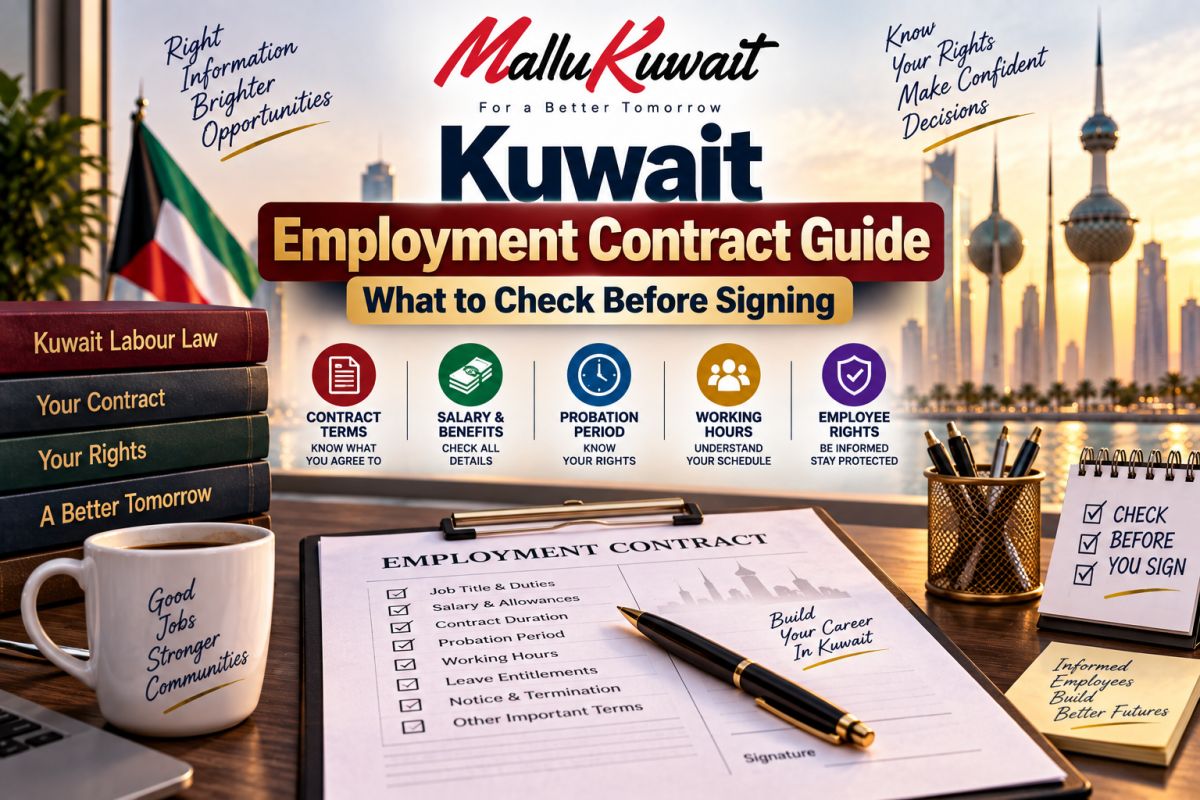
📄 Kuwait Employment Contract Guide: What to Check Before Signing, Salary, Probation & Your Rights
A job offer can look attractive because of the salary, job title or company name. But before signing an employment contract in Kuwait, it is important to check what the contract actually says. Your salary, job, contract duration, probation period and many other employment rights can later depend on the documents you agreed to. This guide explains important points private-sector employees should understand before signing a Kuwait employment contract. 1. Who is this employment-contract guide for? This guide is primarily for workers covered by Kuwait Labour Law No. 6 of 2010 concerning labour in the private sector and its amendments. Government employees, domestic workers and workers governed by special employment regimes may have different contract rules. Important: First confirm which employment regime applies to the job you are accepting. 2. Should your employment contract be in writing? Article 28 provides that a work contract shall be prepared in writing. The Article identifies important information that the written contract should contain, including: • date the contract is signed • effective date • amount of wage • contract period if it is for a limited period • nature of the work These are fundamental terms that deserve careful attention before signing. 3. How many copies of the contract are prepared? Article 28 provides for three copies of the work contract. The official English text describes: • one copy for the worker • one copy for the employer • a third copy for the competent authority Do not leave employment without keeping your own contract records. A clear copy of the signed contract can become extremely important if a disagreement occurs later. 4. What if there is no written contract? Article 28 also addresses this situation. The absence of a written document does not automatically mean that the employment relationship never existed. The Article provides that, where the work contract is not established in writing, it is still deemed to exist and the worker may establish rights through methods of evidence. Even so, relying on a clear written contract is far safer than trying to reconstruct employment terms after a dispute. 5. Which language controls the employment contract? Article 29 states that contracts shall be made in Arabic. A translation into another language may be added. However, if there is a discrepancy, the Arabic-language version has preference under Article 29. Important: If you do not read Arabic, do not assume that an English or other-language translation necessarily says exactly the same thing as the Arabic contract. Obtain help understanding the Arabic terms before signing if anything important is unclear. 6. Compare every language version before signing Check important terms in both versions, particularly: • employer name • employee name • job title or nature of work • basic salary • allowances • contract duration • effective date • probation • work location • any other important conditions If the versions appear inconsistent, ask for clarification before signing rather than waiting until a dispute develops. 7. Check the employer identity Make sure you know which legal employer is actually named in the employment documents. The company or brand where you physically work may not always be the name you expected to see on every document. Compare the employer information across the documents available to you. If something does not match, ask why before signing. 8. Check the nature of work carefully Article 28 specifically identifies the nature of work as an important contract term. The same Article also provides protection concerning assignment of work inconsistent with the nature of work stated in the contract or unsuitable for the qualifications and experience on which the contract was signed. Your job description therefore matters. Do not focus only on the job title. Understand what work you are actually agreeing to perform. 9. Check the salary before signing Compare the salary in the final contract with the salary you were promised during recruitment. Look carefully at: • basic salary • fixed allowances • other wage components • any written benefits • payment frequency • any conditions attached to particular payments Do not rely only on a verbal salary promise. [ACTION] type=service label=💰 Read Kuwait Salary & Wage Rights Guide url=https://mallukuwait.com/mallupost/kuwait-salary-wage-rights-payment-delay-deductions-guide [/ACTION] 10. Can salary simply be reduced during the contract? Article 28 contains an important wage protection. The official English text provides that the worker's wage shall not be reduced during the validity of a limited or unlimited contract, and addresses agreements contrary to this protection. An individual salary dispute can depend on its facts, so obtain proper advice where necessary. But this provision is another reason to make sure the agreed wage is correctly documented from the beginning. 11. Limited-term or unlimited-term contract? Check whether the contract is: • for a specified/limited period or • for an unlimited period The distinction can become important when considering renewal, resignation, termination and other employment consequences. Never assume the contract type from the job advertisement alone. Read the final contract. 12. How long can a limited-period contract be? Article 30 provides that a limited-period employment contract shall generally be: • not more than 5 years and • not less than 1 year The contract may be extended after expiry by agreement of both parties. 13. What happens when a limited contract expires but work continues? Article 31 addresses continuation after expiry. If both parties continue implementing a limited-period contract after its expiry without formally extending it, the law provides for renewal for similar periods under the same conditions unless the parties agree to renew under other conditions. Article 31 also protects accrued dues arising from the previous contract. This is why employees should keep both old and renewed contracts. 14. Check the effective date The date you sign a contract and the date the employment takes effect are not necessarily the same thing. Article 28 specifically identifies both the signing date and effective date. Check them carefully. Dates can later matter when considering: • service duration • probation • annual leave • notice • indemnity • contract expiry Keep evidence of your actual employment history as well. 15. What is the probation-period rule? Article 32 provides that probation must be specified in the work contract. The probation period may not exceed: • 100 working days The law also provides that a worker may not be employed under probation with the same employer more than once. Important: The statutory wording refers to 100 working days, not simply 100 calendar days. 16. Can the contract be ended during probation? Article 32 provides that either party may terminate the contract during the probation period without notice. Where termination during probation is made by the employer, Article 32 addresses the worker's terminal service indemnity for the employment period in accordance with the law. Probation therefore does not mean that employment has no legal consequences at all. 17. Check working hours and weekly schedule Before signing, ask what the actual working arrangement will be. Check: • normal daily hours • weekly hours • break arrangement • number of working days • weekly rest • shift pattern • overtime expectations • Ramadan schedule where applicable [ACTION] type=service label=⏰ Read Kuwait Working Hours Guide url=https://mallukuwait.com/mallupost/kuwait-working-hours-guide-8-hours-break-time-ramadan-weekly-rest [/ACTION] 18. Check overtime arrangements If the job regularly involves work beyond normal hours, understand how overtime is recorded and paid. Ask: • who authorizes overtime? • how are hours recorded? • how does overtime appear on payroll? • are rest-day or holiday hours treated separately? Do not rely only on a verbal statement that overtime will be "taken care of later." [ACTION] type=service label=⏱️ Read Kuwait Overtime Pay Guide url=https://mallukuwait.com/mallupost/kuwait-overtime-pay-calculation-rest-day-holiday-guide [/ACTION] [ACTION] type=service label=🧮 Open Kuwait Overtime Calculator url=https://mallukuwait.com/tools/kuwait-overtime-calculator [/ACTION] 19. Check annual-leave arrangements Understand the statutory annual-leave rules as well as the employer's administrative process. Ask how: • leave is requested • leave is approved • leave balances are recorded • leave salary is processed • unused leave is recorded The employment contract or company policy should not be read in isolation from applicable statutory rights. [ACTION] type=service label=🏖️ Read Kuwait Annual Leave Guide url=https://mallukuwait.com/mallupost/kuwait-annual-leave-guide-30-days-six-month-rule-leave-salary [/ACTION] 20. Check sick-leave procedures Know the employer's procedure for reporting sickness and submitting medical documentation. This is particularly important because qualifying private-sector sick leave has statutory stages and medical-certification requirements. [ACTION] type=service label=🏥 Read Kuwait Sick Leave Guide url=https://mallukuwait.com/mallupost/kuwait-sick-leave-guide-paid-sick-leave-salary-medical-certificate [/ACTION] 21. Check notice and termination clauses Read every clause dealing with: • resignation • termination • notice • contract expiry • disciplinary termination • final settlement Do not assume that limited and unlimited contracts always have identical consequences. We will cover resignation and termination separately in dedicated MalluKuwait guides. 22. Check end-of-service implications End-of-service benefits can become financially important after years of employment. Keep your contracts and salary records from the beginning rather than trying to reconstruct them when employment ends. [ACTION] type=service label=💰 Read Kuwait Indemnity Guide url=https://mallukuwait.com/mallupost/kuwait-indemnity-end-of-service-benefits-calculation-guide [/ACTION] [ACTION] type=service label=🧮 Open Kuwait Indemnity Calculator url=https://mallukuwait.com/tools/kuwait-indemnity-calculator [/ACTION] 23. Offer letter vs final employment contract An offer letter can be useful evidence of what was discussed during recruitment. But do not assume that an earlier offer letter and the final employment contract are identical. Before signing the final documents, compare: • salary • allowances • job title • nature of work • contract duration • work location • benefits • probation • joining date • other important promises If something important disappeared or changed, ask for an explanation before signing. 24. Never sign documents you do not understand Do not sign a contract simply because someone says: "Everyone signs this." Take enough time to understand the important terms. Pay particular attention to Arabic-language provisions because Article 29 gives the Arabic text preference where versions differ. For an important or unusual contract, consider obtaining qualified professional advice. 25. Do not rely on blank spaces or future promises Be cautious if important terms are: • left blank • promised verbally • said to be added later • inconsistent between documents • materially different from recruitment discussions Get important agreed terms documented properly before signing whenever possible. 26. Keep the complete employment-document trail Employees should keep copies of: • job advertisement where relevant • job offer • employment contract • Arabic contract • translated contract • contract amendments • work-permit-related records available to them • salary records • payslips • bank statements • attendance records • leave records • important employer correspondence • resignation or termination documents Do not wait until employment ends to start collecting records. 27. Contract and work permit are related but not identical An employment contract sets out important employment terms. Work-permit and immigration processes involve additional official requirements. Do not assume that possessing one document automatically answers every question about another. [ACTION] type=service label=🪪 Read Kuwait Work Permit & Article 18 Guide url=https://mallukuwait.com/mallupost/kuwait-work-permit-article-18-guide-after-getting-job [/ACTION] 28. Check before paying anyone for a job A legitimate-looking contract does not automatically prove that every recruitment request is genuine. Be cautious if someone asks for money, particularly where the request conflicts with official procedures or comes through an unverified person. [ACTION] type=service label=🚨 Read Kuwait Job Scams Guide url=https://mallukuwait.com/mallupost/kuwait-job-scams-check-offer-before-paying [/ACTION] 29. Before-signing checklist Before signing your Kuwait employment contract, check: • correct employer identity • your correct personal details • signing date • effective date • nature of work • job title • salary • allowances • contract type • limited-contract duration if applicable • probation period • working hours • weekly schedule • work location • overtime arrangements • leave procedures • termination and notice clauses • Arabic and translated versions • any promised benefits • whether you received your own complete copy If anything important is unclear, resolve it before signing where possible. 30. Official references The principal provisions discussed in this guide include Articles 28 to 32 of Kuwait Labour Law No. 6 of 2010 concerning labour in the private sector and its amendments. [ACTION] type=official label=Public Authority for Manpower — Labour Law url=https://www.manpower.gov.kw/docs/LaborLaw/Labor_Law_Eng.pdf [/ACTION] [ACTION] type=official label=Kuwait Government Online — Labour Law url=https://www.e.gov.kw/sites/kgoarabic/Pages/ApplicationPages/LaborLaw.aspx [/ACTION] [ACTION] type=official label=Public Authority for Manpower url=https://www.manpower.gov.kw/ [/ACTION] 31. Important Legal Disclaimer This guide is provided for general informational and educational purposes only. It is not: • legal advice • employment advice • an official interpretation of your contract • an official government decision • a guarantee of any employment right or outcome Contract wording and individual circumstances can materially affect a worker's legal position. Kuwait laws, amendments, regulations, ministerial decisions, procedures and official interpretations may also change. For an important employment decision or contract dispute, verify the current position using official Kuwait sources and, where appropriate, obtain advice from the relevant authority or a qualified legal professional. Important: MalluKuwait does not represent the Public Authority for Manpower, the Ministry of Interior, Kuwait Government Online or any other Kuwait government authority. This information is provided for general guidance only. Always verify your individual situation using current official Kuwait government sources. [RELATED] title=Kuwait Salary & Wage Rights Guide slug=kuwait-salary-wage-rights-payment-delay-deductions-guide [/RELATED] [RELATED] title=Kuwait Working Hours Guide slug=kuwait-working-hours-guide-8-hours-break-time-ramadan-weekly-rest [/RELATED] [RELATED] title=Kuwait Work Permit & Article 18 Guide slug=kuwait-work-permit-article-18-guide-after-getting-job [/RELATED]

💰 Kuwait Salary & Wage Rights: Payment, Delays, Deductions & Employee Rights
Your salary is one of the most important parts of your employment relationship in Kuwait. But employees often have questions such as: • When must my salary be paid? • How late can salary be? • Should salary go to my bank account? • Can my employer deduct money from my salary? • What counts as wage under Kuwait labour law? This guide explains important wage and salary rules for private-sector workers under Kuwait Labour Law No. 6 of 2010 and its amendments. 1. Who is this salary guide for? This guide is primarily for workers covered by Kuwait's private-sector labour law. Government employees, domestic workers and people governed by other employment regimes may be subject to different rules. Important: Before relying on a salary rule, confirm which employment regime applies to you. 2. What does "wage" mean under Kuwait labour law? The legal concept of wage can be broader than simply the basic salary figure written on a payslip. Article 55 defines wage as the basic salary received or that should be received by the worker in consideration for work, together with elements specified by the law. The Article also addresses items such as commissions, bonuses, grants and cash privileges received periodically. This distinction can become important when calculating employment rights. 3. Why does the wage definition matter? Different employment entitlements may depend on the legally applicable wage. That can affect questions involving: • overtime • annual leave • sick leave • end-of-service benefits • other employment payments Do not automatically assume that every calculation should use only one number from your payslip without checking the applicable legal rule. 4. When must monthly workers be paid? Article 56 states that workers employed on a monthly basis shall receive their salaries at least once every month. Salary must be paid on a working day and in the legal currency in circulation. For most salaried private-sector employees, this monthly-payment rule is particularly important. 5. What about workers who are not paid monthly? Article 56 provides a different minimum payment frequency for other workers. Workers outside the monthly-rate category must generally receive their wages at least once every two weeks. The law therefore does not permit wages simply to remain unpaid indefinitely between payment periods. 6. How late can salary be? Article 56 contains an important protection concerning delayed wages. It states that payment of salaries shall not be delayed beyond the seventh day after the due date. This does not mean that the seventh day should automatically be treated as the normal salary date. The contractual or applicable due date still matters. The provision places a limit on how far payment may be delayed after that due date. Important: Keep your employment contract and bank records so that you can establish both the expected salary date and the actual payment date. 7. Should salary be deposited into a bank account? Article 57 requires employers covered by the provision to deposit workers' salaries into their relevant accounts opened with local financial institutions. The Article also provides for information concerning those salary deposits to be forwarded as required under the statutory system. Bank payment records therefore provide important evidence of when and how much salary was actually paid. 8. Why should you keep your bank statements? A bank statement can help establish: • the date salary arrived • the amount received • whether salary was delayed • whether the amount changed • whether a disputed payment was actually deposited Keep salary-related bank records, especially when there is an ongoing employment disagreement. 9. Can a monthly worker be moved to another wage category? Article 58 protects workers employed on a monthly salary from being transferred to another category without their written consent. The provision also protects rights acquired while working under the monthly-salary arrangement. If an employer proposes changing the way your wage is classified or paid, understand the consequences before signing anything. 10. Can an employer deduct a loan or debt from salary? Article 59 places limits on certain wage deductions. For debts or loans due to the employer, the law states that no more than 10% of the worker's wage may be deducted for settlement. The employer also may not charge interest on those entitlements. This provision is important when an employer has advanced money or claims that the employee owes the company money. 11. Are all salary deductions limited to 10%? No. The 10% provision specifically addresses debts or loans due to the employer. Article 59 separately addresses retention or deduction of wages for settlement of debts and provides a limit of 25% in the circumstances stated by the Article, including the priority treatment of alimony obligations. This is why it is unsafe to say that every possible deduction from salary is governed by one universal percentage. 12. What should you do if you see an unexplained deduction? Start by comparing: • your employment contract • payslip • bank deposit • attendance records • approved leave • overtime records • any loan or advance documentation • written employer explanation Ask for a clear breakdown of the deduction. For a significant dispute, verify the applicable rule with the competent Kuwait authority rather than relying only on an informal explanation. 13. Can an employer reduce your salary whenever it wants? A salary or wage dispute can involve the employment contract, the applicable labour law and the nature of the proposed change. Do not assume that an employer can simply change an agreed wage without legal or contractual consequences. Likewise, do not assume every change is automatically unlawful without examining the employment arrangement. Keep copies of your original contract and any amendment you are asked to sign. 14. What if your salary is repeatedly delayed? Repeated delayed salary payments should be documented carefully. Keep a simple record containing: • contractual salary due date • actual bank-credit date • expected salary • amount actually received • missing amount, if any • communications with the employer • payslip or payroll record A pattern is much easier to demonstrate with documents than from memory alone. 15. What if your salary is not paid at all? Do not ignore prolonged non-payment. First preserve your records and request a written explanation from the employer. If the issue is not resolved, check the current complaint procedure with Kuwait's Public Authority for Manpower or the competent authority applicable to your employment. The correct legal remedy can depend on the facts, so MalluKuwait should not determine the outcome of an individual salary dispute. [ACTION] type=official label=Public Authority for Manpower url=https://www.manpower.gov.kw/ [/ACTION] 16. Salary and overtime Overtime compensation is separate from ordinary salary. If you work qualifying additional hours, the working-hours and overtime provisions may become relevant. Keep overtime instructions, attendance records and payslips so that the hours and payments can be compared. [ACTION] type=service label=⏱️ Read Kuwait Overtime Pay Guide url=https://mallukuwait.com/mallupost/kuwait-overtime-pay-calculation-rest-day-holiday-guide [/ACTION] [ACTION] type=service label=🧮 Open Kuwait Overtime Calculator url=https://mallukuwait.com/tools/kuwait-overtime-calculator [/ACTION] 17. Salary and annual leave Annual-leave salary has its own statutory rules. Do not assume that annual-leave payment can be understood only by looking at the ordinary monthly salary deposit. For the detailed annual-leave rules and estimate tool, use the dedicated MalluKuwait resources. [ACTION] type=service label=🏖️ Read Kuwait Annual Leave Guide url=https://mallukuwait.com/mallupost/kuwait-annual-leave-guide-30-days-six-month-rule-leave-salary [/ACTION] [ACTION] type=service label=🧮 Open Annual Leave Calculator url=https://mallukuwait.com/tools/kuwait-annual-leave-calculator [/ACTION] 18. Salary and sick leave Sick-leave pay changes according to the statutory Article 69 stages. That means a qualifying sick-leave period is not necessarily paid at the worker's full ordinary wage throughout. [ACTION] type=service label=🏥 Read Kuwait Sick Leave Guide url=https://mallukuwait.com/mallupost/kuwait-sick-leave-guide-paid-sick-leave-salary-medical-certificate [/ACTION] 19. Salary and end-of-service benefits The legally applicable wage can also matter when calculating end-of-service benefits. End-of-service calculations depend on several factors, including employment history and the applicable legal rules. [ACTION] type=service label=💰 Read Kuwait Indemnity Guide url=https://mallukuwait.com/mallupost/kuwait-indemnity-end-of-service-benefits-calculation-guide [/ACTION] [ACTION] type=service label=🧮 Open Kuwait Indemnity Calculator url=https://mallukuwait.com/tools/kuwait-indemnity-calculator [/ACTION] 20. Records every employee should keep Keep copies of important employment and salary records, including: • signed employment contract • contract amendments • payslips • bank statements showing salary deposits • attendance records • overtime records • approved leave • loan or salary-advance documents • deduction explanations • employer emails or messages • resignation or termination documents These records can become extremely important during a salary or final-settlement dispute. 21. Common salary mistakes to avoid Avoid these assumptions: • only basic salary can ever matter when determining wage rights • salary can legally be delayed indefinitely • every salary deduction is governed by the same percentage • cash or verbal claims are as easy to prove as documented payments • overtime automatically appears correctly in payroll • annual-leave pay and sick-leave pay always equal ordinary salary • a calculator result is an official payroll determination • government-sector rules automatically apply to private-sector employees 22. Salary problem checklist If you believe there is a salary problem, collect: • your contract • salary due date • bank statements • payslips • attendance records • overtime records • leave records • details of deductions • written employer communications • previous salary-payment history Then identify exactly what is disputed: payment date, missing salary, wage amount, overtime, deduction, leave payment or another entitlement. 23. Official references The principal wage provisions discussed in this guide include Articles 55 to 59 of Kuwait Labour Law No. 6 of 2010 concerning labour in the private sector and its amendments. [ACTION] type=official label=Public Authority for Manpower — Labour Law url=https://www.manpower.gov.kw/docs/LaborLaw/Labor_Law_Eng.pdf [/ACTION] [ACTION] type=official label=Kuwait Government Online — Labour Law url=https://www.e.gov.kw/sites/kgoarabic/Pages/ApplicationPages/LaborLaw.aspx [/ACTION] [ACTION] type=official label=Public Authority for Manpower url=https://www.manpower.gov.kw/ [/ACTION] 24. Important Legal Disclaimer This guide is provided for general informational and educational purposes only. It is not: • an official salary determination • an official payroll calculation • legal advice • financial advice • employment advice • a government decision • a guarantee of payment or entitlement Kuwait laws, amendments, regulations, ministerial decisions, employment procedures and official interpretations may change. Individual circumstances can materially affect the result, including employment regime, contract terms, wage components, salary records, deductions, attendance, leave and other facts. Always verify an important salary, employment or legal decision using current official Kuwait sources and, where appropriate, the relevant authority or a qualified professional. Important: MalluKuwait does not represent the Public Authority for Manpower, the Ministry of Interior, Kuwait Government Online or any other Kuwait government authority. This information is provided for general guidance only. Always verify your individual situation using current official Kuwait government sources. [RELATED] title=Kuwait Working Hours Guide slug=kuwait-working-hours-guide-8-hours-break-time-ramadan-weekly-rest [/RELATED] [RELATED] title=Kuwait Overtime Pay Guide slug=kuwait-overtime-pay-calculation-rest-day-holiday-guide [/RELATED] [RELATED] title=Kuwait Annual Leave Guide slug=kuwait-annual-leave-guide-30-days-six-month-rule-leave-salary [/RELATED]

⏰ Kuwait Working Hours Guide: 8-Hour Rule, Break Time, Ramadan Hours & Weekly Rest
Working eight hours in Kuwait does not always mean that you should simply count the time between entering and leaving the workplace. Kuwait's private-sector labour law sets rules for normal working hours, continuous work, rest breaks, Ramadan working hours, weekly rest and overtime. This guide explains the main rules in Articles 64 to 67 of Kuwait Labour Law No. 6 of 2010 and its amendments. 1. Who is this working-hours guide for? This guide is primarily for employees working in Kuwait's private sector under Labour Law No. 6 of 2010 and its amendments. Government employees, domestic workers and workers governed by special employment regimes may have different working-hour rules. Important: Do not automatically apply private-sector Article 64 working-hour rules to every worker in Kuwait. First identify which employment law or regime applies to you. 2. What are the normal private-sector working hours? Article 64 provides that, subject to the provisions of Article 21, a worker generally may not be employed for more than: • 48 hours per week or • 8 hours per day except in cases provided for by the law. These are statutory maximum normal working-hour limits, not a requirement that every employee must necessarily work exactly eight hours every day. 3. Does an eight-hour day include the break? Not necessarily. Article 65 states that the worker generally may not be made to work for more than five continuous hours per day without a break of at least one hour. The law also states that break periods are not calculated within working hours. This means that an employee's total presence at the workplace can, depending on the schedule and applicable rules, be longer than the number of actual working hours. 4. The five-continuous-hours rule Under the general Article 65 rule, a worker should not be made to work more than five continuous hours per day without a following rest period of at least one hour. For example, a normal schedule could divide working time into periods separated by the required break. However, Article 65 itself contains exceptions, so the general rule should not be applied without considering the worker's sector and circumstances. 5. How long must the break be? Under the general Article 65 rule, the break must be at least one hour. The ordinary statutory break is not counted as part of working hours. This distinction is important when comparing: • actual working hours • break time • total time present at the workplace Do not automatically treat all three as the same thing. 6. Are there exceptions to the normal break arrangement? Yes. Article 65 specifically exempts the banking, financial and investment sectors from the general split-work arrangement and provides for eight continuous working hours. Article 65 also provides circumstances in which workers may be employed without a break with ministerial approval for technical or emergency reasons or in office work, subject to the condition stated in the law concerning total daily working hours. Because these are exceptions, workers should check the exact rule applicable to their workplace rather than relying only on a general internet summary. 7. What are working hours during Ramadan? Article 64 provides a special working-hours limit during the Holy Month of Ramadan. The statutory private-sector limit during Ramadan is: • 36 hours per week This is different from the ordinary maximum of 48 hours per week. Important: The Article 64 private-sector rule is a weekly limit of 36 hours during Ramadan. Do not confuse it with government-sector Ramadan schedules announced separately by the Civil Service authorities. 8. Does Ramadan mean exactly six hours every day? Article 64 expresses the private-sector Ramadan limit as 36 hours per week. If that total is spread equally across six working days, it corresponds mathematically to six hours per day. However, actual scheduling can depend on the lawful work arrangement. For that reason, the safest statement is that Article 64 establishes the 36-hour weekly private-sector limit during Ramadan rather than assuming every workplace must use an identical clock-in and clock-out schedule. 9. Can working hours be reduced for difficult or hazardous work? Yes. Article 64 also allows working hours to be reduced for hard labour, work harmful to health, hazardous work or difficult conditions by a decision issued by the Minister. This means the eight-hour/48-hour limits should not be interpreted as preventing a legally applicable shorter working-hour arrangement. 10. When does extra work become overtime? Work beyond the normal statutory working limits can raise overtime questions. Article 66 regulates additional working hours and provides conditions for overtime. It states that overtime may be required under a written order from the employer where necessary for circumstances described in the law, including preventing a dangerous accident, repairing resulting breakdowns, avoiding certain loss or dealing with work exceeding the normal daily amount. Overtime has separate limits and compensation rules. [ACTION] type=service label=⏱️ Read Kuwait Overtime Pay Guide url=https://mallukuwait.com/mallupost/kuwait-overtime-pay-calculation-rest-day-holiday-guide [/ACTION] [ACTION] type=service label=🧮 Open Kuwait Overtime Calculator url=https://mallukuwait.com/tools/kuwait-overtime-calculator [/ACTION] 11. How much overtime can be required? Article 66 places limits on additional working hours. The English labour-law text published by the Public Authority for Manpower states that additional working hours shall not exceed: • 2 hours per day • 180 hours per year It also states that additional work periods shall not exceed: • 3 days per week • 90 days per year These limits should be read together with the other conditions contained in Article 66. 12. What is the normal overtime rate? Article 66 provides that the worker is entitled to wage for overtime at a rate 25% higher than the ordinary wage for a similar period, subject to the wage-calculation provisions referenced by the law. In simple terms, this is commonly represented as: Normal overtime = ordinary comparable hourly wage × 1.25 But the actual wage basis and circumstances matter. For an estimate, use the MalluKuwait Overtime Calculator and verify important payroll disputes using official records. [ACTION] type=service label=💰 Estimate Your Overtime Pay url=https://mallukuwait.com/tools/kuwait-overtime-calculator [/ACTION] 13. What is the weekly rest rule? Article 67 provides a worker with a fully paid weekly rest period of: • 24 continuous hours after: • every six working days This is the statutory weekly-rest principle for workers covered by this provision. 14. What if you work on your weekly rest day? Article 67 permits an employer, where necessary and required by work conditions, to have a worker work on the weekly rest day. In that situation, the law provides additional compensation and another rest day. The official English text states that the worker shall receive at least 50% of salary in addition to the original salary and shall also be compensated with another day for the weekly rest day. Working on a weekly rest day therefore should not simply be treated as an ordinary working day. 15. Is Friday always the legal weekly rest day? Article 67 establishes the right to 24 continuous hours of paid weekly rest after every six working days. The key statutory protection is the weekly-rest entitlement. An employee should therefore check the actual lawful weekly-rest day applicable under the employment arrangement rather than assuming that every private-sector workplace must use exactly the same weekly schedule. 16. Working hours and daily wage calculations Article 67 also contains an important wage-calculation provision. It states that, when calculating certain worker rights including daily wage and leave, salary is divided by the number of actual working days without counting weekly rest days, even though those weekly rest days are paid. This is one reason MalluKuwait calculators ask for actual working days instead of silently assuming that every employee has an identical monthly work schedule. 17. Working hours and annual leave Normal working hours, weekly rest and annual leave are related but separate concepts. Annual leave has its own statutory rules, including the treatment of weekly rest days, official holidays and sick-leave days occurring during annual leave. For the detailed rules, use the dedicated Annual Leave Guide. [ACTION] type=service label=🏖️ Read Kuwait Annual Leave Guide url=https://mallukuwait.com/mallupost/kuwait-annual-leave-guide-30-days-six-month-rule-leave-salary [/ACTION] [ACTION] type=service label=🧮 Open Annual Leave Calculator url=https://mallukuwait.com/tools/kuwait-annual-leave-calculator [/ACTION] 18. Working hours and sick leave Sick leave is also a separate entitlement. A worker who is medically unable to work should not simply treat the absence as a working-hours adjustment. Article 69 establishes the private-sector sick-leave sequence and its different wage stages. [ACTION] type=service label=🏥 Read Kuwait Sick Leave Guide url=https://mallukuwait.com/mallupost/kuwait-sick-leave-guide-paid-sick-leave-salary-medical-certificate [/ACTION] 19. Records employees should keep If you have a disagreement about working hours or overtime, useful records can include: • employment contract • official duty schedule • attendance or biometric records • clock-in and clock-out records • overtime instructions • emails and work messages • payslips • weekly-rest schedules • Ramadan duty schedules • employer notices about shift changes Keeping accurate records can make it much easier to compare actual working time with payroll calculations. 20. Common working-hours mistakes Avoid these common assumptions: • every private-sector employee must work exactly eight hours every day • an unpaid break automatically counts inside the eight working hours • Ramadan private-sector hours are the same as government-sector Ramadan schedules • every hour beyond a scheduled shift automatically has identical legal treatment • weekly rest and annual leave are the same entitlement • working on a weekly rest day is automatically treated like an ordinary working day • every industry has exactly the same break arrangement • a calculator result is an official payroll decision 21. Quick working-hours checklist Before raising a working-hours or overtime question, check: • which employment regime covers you • your employment contract • your normal duty schedule • actual hours worked • break periods • weekly-rest day • overtime instructions • Ramadan schedule, if relevant • attendance records • payslips • whether a sector-specific or ministerial exception applies 22. Official references The principal provisions discussed in this guide are Articles 64, 65, 66 and 67 of Kuwait Labour Law No. 6 of 2010 concerning labour in the private sector and its amendments. [ACTION] type=official label=Public Authority for Manpower — Labour Law url=https://www.manpower.gov.kw/docs/LaborLaw/Labor_Law_Eng.pdf [/ACTION] [ACTION] type=official label=Kuwait Government Online — Labour Law url=https://www.e.gov.kw/sites/kgoarabic/Pages/ApplicationPages/LaborLaw.aspx [/ACTION] [ACTION] type=official label=Public Authority for Manpower url=https://www.manpower.gov.kw/ [/ACTION] 23. Important Legal Disclaimer This guide is provided for general informational and educational purposes only. It is not: • an official working-hours determination • an official payroll calculation • legal advice • financial advice • employment advice • a government decision • a guarantee of any payment or entitlement Kuwait laws, amendments, ministerial decisions, regulations, working-hour arrangements, sector-specific rules and official interpretations may change. Individual circumstances can materially affect the result, including employment regime, occupation, sector, contract, shift arrangement, actual working days, breaks, overtime instructions and weekly-rest arrangements. Always verify an important employment, payroll or legal decision using current official Kuwait sources and, where appropriate, the relevant authority or a qualified professional. Important: MalluKuwait does not represent the Public Authority for Manpower, the Ministry of Interior, Kuwait Government Online or any other Kuwait government authority. This information is provided for general guidance only. Always verify your individual situation using current official Kuwait government sources. [RELATED] title=Kuwait Overtime Pay Guide slug=kuwait-overtime-pay-calculation-rest-day-holiday-guide [/RELATED] [RELATED] title=Kuwait Annual Leave Guide slug=kuwait-annual-leave-guide-30-days-six-month-rule-leave-salary [/RELATED] [RELATED] title=Kuwait Sick Leave Guide slug=kuwait-sick-leave-guide-paid-sick-leave-salary-medical-certificate [/RELATED]

🏥 Kuwait Sick Leave Guide: Paid Sick Leave, Salary Rates & Medical Certificates
If you become sick while working in Kuwait, one of the first questions is usually simple: how many sick-leave days can you take, and how much salary will you receive? For private-sector workers covered by Kuwait Labour Law No. 6 of 2010 and its amendments, Article 69 provides a structured sick-leave entitlement during the year. This guide explains the stages in simple terms, what happens to your salary at each stage, why the medical certificate matters, and what records you should keep. 1. Who is this sick-leave guide for? This guide is intended for employees working in Kuwait's private sector under Labour Law No. 6 of 2010 and its amendments. Government employees and domestic workers may be governed by different rules and procedures, so their entitlements should not automatically be calculated using the private-sector Article 69 structure explained here. Important: Always identify which employment regime applies to you before relying on a sick-leave calculation. 2. What does Article 69 provide? Article 69 gives an eligible private-sector worker sick leave during the year through several pay stages. The statutory sequence is: • First 15 days — full wage • Next 10 days — three-quarter wage • Next 10 days — half wage • Next 10 days — quarter wage • Next 30 days — without wage This creates a total Article 69 sequence of up to 75 sick-leave days during the year, but the salary payable is different across the stages. 3. First 15 days — full wage The first 15 sick-leave days in the Article 69 sequence are with full wage. For example, if a worker uses five qualifying sick-leave days, those days fall within the first full-pay stage. If the worker later uses more qualifying sick leave during the relevant year, the cumulative number of sick-leave days becomes important because later days may move into another pay stage. 4. Next 10 days — three-quarter wage After the first 15 days, Article 69 provides the next 10 sick-leave days at three-quarter wage. In simple percentage terms, this stage corresponds to 75% of the applicable wage for those sick-leave days. That means days 16 through 25 of the Article 69 sequence fall within this stage. 5. Next 10 days — half wage After those 25 days, the next 10 sick-leave days are with half wage. In percentage terms, this stage corresponds to 50% of the applicable wage for those days. That covers days 26 through 35 of the sequence. 6. Next 10 days — quarter wage The following 10 sick-leave days are with quarter wage. In percentage terms, this corresponds to 25% of the applicable wage for those days. That covers days 36 through 45 of the Article 69 sequence. 7. Final 30 days — without wage Article 69 then provides a further 30 sick-leave days without wage. These correspond to days 46 through 75 of the statutory sequence. "Without wage" does not mean that an employee should simply stay away from work without documentation. The medical-certification requirements remain important. 8. Simple Article 69 table The Article 69 sequence can therefore be understood like this: • Days 1–15: full wage • Days 16–25: 75% wage • Days 26–35: 50% wage • Days 36–45: 25% wage • Days 46–75: unpaid This is a much safer way to understand the entitlement than assuming that every sick-leave day is paid at the same rate. 9. Why your previous sick-leave days matter Suppose you have already taken 12 qualifying sick-leave days during the relevant year and later receive another medical certificate for five days. Those five days do not necessarily all fall into the same pay stage. The first three would complete the initial 15-day full-wage stage. The remaining two would move into the next Article 69 stage. This is why employees should keep a record of sick-leave days already used. 10. Do you need a medical certificate? Yes. Article 69 links qualifying sickness requiring sick leave to medical evidence. The law refers to a certificate from the physician determined by the employer or the doctor responsible for a government health centre. The exact administrative process can depend on where the certificate was issued and the circumstances of the case. Important: Do not assume that simply informing your employer that you are sick is equivalent to satisfying the applicable medical-certification requirements. 11. What happens if there is a dispute about the sick leave? Article 69 also addresses disputes concerning entitlement to sick leave or its duration and gives importance to the medical certification process. If your employer questions the leave, keep the original medical documentation, any authentication or approval records, and evidence showing when you informed or submitted the certificate to the employer. For a significant dispute, verify the current procedure with the competent Kuwait authority. 12. Sick-leave authentication in Kuwait Kuwait Government Online provides information about authenticating sick leaves through the General Medical Council. The government service states that citizens and residents can authenticate sick leaves issued by the private sector for any duration. It also describes required documentation and procedures. The exact authentication requirement for your situation may depend on the certificate and employer or authority process. [ACTION] type=official label=🏥 Check Kuwait Government Sick Leave Authentication url=https://www.e.gov.kw/sites/kgoenglish/Pages/Services/MOH/CertifySickLeave.aspx [/ACTION] 13. How can you estimate sick-leave salary? To estimate sick-leave pay, you need to know: • the applicable wage basis • the appropriate daily wage calculation • how many qualifying sick-leave days have already been used in the relevant year • how many new sick-leave days are being considered • which Article 69 pay stages those days fall into A simple estimate should allocate the days across the Article 69 stages instead of applying one percentage to the entire period. 14. Example of a mixed sick-leave period Imagine that a worker has already used 10 qualifying sick-leave days and then takes another 12 qualifying days. The first five new days would bring the worker to 15 days and remain within the full-wage stage. The remaining seven new days would fall into the three-quarter-wage stage. So the new 12-day period would not all have the same pay rate. 15. Sick leave and annual leave are different Sick leave and annual leave are separate statutory concepts. Do not automatically deduct qualifying sick-leave days from your annual-leave balance. Article 70 also deals with the treatment of sick-leave days that fall within annual leave. For the annual-leave rules, use the dedicated MalluKuwait guide. [ACTION] type=service label=🏖️ Read Kuwait Annual Leave Guide url=https://mallukuwait.com/mallupost/kuwait-annual-leave-guide-30-days-six-month-rule-leave-salary [/ACTION] 16. Sick leave and termination of employment Sick leave can become especially important when an illness continues for a long period. Other provisions of Kuwait labour law may become relevant to termination, inability to work, employment status and end-of-service rights. Do not assume that reaching a particular Article 69 pay stage automatically answers every question about termination or end-of-service entitlement. For end-of-service estimates, use the separate MalluKuwait indemnity guide and calculator. [ACTION] type=service label=💰 Open Kuwait Indemnity Calculator url=https://mallukuwait.com/tools/kuwait-indemnity-calculator [/ACTION] 17. Records you should keep Keep copies of documents that could matter later, including: • medical certificates • sick-leave approvals or authentication records • employer notifications • emails or messages confirming submission • payslips • employment contract • attendance records • previous sick-leave records • any correspondence about a disputed leave Good records make it much easier to understand how many qualifying sick-leave days have already been used and how the employer calculated the salary. 18. Common mistakes to avoid Avoid these common assumptions: • every sick-leave day is paid at 100% • all 75 days are paid • a verbal notification automatically replaces medical documentation • annual leave and sick leave are the same balance • a salary estimate is automatically an official payroll calculation • government-sector rules automatically apply to private-sector workers • a calculator result determines legal entitlement 19. Quick sick-leave checklist Before checking your sick-leave pay, confirm: • you are covered by the private-sector labour law discussed here • the relevant medical certificate is available • you know how many qualifying sick-leave days you have already used • you know which Article 69 stage the new days enter • you have checked your payslips and attendance records • you have kept copies of employer submissions and approvals • you verify disputed or important cases with the competent authority 20. Official references The main legal provision for the sick-leave stages discussed in this guide is Article 69 of Kuwait Labour Law No. 6 of 2010 concerning labour in the private sector. [ACTION] type=official label=Kuwait Private Sector Labour Law — PAM url=https://www.manpower.gov.kw/docs/LaborLaw/Labor_Law_Eng.pdf [/ACTION] [ACTION] type=official label=Kuwait Government Online — Labour Law url=https://www.e.gov.kw/sites/kgoarabic/Pages/ApplicationPages/LaborLaw.aspx [/ACTION] [ACTION] type=official label=Public Authority for Manpower url=https://www.manpower.gov.kw/ [/ACTION] 21. Important Legal Disclaimer This guide is provided for general informational and educational purposes only. It is not: • an official government sick-leave calculation • an official payroll calculation • legal advice • financial advice • employment advice • medical advice • a guarantee of salary or entitlement Kuwait laws, amendments, regulations, administrative decisions, medical-certification procedures and official interpretations may change. Individual circumstances can materially affect the result, including employment regime, wage components, medical documentation, previous sick-leave usage, employment records and the circumstances of the illness. Always verify an important employment, payroll or legal decision using current official Kuwait sources and, where appropriate, the relevant authority or a qualified professional. Important: MalluKuwait does not represent the Public Authority for Manpower, the Ministry of Health, the Ministry of Interior, Kuwait Government Online or any other Kuwait government authority. This information is provided for general guidance only. Always verify your individual situation using current official sources. [RELATED] title=Kuwait Annual Leave Guide slug=kuwait-annual-leave-guide-30-days-six-month-rule-leave-salary [/RELATED] [RELATED] title=Kuwait Indemnity & End-of-Service Benefits Guide slug=kuwait-indemnity-end-of-service-benefits-calculation-guide [/RELATED] [RELATED] title=Kuwait Overtime Pay Guide slug=kuwait-overtime-pay-calculation-rest-day-holiday-guide [/RELATED]
